
Every masterpiece you have ever admired began with a human being, a moment in history, and a decision to create something that did not exist before. Understanding great artists and their works is not about memorizing names and dates: it is about learning to read the visual language that shaped our world. This pillar page serves as your complete introduction to the subject, whether you are a curious beginner standing in front of a museum for the first time, or an intermediate enthusiast looking to connect the dots between movements, artists and iconic works.
Think of art history as a vast conversation spanning centuries. Each great artist responded to those who came before, agreed with some, argued with others, and passed the conversation forward. Once you see this pattern, every museum visit becomes a chance to eavesdrop on that conversation.
Greatness in art is not simply talent. Many technically brilliant painters have been forgotten, while works with visible imperfections have become world-famous. So what is the secret ingredient?
A useful analogy: art history is like a relay race. Most runners are competent, but the great ones handed off the baton in a new direction, changing the entire course of the race.
You do not need to memorize every movement, but a simple mental map helps enormously. Here is a chronological outline of the essential milestones.
Standing in front of a masterpiece can be intimidating. What are you supposed to feel? The good news: there is no single correct answer, but there is a reliable process. Think of it as learning to taste wine — the first sip is confusing, but a method unlocks flavor you would otherwise miss.
Practical example: imagine viewing Vermeer’s Girl with a Pearl Earring. Step one: soft light, dark background, a glance over the shoulder. Step two: intimacy, mystery. Step three: a quiet Dutch interior, painted with near-photographic delicacy. Step four: the pearl is barely more than two brushstrokes — a lesson in economy. Step five: you decide for yourself what the moment means.
Certain works function as landmarks in the landscape of art. Knowing them, even briefly, gives you reference points for everything else.
A helpful tip: great works become famous partly through their stories — the theft of the Mona Lisa, Van Gogh’s letters to his brother Theo, Vermeer’s mysterious model. Narrative and artwork travel together, and knowing the story deepens the looking.
No artist creates in a vacuum. One of the most rewarding aspects of studying great artists is discovering how ideas pass from hand to hand. Consider a simple chain: Cézanne told painters to treat nature in terms of cylinders and spheres; Picasso took that advice literally and invented Cubism; Cubism’s fragmentation opened the door to abstract art. One sentence from one artist reshaped a century.
Another example: Caravaggio’s stark lighting influenced Rembrandt, traveled across Europe through his followers, and still echoes in the dramatic photography of cinema today. When you watch a film with deep shadows and a single illuminated face, you are watching the Baroque — four centuries later.
The lesson for learners: instead of studying artists one by one, study the connections between them. Ask three questions of any artist:
This relational approach turns isolated facts into a living network — and it is exactly how experts think about art history.
Feeling overwhelmed is normal; the field spans thousands of years. Here is a realistic, beginner-friendly progression.
A common mistake to avoid: trying to "understand everything" before enjoying anything. Art rewards those who look first and analyze second. Curiosity is the only prerequisite.
Absolutely not. Formal knowledge helps, but the fundamental skill is attention. Many great connoisseurs were self-taught. What matters is honest looking, honest feeling, and gradual curiosity.
Because they are often deliberate solutions to a problem you cannot see at first glance. Picasso could paint with academic precision before choosing to simplify — simplification was a choice, not a limitation. Context turns apparent naivety into sophistication.
Not at all. Personal taste is valid. The richer approach is simply to ask why a work moves you — or why it does not. That question turns preference into understanding.
You don’t need to. Retain the landmarks — a handful of movements, a dozen iconic works, and the habit of asking how artists relate to one another. The rest fills in naturally over time.
Great artists and their works form one of humanity’s longest and richest conversations — about beauty, belief, suffering and joy. You do not need to memorize centuries to join it. Start with one painting, one artist, one honest question. Look longer than feels comfortable, let the work speak, and follow the threads that intrigue you. Step by step, the museum stops being intimidating and becomes what it was always meant to be: an open invitation. The masters left their answers on canvas and in marble; all that remains is for you to start looking.
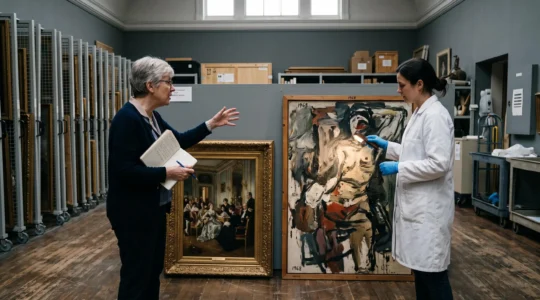
A painter can render human anatomy impeccably, control light with extraordinary precision and reproduce textures that seem almost tangible, yet leave little lasting impression on art history. Another can distort figures, expose awkward brushstrokes and abandon conventional perspective, only to…
Lire la suite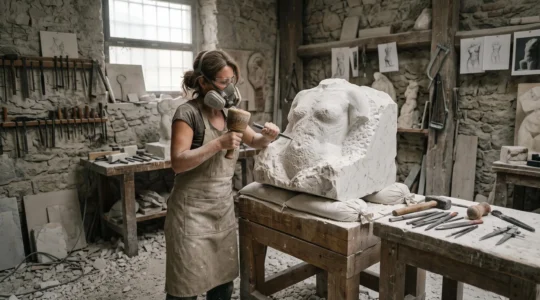
A human shoulder appears to turn beneath the surface of a marble block. A waist narrows, a knee bends, and an apparently rigid mass begins to suggest the movement of living anatomy. Yet every curve is produced by removing stone…
Lire la suite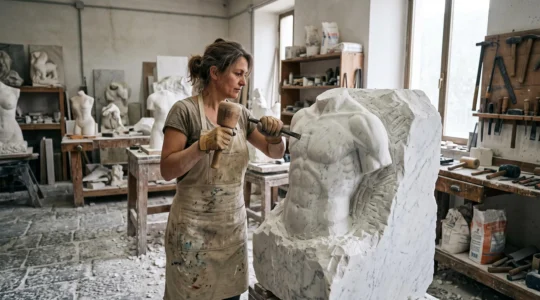
Michelangelo did not need a medical degree to understand the human body with extraordinary sophistication. His anatomical knowledge developed through direct observation, artistic apprenticeship, access to human dissections, and sustained investigation of how bones, muscles, and skin interact in movement….
Lire la suite