
The classical arts occupy a singular place in human culture. They are the disciplines that formalized beauty, proportion and expression into teachable traditions, shaping how civilizations have seen themselves for centuries. Yet for many people, the term feels intimidating: it evokes marble museums, silent concert halls and long theoretical debates. This pillar page is designed to remove that intimidation. It offers a clear, structured and friendly introduction to the classical arts, connecting their history, their disciplines and their relevance today.
At their core, the classical arts are artistic disciplines defined by established rules of composition, technique and aesthetics, transmitted through formal training across generations. The word « classical » refers primarily to the Greco-Roman heritage, but it also designates any art form whose principles have been codified and refined over time. Think of classical art as a language: it has grammar (rules of proportion and harmony), vocabulary (techniques and forms) and literature (masterworks that continue to inspire).
Traditionally, the classical arts are grouped into major families:
What unites them is not a subject matter but an attitude: a belief that art can strive toward universal ideals of harmony, balance and emotional truth.
To understand classical art, you must understand its two great pillars: antiquity and the Renaissance.
Ancient Greece established the intellectual framework: mathematics applied to beauty, the idealized human body, and the conviction that art should imitate nature while perfecting it. Greek sculpture introduced the famous canon of proportions, and Roman architects mastered the arch, the vault and concrete, enabling vast structures like the Pantheon.
Centuries later, Renaissance artists looked back to antiquity as a source of renewal rather than nostalgia. Artists such as Leonardo da Vinci and Michelangelo combined observation of nature, anatomical study and mathematical perspective to create works of unprecedented realism and ambition. This period fixed many of the « rules » of classical art that academies would teach for generations.
From the Renaissance onward, official academies codified training: drawing from life, studying anatomy, copying masterworks and mastering hierarchies of genres. This system, often called academic art, standardized what counted as excellence — and, inevitably, provoked the rebellions of modern movements that followed.
Classical painting privileges composition, drawing and modeling. The aim is to create convincing illusions of space, light and volume on a flat surface. Key techniques include chiaroscuro (the dramatic contrast of light and shadow), linear perspective and the careful layering of glazes in oil painting. A simple analogy: a classical painter works like a stage director, arranging every element — figures, light, color — to guide the viewer’s eye toward a central narrative moment.
Sculpture is the art of giving form to ideas in three dimensions. Classical sculpture is deeply tied to the human figure: the contrapposto pose, where weight rests on one leg creating a natural curve of the body, remains one of the most influential inventions in art history. The discipline demands both patience and physicality — carving marble or casting bronze involves months of labor and irreversible decisions.
Classical architecture is built on a vocabulary still visible in courthouses, museums and universities worldwide: columns, pediments, entablatures and the three canonical orders (Doric, Ionic and Corinthian). Its genius lies in combining structural logic with symbolic dignity. A well-proportioned classical facade works like a well-constructed sentence: every element has its place and function.
Classical music is the art of organized sound across time. Its strength lies in form and development: a single melodic idea can be transformed, combined and reinterpreted across an entire symphony. Genres range from the fugue to the sonata, from chamber music to grand opera. For beginners, the best entry point is often a short, vivid piece — a dance movement, a nocturne — before tackling large-scale symphonies.
Ballet codified movement into a precise vocabulary: turnout, pointe work, the five positions of the feet. It transforms the dancer’s body into an instrument of line and narrative, blending athletic discipline with poetic expression. The classical ballets of the great repertoire are, in essence, dramas told entirely through gesture.
Classical theatre descends directly from Greek tragedy and comedy, with its rules of unity, catharsis and dramatic structure. Opera fuses music, drama and stagecraft into a total artwork — arguably the most ambitious synthesis the classical arts ever achieved.
Despite their diversity, the classical disciplines rest on common foundations:
A useful metaphor: if modern art often celebrates the breaking of rules, classical art celebrates the mastery of rules. One is revolution; the other is craftsmanship raised to perfection.
It would be a mistake to see the classical arts as museum pieces. They remain active, living references:
Contemporary choreographers rework classical ballets, film composers borrow symphonic structures, and digital painters study Renaissance lighting. The classical arts are less a closed chapter than a foundation constantly being reinvented.
Getting started requires no prior knowledge — only curiosity and a method. Here is a simple approach:
Classical art refers to the broader tradition of ideals and disciplines inherited from antiquity. Academic art is the specific institutional system, run by official academies, that taught and enforced those ideals. All academic art is classical in spirit, but classical art includes much more than what academies produced.
No. Many living artists, composers, dancers and architects work within classical traditions, either by continuing them or by deliberately engaging with them. Modernity did not end the classical arts; it expanded the conversation around them.
Absolutely. Appreciation begins with attention, not knowledge. A beginner who spends ten focused minutes with one painting often understands more than a hasty visitor who walks past a hundred. Knowledge deepens the experience, but it is never a prerequisite.
The classical arts are not a locked cabinet reserved for specialists. They are a centuries-long conversation about beauty, discipline and what it means to be human — a conversation anyone can join. By understanding their history, their shared principles and their living influence, you gain not only knowledge but a sharper eye and ear for all art, including the art of today. Use this pillar as your starting point: each discipline introduced here opens the door to a world of works, techniques and stories waiting to be explored at your own pace.
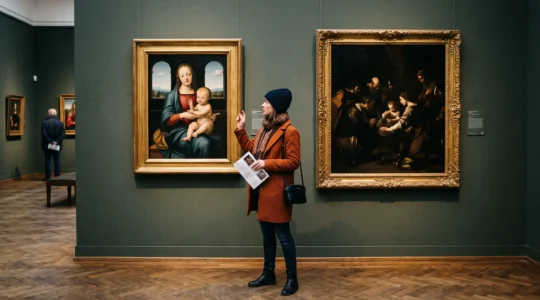
A Renaissance painting typically invites the viewer to contemplate a carefully organised world. A Baroque painting is more likely to draw the viewer into an unfolding event. This difference can be recognised through composition, light, spatial geometry and the relationship…
Lire la suite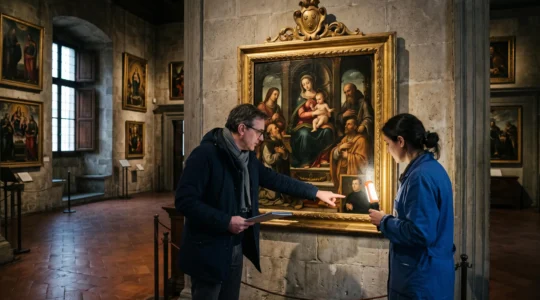
Renaissance artists did not decide independently what the public could see. Their opportunities depended on wealthy patrons, religious institutions, civic authorities and political rulers who financed artworks, approved their subjects and controlled their placement. A painting could be technically accomplished…
Lire la suite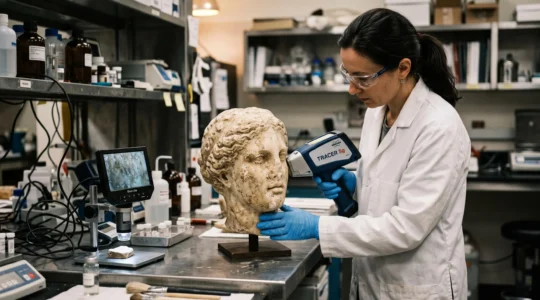
A marble statue can reproduce the proportions, expression, and surface finish of an ancient Greek masterpiece without having been carved in antiquity. For collectors and museum authenticators, the distinction between genuine classical art and nineteenth-century Neoclassical reproductions therefore cannot rest…
Lire la suite
Renaissance art did not turn away from God so much as reconsider how divine meaning could be expressed through human existence. Between the fourteenth and sixteenth centuries, humanist scholarship encouraged artists and patrons to treat individual identity, bodily proportion, emotion…
Lire la suite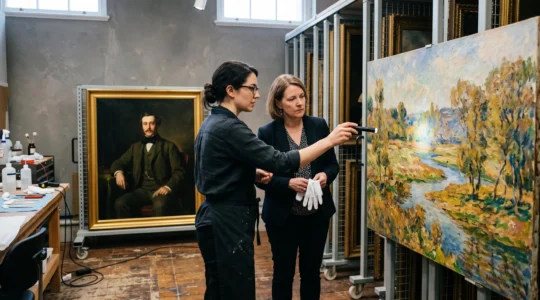
Art history often resembles a succession of revolutions. Impressionists challenged academic finish, Cubists dismantled conventional perspective, Dadaists questioned the status of art itself, and later conceptual artists challenged the assumption that an artwork had to be a carefully crafted physical…
Lire la suite