
Every painting, melody, dance, or sculpture we admire today exists because someone, somewhere, chose to share what they knew. Art education and transmission is the invisible thread that connects creators across time: the master guiding an apprentice’s hand, the teacher opening a child’s imagination, the community passing down rituals and techniques. This page is your starting point for understanding how artistic knowledge lives, moves, and survives — and how you can become part of that chain, whether as a learner, a teacher, or simply a curious observer.
At first glance, the two words in our category title may seem interchangeable, but they describe two complementary dimensions of how culture survives. Think of a river: education is the riverbed that gives the water direction, while transmission is the water itself, flowing from one place to another.
Both are essential. An art school can teach color theory, but only sustained transmission — watching, questioning, imitating, failing — turns theory into embodied knowledge. This distinction matters because many of the world’s most precious artistic traditions, from Japanese ceramics to West African drumming, have historically depended far more on transmission than on formal education.
Understanding where our modern methods come from helps us appreciate their strengths and limitations.
For centuries, the dominant method was simple: a young person attached themselves to a master and learned by doing. Renaissance workshops operated this way — a teenager might start by grinding pigments and preparing canvases, gradually earning the right to paint minor sections of a composition before, years later, producing independent work. The analogy is often used of learning to cook by living in a professional kitchen: you absorb far more than any recipe book can teach.
The rise of academies and then public education systems brought art into the classroom. This democratized access enormously — talent no longer needed a personal connection to a master. But it also introduced a tension that persists today: can creativity really be taught in standardized lessons, graded and scheduled?
In recent decades, transmission has become increasingly horizontal: artists learn from peers online, share techniques through video tutorials, and participate in global communities. Knowledge that was once guarded as a trade secret is now often freely documented. This shift has lowered barriers to entry while raising new questions about depth, context, and the loss of the mentor relationship.
Artistic knowledge currently circulates through several distinct channels, each with its own logic and value.
Consider a concrete example: a young guitarist today might combine a weekly lesson with a teacher (formal education), learn songs from online videos (digital transmission), and play with friends at a local jam session (community transmission). The richest artistic development usually weaves several of these strands together.
Transmission is not merely about technique; it is how a society keeps its cultural memory alive. When a tradition stops being transmitted, it can vanish within a single generation. UNESCO’s concept of intangible cultural heritage exists precisely because dances, crafts, and oral arts cannot be stored in a museum — they live only in practiced bodies and trained minds.
On a personal level, learning and teaching art develop capacities that extend far beyond the studio:
Research in education consistently supports what artists have always known intuitively: engagement with the arts strengthens creativity, emotional intelligence, and even academic performance in other subjects.
Being honest about the obstacles helps learners and teachers navigate them with confidence rather than frustration.
The most widespread barrier is the myth of innate talent. Many adults believe that if they were not « born an artist, » learning is pointless. The reality, supported by decades of research on skill acquisition, is that deliberate practice matters far more than initial gifts. Talent is better understood as a starting point, not a verdict.
Grading creativity is inherently delicate. A grading system can motivate progress but may also push students toward safe, teacher-pleasing work rather than genuine expression. Good educators navigate this by assessing effort, technique, and growth — leaving room for risk-taking.
Many traditional crafts and regional art forms face a shortage of both masters and successors. Economic pressure often pushes young people away from disciplines that require long training before producing income. Preservation initiatives, documentation projects, and stipends for apprentices are among the responses developed in recent years.
Paradoxically, unlimited access to tutorials can slow learning. Watching a hundred videos about painting is not the same as painting. Knowledge transmitted without practice, feedback, or context remains shallow — which is why the mentor relationship, in some form, remains irreplaceable.
If you are beginning or restarting your artistic journey, a few practical principles will serve you well.
Transmission is not reserved for certified teachers. Any practitioner who shares their process — with a child, a friend, an online audience — becomes a link in the chain. If you feel called to teach, remember the core of good pedagogy: meet people where they are. Break skills into small, achievable steps, celebrate progress visibly, and protect your student’s motivation above all. A single encouraging mentor can shape a lifelong relationship with art; most professional artists can name the person who first told them their work was worth pursuing.
Art education and transmission is ultimately a story about generosity: every artist who teaches, demonstrates, or simply creates in public is adding a link to a chain stretching back to the first handprint pressed onto a cave wall. Whether you are picking up a brush for the first time, deepening an existing practice, or considering sharing what you know with others, you are already participating in this ancient and ongoing conversation. The articles in this category are here to support you at each stage — with practical advice, historical perspective, and honest guidance for learning and teaching the arts with confidence.
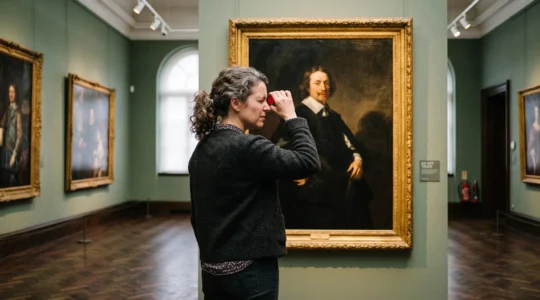
A painting rarely presents every element with equal visual urgency. Your attention may settle on a brightly illuminated face, move toward a raised hand, and then travel into a shadowed background. That experience is shaped partly by compositional design: the…
Lire la suite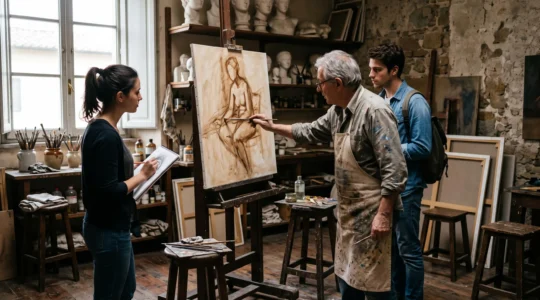
A painting student can watch a Renaissance glazing demonstration repeatedly, enlarge every brushstroke on a tablet and read a historical treatise in translation. Yet at the easel, that same student may still struggle to judge when a paint layer is…
Lire la suite
Gallery representation and teaching careers demand different forms of professional preparation. Commercial galleries generally evaluate an artist’s work, exhibition record, audience and compatibility with their programme. Formal teaching positions, particularly in regulated schools, may require recognised degrees, professional qualifications and…
Lire la suite
A hillside scattered with trees, rocks, grasses and winding streams can be extraordinary to experience but surprisingly difficult to paint or photograph. Everything competes for attention. An interesting branch interrupts a promising skyline; a patch of sunlight attracts the eye…
Lire la suite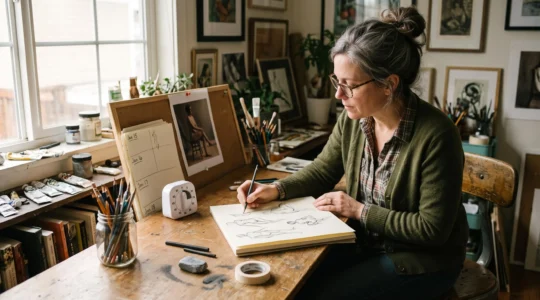
The difference between an artist who improves steadily and one who repeats the same mistakes for years is rarely explained by practice hours alone. What matters is how consistently those hours expose technical weaknesses, generate useful feedback, and translate into…
Lire la suite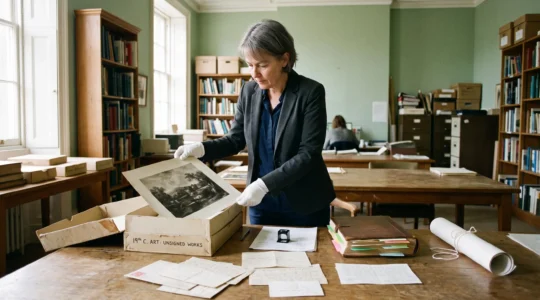
A curator who knows an obscure artistic subfield exceptionally well can become more professionally valuable than a generalist with a much larger public profile. The advantage comes not from obscurity itself, but from developing expertise that museums, researchers, collectors and…
Lire la suite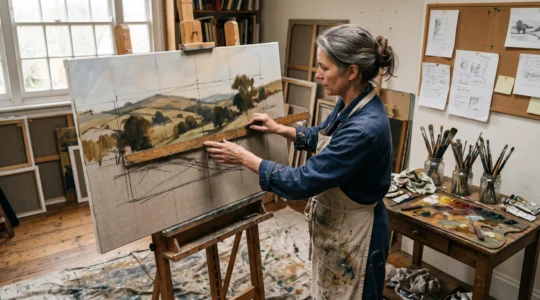
A painting can contain beautifully rendered objects and still feel strangely incomplete. The problem often lies not in the individual objects but in their relationships: how space is divided, where visual weight accumulates, which directions carry attention, and whether the…
Lire la suite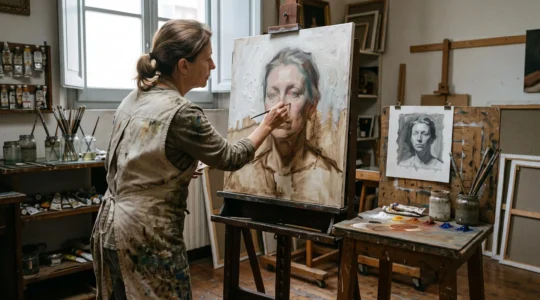
A painting can contain beautiful colours, expensive pigments and carefully rendered details yet still fail to communicate convincing form. Another painting, executed with a handful of colours and economical brushstrokes, can feel remarkably complete. The difference often lies in technical…
Lire la suite