
Walk into any great gallery and you feel it immediately: a sense of order, intention and quiet drama. Nothing is there by accident. Every painting, sculpture or photograph has been chosen, placed and lit for a reason. That invisible architecture of decisions is what galleries and collections are really about — and understanding it transforms the way you look at art, whether you visit museums, browse online exhibitions, or dream of starting a collection of your own.
This page is your starting point. Think of it as a map of the territory: what galleries and collections actually are, how they differ, how professionals curate and care for art, and how you can begin collecting with confidence. Each section below introduces a key theme in depth, so you can build your knowledge step by step.
The word gallery covers more ground than most people realize. At its simplest, a gallery is a space designed to show art. But the purpose behind that space varies enormously, and knowing the differences helps you navigate the art world with ease.
A useful analogy: if art were music, a public museum would be a great concert hall preserving the classics, a commercial gallery would be a label presenting new artists, and an independent space would be an underground club where the next sound is being invented. All three matter, and they feed one another.
A collection is a set of works brought together deliberately, around a vision, a theme or a passion. The key word is deliberate. Owning three prints you love is not automatically a collection; owning fifteen works chosen because they explore a single idea — say, urban light, or abstraction after a certain movement — is.
Collections come in many shapes:
A good mental model is to see a collection as a sentence: each work is a word, and the collection is the meaning that emerges when the words are placed together. Remove a word, and the sentence changes. That is why serious collectors think carefully before adding — or deaccessioning — a piece.
Curation is the art of selecting, organizing and contextualizing works so they speak to viewers. Far from being mere decoration, it is closer to writing an essay in space. A curator decides what story the exhibition tells, which works carry it, and in what rhythm the visitor encounters them.
The core decisions a curator makes include:
A concrete example: imagine an exhibition on the color blue. A curator might open with a deep, almost monastic room of a single indigo painting, letting the visitor slow down. The next room could pair historical pigment samples with contemporary photography, showing how the same hue carries different meanings. The final room might return to one luminous work alone, leaving a lasting afterimage. That arc — immersion, comparison, resolution — is curation at work.
Display is where curation becomes physical. Several technical pillars recur in almost every professional installation:
Even at home, these principles scale down beautifully. Hang works away from direct sunlight and radiators, keep framing materials archival, and leave enough space around each piece so the eye can rest. A work deserves a little silence around it, just as a soloist needs silence to be heard.
Collecting is not reserved for the wealthy. Many meaningful collections are built with modest means, patience and curiosity. What matters most is developing an eye — and that is a skill anyone can train.
A fictional but realistic case: a beginner collector falls in love with small-format photography. She sets a rule — one work every few months, always by an artist she has seen exhibited — and within a few years she owns a coherent set of twelve images by six emerging photographers, displayed salon-style along a staircase. The collection cost less than a single big-name painting, yet it is coherent, personal and genuinely valuable to her.
Any serious discussion of galleries and collections must address preservation and ethics. Institutions follow rigorous standards: documented provenance (the history of ownership), conservation science, controlled environments and transparent acquisition policies. Collectors, even beginners, benefit from adopting the same mindset.
The articles in this category expand on each of the foundations introduced above. You will find dedicated pieces on how to read an exhibition, how commercial galleries and artists work together, the rituals of collecting for beginners, framing and display techniques for the home, the language of art markets and fairs, and the quiet science of conservation. Each article stands on its own, but together they form a complete path: from visitor, to informed admirer, to confident collector.
Wherever you are on that path, the essential advice remains the same: slow down, look closely, ask questions. Art rewards attention like little else in life — and galleries and collections exist precisely to make that attention possible.

A contemporary artist achieves a seven-figure auction result. Galleries announce waiting lists, collectors compete for allocations, and commentators describe a new market phenomenon. Five years later, comparable works struggle to find buyers. What appeared to be appreciation was partly a…
Lire la suite
Building a private art collection worth £500,000 or more over twenty years requires more than acquiring excellent paintings at attractive prices. The central challenge is to assemble works that reinforce one another intellectually, retain individual market appeal and eventually constitute…
Lire la suite
A visitor enters a gallery containing thirty remarkable paintings. Twenty minutes later, they remember only one. Another visitor encounters a smaller, less celebrated collection and leaves with a question that changes how they look at art. The difference may lie…
Lire la suite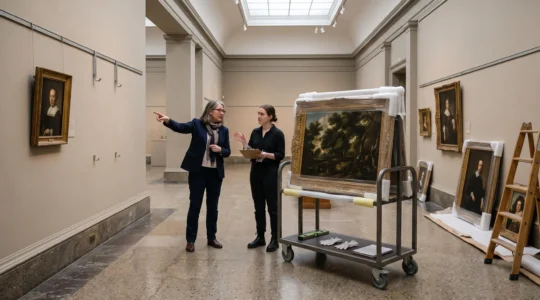
An exhibition becomes intellectually compelling when its artworks do more than illustrate a subject. They advance an argument that visitors can examine, question, and potentially carry into their encounters with art elsewhere. The distinction is fundamental. An exhibition about artistic…
Lire la suite