
Every work of art that moves us, surprises us or simply makes us pause for a moment rests on a foundation that is often invisible: techniques and skills. Whether you are picking up a pencil for the first time or returning to a creative practice after years away, understanding these foundations is what transforms vague inspiration into real, repeatable results. This pillar page is designed as a comprehensive introduction to the world of artistic techniques — what they are, why they matter, and how to approach them with confidence rather than intimidation.
Think of techniques as the grammar of art. A writer who knows grammar can break the rules intelligently; a painter who understands composition can subvert it deliberately. The goal here is not to turn you into a mechanical executor of recipes, but to give you the vocabulary and the tools to express what you truly intend.
Although the two words are often used interchangeably, they describe different things. A technique is a specific, teachable method — for example, watercolor wet-on-wet, oil glazing, or the lost-wax casting method used in sculpture. A skill is a broader, transferable ability developed through practice — such as observational drawing, color perception, or hand-eye coordination.
A useful analogy: techniques are like recipes, while skills are like knowing how to cook. You can follow a recipe once and get a decent result, but only an understanding of how heat, seasoning and timing interact allows you to improvise. In art, techniques give you reliable procedures; skills give you freedom.
Both are learnable. Research in skill acquisition consistently shows that deliberate, structured practice matters far more than innate talent, especially at the beginner and intermediate levels. This is genuinely good news: almost everything that looks like ‘gift’ in a finished artwork is, up close, a set of techniques applied with practiced judgment.
Whatever medium attracts you — graphite, oil, clay, pixels or textiles — a small number of core skills support nearly everything else. These are worth investing in early, because they compound over time like interest on a savings account.
Drawing from observation is the single most valuable foundational skill in the visual arts. It trains you to see edges, angles, proportions and negative space accurately. A classic exercise for beginners is the ‘still life triangle’: three everyday objects (a cup, a spoon, a piece of fruit), drawn weekly with attention to proportion and value rather than detail. Most learners see measurable improvement within weeks of consistent practice.
Value — the range between light and dark — is what gives images depth and volume. A helpful rule of thumb: if a drawing or painting looks ‘flat’, the problem is almost always value, not line. Squinting at your subject to simplify it into light and dark shapes is a technique used by professionals across every medium.
Color theory sounds academic, but at its core it answers practical questions: Which colors look harmonious together? How do I mix the green I actually see in that landscape? Key concepts include:
Composition is the arrangement of elements within a frame. Concepts like the rule of thirds, leading lines, focal points and visual balance are not arbitrary rules — they are observations about how human attention works. Even a technically modest piece with strong composition will read as confident and intentional.
Art techniques can be grouped into families, each with its own logic, materials and learning curve. Knowing the landscape helps you choose where to start and understand how disciplines relate to each other.
Drawing is the most accessible entry point: the materials cost little and the feedback loop is fast. Essential techniques include hatching and cross-hatching for shading, contour drawing for capturing edges, and gesture drawing (short, timed sketches of 30 seconds to two minutes) for capturing movement and energy.
Each painting medium rewards a different temperament:
Working in three dimensions introduces skills with no drawing equivalent: modeling (additive, as with clay), carving (subtractive, as with stone or wood), and constructing (assembling, as with metal or mixed media). Even two-dimensional artists benefit from sculpture fundamentals, because thinking in volume dramatically improves figure drawing and spatial reasoning.
Printmaking techniques such as relief printing, intaglio and screen printing teach a valuable discipline: every mark is a deliberate decision that will be repeated. Digital tools, meanwhile, have created their own technique families — layers, brushes, selections and non-destructive editing — while still rewarding the same foundational skills of value, color and composition. A digital painter with strong traditional fundamentals will always move faster than one who has only learned software.
Knowing what to learn is half the battle; knowing how to learn is the other half. Art skills respond to the same principles as music or sport: consistency, feedback and progressive challenge.
As you gain experience, you will notice that techniques are not isolated tricks but a connected system. Value informs color; drawing informs painting; composition informs everything. The most satisfying stage of an artistic journey begins when these elements start talking to each other — when you stop asking ‘how do I do this?’ and start asking ‘what do I want to say, and which technique serves that best?’
Start small, stay curious, and treat every exercise as a conversation with your materials rather than a test of your worth. The skills will come — reliably, measurably — and with them, the freedom to create work that is truly your own. The articles in this category are here to support each step of that journey, one technique at a time.

Removing 2mm of marble without damaging the surrounding stone is not a matter of finding one perfect chisel angle or delivering an exceptionally delicate blow. It requires controlled, progressive material removal, supported by frequent measurements and an understanding of how…
Lire la suite
An oil painting can look perfectly finished while its internal layers are still developing stresses that may eventually produce cracks, wrinkling or paint loss. Preventing these failures requires more than following a traditional instruction to paint fat over lean. Each…
Lire la suite
Before attempting complex anatomy, photorealistic painting, sophisticated colour harmonies, or intricate compositions, artists need dependable control of a few underlying abilities: observation, proportion, gesture, value, form, spatial relationships, and edge control. These are the skills that allow advanced techniques to…
Lire la suite
A red beside a green can look electrifying. Blend those same pigments together, and the result may become a subdued grey-brown. Neither outcome is automatically successful or unsuccessful: what matters is how the colours behave within the painting. Colour harmony…
Lire la suite
A brushstroke can describe the curve of a shoulder, the violence of a storm or the trembling edge of a shadow. But it can also reveal something beyond the object being painted: the physical act of painting itself. When a…
Lire la suite
Transparent oil glazes create luminous complexity by allowing light to penetrate successive colored paint films, interact with the layers beneath, and return to the viewer with altered color and intensity. Unlike a single opaque mixture, which largely determines its appearance…
Lire la suite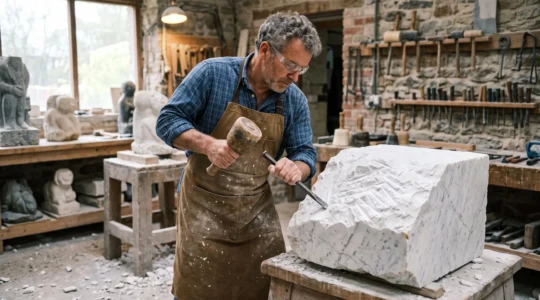
Preventing marble from shattering during detailed carving requires more than striking gently. The safest techniques control where a cutting edge enters the stone, how deeply it penetrates and whether the surrounding material can withstand the resulting forces. A shallow, well-supported…
Lire la suite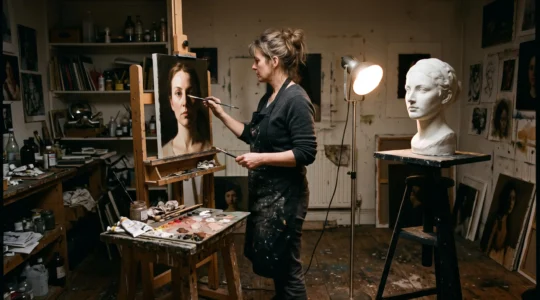
A painted face can possess accurate proportions, convincing skin colours and meticulously observed features yet still resemble a flat mask. The missing element is often not drawing accuracy but the organisation of light and shadow. Tonal contrast creates the illusion…
Lire la suite