
Museums and heritage are the twin pillars of our collective memory. One is a place, the other a practice — and together they form a bridge between past and present that anyone can walk across. If you have ever stood before a centuries-old painting, a weathered stone tool, or a beautifully restored historic building and wondered how it survived, who decided it mattered, and why it is displayed this way, this page is for you. Think of it as your starting point: a friendly, complete orientation to the world of museums and cultural heritage, written to help newcomers and curious visitors build real confidence in the subject.
Although the two words often appear together, they refer to distinct but deeply connected ideas.
A museum is an institution in the service of society: it acquires, conserves, researches, communicates, and exhibits tangible and intangible heritage for education and enjoyment. Museums come in many shapes — art galleries, history museums, science centers, open-air living museums, memorials, and house museums — but they all share one mission: to care for objects and stories and to share them with the public.
Heritage is broader. It is everything inherited from the past that a community considers worth preserving: monuments, archaeological sites, works of art, archives, languages, rituals, recipes, and even traditional crafts. Experts usually divide it into three categories:
A helpful analogy: if heritage is the vast library of human memory, museums are its most visible reading rooms — curated spaces where a small, carefully chosen slice of that memory is made accessible to everyone.
It is easy to think of museums as quiet, slightly old-fashioned places. In reality, they play an active role in modern life, and understanding why helps you appreciate them far more deeply.
Heritage anchors communities. When a town restores its old market hall or a museum exhibits objects from local artisans, it tells residents: your story matters. This is why post-crisis reconstruction efforts so often prioritize rebuilding cultural landmarks before anything else — a shared past is a foundation for a shared future.
Museums are among the most trusted sources of information in the world. Surveys consistently rank museum professionals among the most trusted public figures, above journalists and politicians. A single well-designed exhibition can spark a lifelong passion — many archaeologists and curators describe a childhood museum visit as the moment their vocation was born.
Cultural tourism is a major economic driver. Heritage sites and museums attract millions of visitors, sustain local businesses, and create jobs in conservation, education, design, and hospitality. Studies also show that regular cultural engagement is associated with improved well-being and reduced feelings of isolation — visiting a museum is not just enriching; it is genuinely good for you.
What visitors see in the galleries is only the visible tip of the iceberg. Behind the scenes, museums operate according to rigorous professional standards. Understanding this hidden machinery transforms the way you look at any display case.
Museums grow their collections through several channels, each governed by strict ethical rules:
A key principle today is provenance research: tracing an object’s ownership history to ensure it was not looted, stolen, or illegally exported. This ethical dimension has reshaped the field in recent decades, leading to increased transparency and, in some cases, the return of objects to their communities of origin.
Conservation is often compared to medicine: the conservator is a doctor for objects. The goal is rarely to make something look new — it is to stabilize it and slow its decay while preserving the traces of its history. A conservator will remove harmful dirt and old failing restorations, but will never erase the honest patina of age.
Preventive conservation, the quiet hero of the discipline, controls the enemies of artifacts:
A concrete illustration: a rare medieval illuminated manuscript may only be displayed for a few months at a time, under dim light, before resting in darkness for years. What looks like overcaution is actually the reason the object will still exist for future generations.
Curators decide which objects are shown, how they are arranged, and what they say. A good exhibition is like a well-written essay without words: it has a thesis, an argument, a rhythm, and even moments of surprise. Interpretation — labels, audio guides, interactive stations, immersive design — translates scholarly knowledge into something a first-time visitor can enjoy. This is why the same museum can feel completely different from one exhibition to the next.
Not everything old is protected, and not everything protected is old. Heritage designation is a formal process by which authorities recognize an asset’s significance and grant it legal protection.
At the international level, the World Heritage List, maintained under an international convention for cultural and natural sites of outstanding universal value, is the most famous framework. Inscription brings prestige, tourism, and access to conservation support — but also obligations: listed sites must be actively monitored and managed.
At national and local levels, most countries maintain their own registries of historic monuments, conservation areas, and protected landscapes. In practical terms, designation means:
A useful way to think about it: designation is to heritage what a protected name is to fine wine — it certifies authenticity, ensures standards, and confers responsibility on those who care for it.
Anyone can walk into a museum, but a few simple habits dramatically improve the experience. Here is a practical checklist used by frequent museum-goers:
For families, look for hands-on galleries, discovery trails, and workshop programs. Museums increasingly design for children as genuine visitors, not just future ones.
Heritage is not confined to glass cases. All around you, there are ways to engage with the past actively:
Participating is easier than most people assume, and it is one of the most rewarding ways to develop a personal connection with history.
To understand this field honestly, you need to know its current debates. None of them are reasons to disengage — they are reasons to pay attention.
Conservation is expensive, and many institutions depend on a fragile mix of public subsidies, admissions, donations, and sponsorships. This tension shapes everything from ticket prices to exhibition choices. Meanwhile, the sector works to become more accessible — physically, financially, and culturally — so that museums truly serve everyone, not just those already familiar with them.
Questions about where objects belong, and whose voices tell their stories, have become central. Many institutions are publishing their collection histories online, entering dialogues with source communities, and reframing displays to include perspectives that were long overlooked. This is not a crisis of museums; it is their evolution.
Rising temperatures and extreme weather threaten historic buildings and coastal sites, pushing the sector toward greener practices. At the same time, digital tools — 3D scanning, virtual exhibitions, online databases — are expanding access and creating digital twins of fragile heritage, preserving detail even where the physical original is at risk.
Finally, a compact glossary to read museum communications with confidence:
Museums and heritage are not relics of the past; they are living tools for understanding who we are. Whether your next step is a visit to a local gallery, a deep dive into a digital collection, or simply reading one of our focused articles on the topics covered here, you now hold the essential keys. Take your time, stay curious, and let the past enrich your present.
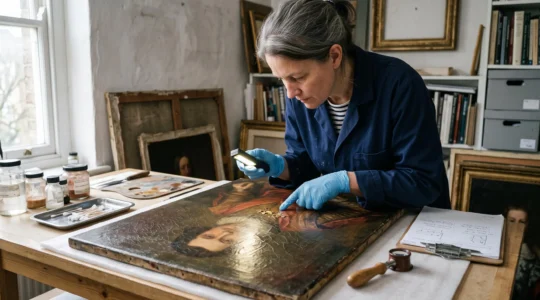
Some Renaissance paintings retain remarkably coherent surfaces after five centuries, while others have developed extensive cracking, discoloured passages, detached paint and missing areas. Their contrasting conditions are not simply consequences of age. They reflect differences in pigment chemistry, binding media,…
Lire la suite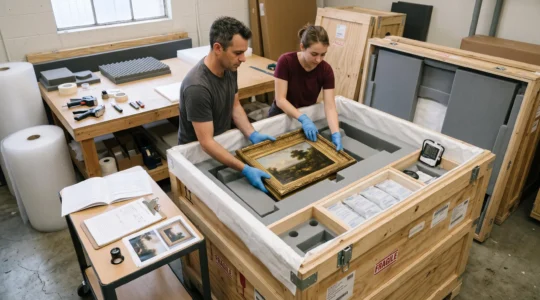
A £100 million painting may weigh only a few kilograms, yet moving it between continents requires an engineered protection system, a carefully controlled chain of custody and a transport plan that anticipates failure at every handover. The shipping challenge is…
Lire la suite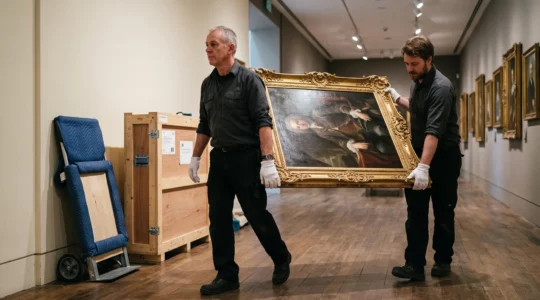
A painting does not have to fall to suffer serious damage. A hand placed on unstable gilding, a frame twisted during a doorway turn, or repeated vibration inside an inadequately cushioned crate can compromise an object without producing an obvious…
Lire la suite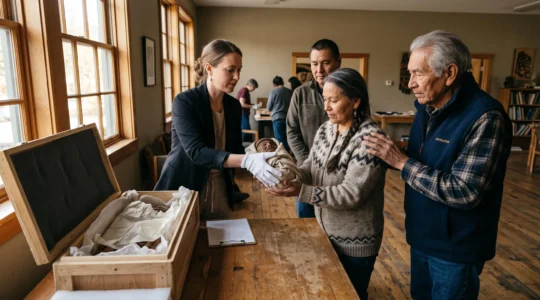
When Indigenous communities reclaim cultural objects from museums, the significance extends far beyond the physical transfer of an artwork. Repatriation can restore relationships between ancestors, living custodians, ceremonial traditions, and future generations. An object previously classified as a museum collection…
Lire la suite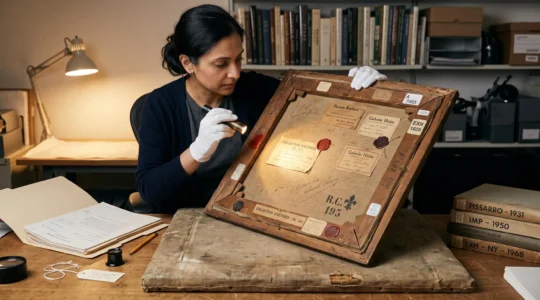
A painting may be attributed to a celebrated artist, exhibit convincing materials and possess exceptional visual quality, yet remain difficult to sell because nobody can establish where it was during a critical period. Conversely, a comparable work supported by original…
Lire la suite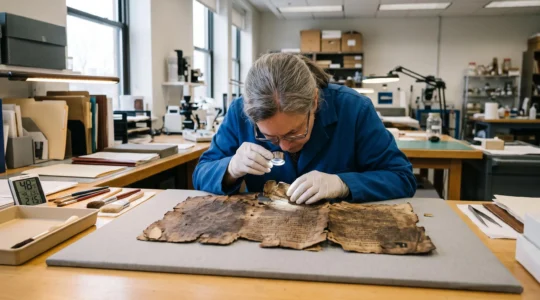
A manuscript that has survived two millennia can begin losing fragments during a single handling session. Its apparent solidity may conceal weakened cellulose, degraded collagen, fractured ink layers or damage accumulated through centuries of environmental change. Preventing further loss requires…
Lire la suite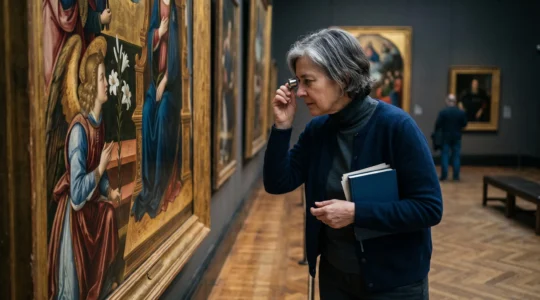
A white lily standing beside a young woman, a pair of keys held by an elderly apostle, or a skull positioned beneath the Crucifixion may look like incidental details to a modern museum visitor. For viewers familiar with Christian scripture,…
Lire la suite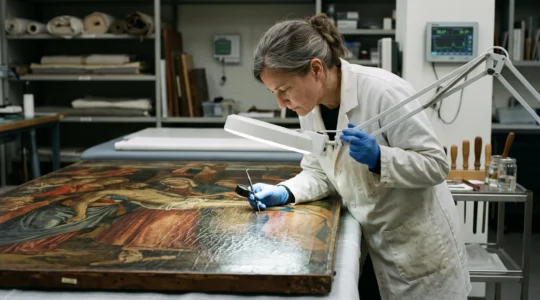
A painting can develop cracks inside a climate-controlled gallery. A centuries-old textile can weaken while resting undisturbed in storage. Even a carefully restored masterpiece may continue deteriorating because its materials remain chemically and physically active. The claim that 70% of…
Lire la suite