
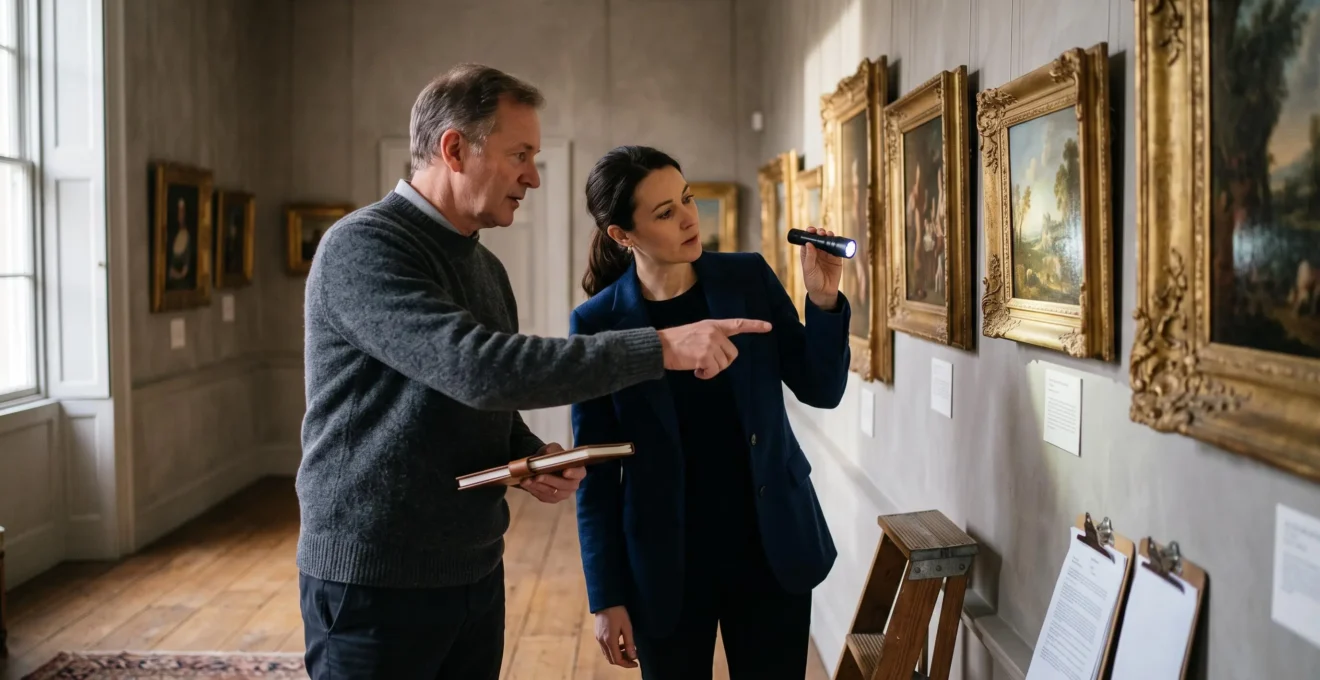
Building a private art collection worth £500,000 or more over twenty years requires more than acquiring excellent paintings at attractive prices. The central challenge is to assemble works that reinforce one another intellectually, retain individual market appeal and eventually constitute a collection that scholars, institutions and future buyers can understand.
The strongest approach begins with a defined collecting thesis, written acquisition rules and continuous assessment of artistic quality. Established artists may provide market recognition, while carefully selected emerging artists can deepen the collection’s originality. Neither approach guarantees appreciation. Ownership costs, uneven liquidity, changing reputations and acquisition mistakes can materially affect the eventual value.
The £500,000 threshold should therefore be treated as a planning objective, not a promised outcome. Purchase expenditure, current market valuation and net proceeds after selling costs are different measures. A serious collector monitors all three while building an archive of provenance, condition records and research that supports the collection’s cultural purpose.
The principles of strategic art collection building
- Define the collecting thesis first: acquire works that strengthen a recognisable artistic argument rather than assembling unrelated purchases.
- Separate cultural merit from market momentum: evaluate quality, provenance, institutional engagement and evidence of sustained demand.
- Build the collection’s future from the beginning: maintain documentation, cultivate specialist relationships and plan for eventual loans, gifts or sales.
- Why Do Scattered Collections Sell for Less Than Focused Ones at Auction?
- How Do You Define Collection Boundaries That Allow Growth Without Losing Focus?
- Emerging Talent vs Blue-Chip Masters: Which Strategy Builds Collections Faster?
- The Trend-Chasing Error That Left Collectors With Overpriced Market Darlings
- The Critical Mass: When Do Private Holdings Become Institutionally Significant?
- Why Do Artists With Major Sales Sometimes Disappear From the Market Within 5 Years?
- Why Do Mediocre Works by Famous Artists Outsell Masterpieces by Unknown Painters?
- Which Market Indicators Separate Temporary Hype From Genuine Long-Term Artist Appreciation?
Why Do Scattered Collections Sell for Less Than Focused Ones at Auction?
A focused collection can attract stronger specialist interest because its works collectively communicate an artistic argument. Related holdings may support exhibition, research or a thematic sale, whereas unrelated objects depend more heavily on their individual markets. However, there is no established universal percentage discount for scattered collections, and exceptional individual works can command high prices regardless of context.
The distinction concerns curatorial narrative value: the additional interpretative importance that arises when works form a meaningful group. A carefully assembled body of British postwar abstraction, for example, may illuminate relationships between artists, institutions and successive stylistic developments that isolated purchases cannot reveal as clearly.
This intellectual coherence can make a collection attractive to specialist buyers or curators. An auction house may find a unified narrative easier to explain through a dedicated catalogue or carefully structured sale. A museum may see research or exhibition potential. Yet neither outcome necessarily establishes a financial premium, and even a historically important collection may ultimately achieve better results through selective individual sales.
The difference between a collector of art and a collector of a movement is consequently significant. The first acquires compelling objects; the second deliberately builds knowledge, relationships and a recognised position within a particular field.
Over time, that specialisation can create informational advantages. Dealers learn the collector’s priorities, scholars recognise the holding’s relevance and advisors can evaluate new acquisitions against an established body of work. These benefits are not automatic discounts or preferential access guarantees, but they can improve decision quality.
Consider a hypothetical collector owning twelve unrelated paintings and another owning twelve carefully selected works tracing a single artistic development. Both groups might have identical independently assessed values. The second nevertheless offers an immediately intelligible research proposition. Whether that proposition translates into higher sale proceeds depends on individual quality, demand and the transaction method.
A useful diagnostic question is: If one artwork left the collection tomorrow, what would be lost beyond the artwork itself? If its departure breaks an important visual, historical or scholarly relationship, it contributes to the collection’s structure. If nothing changes, the work may be an isolated holding rather than an essential acquisition.
The wider market reinforces the need for caution. The Art Basel and UBS Global Art Market Report 2026 estimated global art sales of $59.6 billion in 2025, up 4% year-on-year, but noted an uneven recovery across segments. Aggregate market growth is not evidence that any particular collection appreciated.
$59.6 billion
Estimated global art market sales in 2025, representing 4% annual growth. This measures aggregate transactions rather than investment returns or a premium for focused collections.
Art Basel and UBS Global Art Market Report 2026, research by Dr. Clare McAndrew, Arts Economics.
Over twenty years, focus may also improve the collector’s negotiating position through continuity of relationships and expertise. Nevertheless, the benefits can be outweighed by weak individual artworks, excessive concentration or unfavourable selling conditions.
Once coherence becomes an explicit objective, the next problem is setting boundaries that preserve it without preventing worthwhile discoveries.
How Do You Define Collection Boundaries That Allow Growth Without Losing Focus?
Effective collection boundaries define what belongs, why it belongs and what would justify an exception. A written collecting charter should identify the artistic field, eligible periods, media, geographical scope, acquisition budgets and circumstances under which an otherwise attractive work must be rejected. The charter should be reviewed annually but not rewritten impulsively whenever a desirable artwork becomes available.
Three approaches offer different balances between precision, adaptability and future marketability.
| Boundary | Strategic advantage | Long-term limitation |
|---|---|---|
| Individual artist | Creates depth within an identifiable body of work and can support specialist scholarship. | Supply may be restricted; prices and liquidity remain exposed to one artist’s reputation. |
| Movement or historical period | Permits comparison between artists while maintaining a recognisable scholarly field. | Definitions can become contested, while desirable works may attract substantial competition. |
| Theme or sensibility | Allows discoveries across periods, media and geographies. | Relationships between works may require more explanation and can be harder to communicate to buyers. |
A written charter should turn intellectual ambitions into acquisition decisions. It might describe a collection of European figurative painting across a specified period, require independently supported attribution and condition assessment, and limit exposure to any single artist. These are possible policy choices, not universal rules.
The most important provision is the scope-creep rule. Before encountering an exceptional but unrelated work, the collector decides whether exceptions are prohibited, allowed within a separately controlled allocation or permitted only after a formal revision of the collecting thesis.
Such discipline has a useful institutional parallel. The American Alliance of Museums collections management standards identify collection scope, acquisitions, deaccessioning, loans and documentation as important components of museum governance. Those standards govern institutions rather than private investors, but the principle of explicit decision criteria is adaptable to personal holdings.
Boundaries also need an explicit patience budget. An overly narrow field may yield few appropriate acquisitions in any given year. Rather than lowering standards, the collector can redirect time towards research, specialist relationships, exhibition visits or commissions consistent with the thesis. Unspent acquisition capital can remain available, subject to the collector’s broader financial planning.
During an annual review, compare the original charter with the acquisitions actually made. Repeated explanations such as “it connects to something already owned” are worth questioning: almost any artwork can be connected to another through sufficiently broad interpretation.
Create a collection charter with five verifiable decisions
- Write the collecting thesis: produce a one-page statement identifying the artistic question the collection will explore.
- Set inclusion criteria: create a written matrix covering period, medium, geography, quality and acceptable attribution evidence.
- Define financial limits: prepare an acquisition budget separating purchase prices from taxes, insurance, conservation and other costs.
- Document the exception process: add a written rule explaining when out-of-scope purchases may be considered and who reviews them.
- Schedule the annual audit: create an acquisition register with a charter-fit assessment and a dated annual review record.
Liquidity considerations belong in the charter as well. A narrowly defined collection may build exceptional scholarly depth while remaining difficult to sell if the relevant market has few active participants. A thematic collection may reach more buyers but require additional explanation of its intellectual coherence.
The charter establishes what may be purchased. The next question is which career stages provide the most effective combination of artistic opportunity, market recognition and financial risk.
Emerging Talent vs Blue-Chip Masters: Which Strategy Builds Collections Faster?
Established artists can establish recognisable financial and institutional reference points relatively quickly, while emerging artists may allow a collector to assemble greater depth with less initial capital. Neither strategy is inherently faster at producing a valuable collection. The choice depends on whether speed means recognised market value, distinctive scholarly significance or the development of long-term artistic judgment.
Blue-chip collecting typically involves artists with established reputations, substantial exhibition histories and comparatively developed secondary markets. Their works may offer more available price references, but acquisition costs can be high and competition intense. Reputation does not eliminate valuation risk, illiquidity or the possibility of buying a weak example at an excessive price.
Emerging-artist collecting reverses several characteristics. Earlier-career artists may be accessible through studios and primary-market galleries, enabling direct study of their practice. However, historical auction evidence can be limited, representation may change and institutional recognition may never develop to the level anticipated.
The essential resource in this second strategy is often time. Studio visits, sustained research, conversations with specialists and repeated comparisons of works demand long-term engagement. The collector must also accept that resale opportunities may be sparse for many years.
A hybrid approach can reconcile the competing objectives. In a barbell collection, established names form an anchoring core, while a separately budgeted group of emerging artists contributes discovery, originality and potentially greater variation in future outcomes.
| Decision factor | Established artists | Emerging artists |
|---|---|---|
| Initial capital | Often higher for important works | Potentially more accessible, though highly variable |
| Market evidence | More extensive transaction histories may exist | Limited or immature secondary-market records |
| Primary risk | Overpayment, quality selection and market concentration | Career uncertainty, thin demand and limited liquidity |
| Collector involvement | Specialist due diligence and close comparison of quality | Extended studio research and relationship maintenance |
| Institutional relevance | Existing scholarship can provide context | Potential to document an artist’s development before broader recognition |
The allocation between these groups should be determined by the collector’s financial capacity, risk tolerance and thesis rather than a fixed formula. Separate budget limits can prevent speculative acquisitions from consuming resources reserved for foundational works.
The financial distinction must also account for holding costs. Higher-value works may require substantial insurance, specialist storage and conservation, while international transactions can introduce shipping, duties and other expenses. Applicable taxes and import requirements depend on jurisdiction and transaction structure, so they should be reviewed individually before acquisition.
The emerging allocation creates different obligations: extensive documentation, uncertain exit routes and the possibility that an artist’s market develops slowly or contracts.
The greatest strategic mistake may occur between these two approaches: buying artists described as emerging after promotional momentum has already produced established-artist prices, without equivalent depth of scholarship or demand.
The division works only if artistic merit remains the starting point. Once fashionable price movements replace independent judgment, both established and emerging allocations can become speculative.
The Trend-Chasing Error That Left Collectors With Overpriced Market Darlings
Trend-chasing becomes dangerous when collectors mistake rapidly rising visibility for durable artistic importance. Gallery promotion, auction competition and social attention can reinforce one another, encouraging purchases at prices unsupported by broad, persistent demand. When enthusiasm fades, late buyers may face substantial losses or find no acceptable resale market, even if the artist’s work retains genuine cultural value.
Fashion cycles develop through interactions between scarcity, attention and social proof. A prominent exhibition or record auction result attracts discussion. More collectors compete for a limited number of works, while sellers become increasingly confident about asking prices.
Price appreciation can then appear to validate the original enthusiasm, although the underlying buyer population may remain small. The last participants to acquire works at elevated prices carry the greatest exposure if demand subsequently weakens.
The collector buying solely because an artwork has recently become expensive is effectively depending on another buyer accepting an even higher valuation. That expectation may prove correct, but it is not the same as independently assessing the work’s artistic importance.
Historical market booms demonstrate that fashionable reputations can be unstable. However, it would be misleading to treat the 1980s, or any other period, as proof that an entire generation of prominent artists became worthless. Artists’ subsequent trajectories differ, and fading auction activity is not equivalent to the disappearance of cultural significance.
Distinguishing momentum from fundamentals requires examining several dimensions together:
- Museum acquisitions: identify whether institutions have actually acquired works, rather than merely included them in temporary exhibitions.
- Critical literature: examine substantial scholarly publications, independent research and sustained reassessment of the artist’s practice.
- Gallery continuity: review representation history, exhibition commitments and evidence of relationships extending beyond a single fashionable cycle.
- Demand breadth: investigate whether collectors purchase different periods, media and price tiers rather than competing for only a narrow group of highly promoted works.
- Artistic development: judge whether the work demonstrates a coherent practice and meaningful development beyond a recognisable signature style.
Museum attention is valuable evidence but requires interpretation. A temporary appearance in a sponsored exhibition does not have the same evidential meaning as a documented permanent acquisition accompanied by sustained scholarly work.
Psychological pressure also matters. Private viewings, collecting circles and prominent auction results can create fear of missing out. An acquisition charter offers a practical defence by requiring the collector to explain the purchase before the excitement of the event determines the decision.
A simple countermeasure is to prepare an independent valuation range, assess the work against comparable examples and write down the artistic reason for buying it. If the justification depends primarily on recent price acceleration, the purchase deserves further scrutiny.
Declining popularity does not always mean permanent failure. Some artists continue producing significant work despite diminished market attention; others receive meaningful scholarly reassessment much later. Careful attention to the strongest periods of an artist’s practice can reveal opportunities, though patience cannot guarantee a recovery.
The long-term objective is not to predict every change in taste but to own works whose significance can withstand a period when fashion no longer supports their prices.
The Critical Mass: When Do Private Holdings Become Institutionally Significant?
A private collection becomes institutionally significant when its works, relationships or documentation make a meaningful contribution to scholarship, exhibitions or cultural preservation. No universal number of artworks or monetary threshold establishes that status. A useful assessment asks whether museums would seek loans, researchers would need access to the collection and its dispersal would weaken understanding of a particular field.
The first test is curatorial usefulness. Does the collection contain artworks that could strengthen a serious exhibition or address a gap in an institution’s holdings? A single outstanding work may satisfy this criterion more convincingly than numerous ordinary pieces.
The second test is scholarly relevance. A group that documents an artist’s development, preserves important correspondence or establishes relationships between previously underexamined works may serve a research purpose extending beyond private ownership.
The third test concerns potential loss. If the works were dispersed and the archive separated, would their collective contribution to knowledge diminish? This is particularly important for focused collections in which comparative material and documentary context are integral to understanding individual objects.
Institutional significance is therefore a functional achievement, not a valuation milestone. A £500,000 collection may be highly relevant to a specialised museum while a substantially more expensive assortment has limited collective research value.
Reaching this position requires sustained activity. Exhibition loans, accurate cataloguing, condition reports and relationships with curators make a collection easier to study and assess. The collector must also be prepared for the possibility that an institution will decline a proposed loan or gift.
The Getty Museum‘s provenance research practices describe investigations into ownership histories using archival documents, sale catalogues, inventories and physical evidence. Comparable recordkeeping is valuable for private collections because it helps substantiate an artwork’s documented history and provides researchers with material they can assess.
Provenance records should distinguish verified facts from unconfirmed claims. Documentation may reveal gaps or contested ownership, making responsible due diligence essential rather than merely promotional.
Legacy planning introduces several potential destinations for the collection.
| Approach | Cultural objective | Principal trade-off |
|---|---|---|
| Promised gift or bequest | Preserve selected works within an institution’s long-term collection. | Future control, acceptance conditions and estate arrangements require careful planning. |
| Partial gift with retained use | Support an institution while potentially preserving specified lifetime enjoyment. | Availability and treatment depend on governing law and institutional agreement. |
| Museum placement | Develop an ongoing institutional relationship, potentially including recognition arrangements. | Institutional priorities may differ from the collector’s wishes. |
| Specialist sale or dispersal | Transfer works to new owners and potentially recover capital. | The collection’s scholarly unity may be weakened or lost. |
Gift structures, tax consequences, legal obligations and retained-use provisions vary substantially between the United Kingdom, United States and other jurisdictions. No particular arrangement should be assumed available or advantageous without qualified local advice and direct institutional agreement.
Collectors should also recognise that a museum’s acceptance of a work is not a guarantee of permanent display. Institutions make acquisitions according to their missions, resources, collection policies and stewardship obligations.
That long-term perspective also changes how collectors interpret auction prices: a remarkable sale may attract attention, but it says relatively little about whether an artist has a durable market or a lasting place in cultural history.
Why Do Artists With Major Sales Sometimes Disappear From the Market Within 5 Years?
An artist can achieve a major auction result without developing a sustainable secondary market. A headline price may reflect competition between a small number of bidders, unusual scarcity or a transaction involving financial guarantees. If repeat buyers do not emerge, subsequent works may struggle to sell. Disappearing auction activity, however, does not necessarily mean the artist has stopped producing important work.
The distinction is between a record price and a functioning market. One successful sale establishes that a particular work achieved a particular result under specific conditions. A durable market requires repeated transactions across relevant works, prices and sale periods.
Guarantees require especially careful interpretation. Certain auction arrangements involve a minimum commitment to the seller, sometimes supported by a third party. Such structures allocate financial exposure differently from an entirely uncommitted auction, but their existence does not by itself prove that a result was inflated or invalid.
Collectors should read the applicable auction catalogue’s disclosures, review the transaction context where available and distinguish competitive bidding evidence from assumptions based on a reported headline figure.
Several structural developments can weaken an artist’s market:
- Multiple owners, dealers or an estate release substantial inventory during a short period, overwhelming available demand.
- A gallery closes or ends representation, disrupting its commercial and professional support network.
- An artist’s production changes direction, reducing demand for particular periods or bodies of work.
- A concentrated group of early buyers withdraws, revealing how few independent purchasers supported previous prices.
- Public attention moves elsewhere before a stable foundation of scholarship and institutional recognition develops.
These explanations are possibilities to investigate, not conclusions that can be drawn from a declining auction result alone.
Monitoring should therefore compare several seasons rather than isolated transactions. Track gallery asking prices where credible information is available, realised auction prices for genuinely comparable works, unsold lots and the proportion of offered works that sell.
Sell-through rates are useful only when interpreted with the quantity and quality of material offered. A high rate across very few carefully selected lots offers different evidence from consistent success across numerous unrelated consignments.
Likewise, a wide gap between primary-market asking prices and secondary-market results may indicate changing conditions, but comparability matters. Differences in medium, scale, period, condition and transaction costs can explain part of the gap.
Institutional acquisitions provide another dimension. Continuing museum engagement does not guarantee price recovery, yet it can show that the artist’s relevance extends beyond immediate speculative demand.
A collector following these indicators can distinguish a market experiencing temporary consolidation from one with persistent deterioration in transaction breadth and institutional engagement.
Even an established secondary market must be analysed at the level of individual works, because a famous artist’s weakest production and an overlooked painter’s finest achievement can attract very different types of value.
Why Do Mediocre Works by Famous Artists Outsell Masterpieces by Unknown Painters?
Works by famous artists often command higher prices because recognised attribution reduces uncertainty and connects the object to an established market, documented scholarship and an identifiable buyer audience. Exceptional paintings by lesser-known artists may lack those advantages despite superior artistic quality. This creates opportunities for knowledgeable collectors, but low recognition also brings genuine liquidity and reputational risks.
The mechanism is commonly described as a brand premium. Buyers pay partly for confidence that an artist’s reputation, authenticity framework and market history will remain intelligible to future purchasers.
Under conditions of information asymmetry, this behaviour can be rational. A prospective buyer may know comparatively little about a neglected painter but have access to substantial research, exhibition history and auction precedents for an established name.
The resulting valuation difference does not necessarily reflect a careful comparison of the individual works’ visual quality. Price can incorporate reputation, scarcity, provenance, institutional recognition and expectations about future demand.
That is why connoisseurship matters within established artists’ markets. A celebrated signature may appear on paintings from different career periods, produced under different artistic circumstances and displaying very different levels of originality.
The collector should evaluate composition, technique, condition, provenance, importance within the artist’s development and comparison with documented works of similar character. In fields where workshop participation or attribution uncertainty matters, independent expert confirmation is especially important.
Buying a superior example of a recognised artist can be strategically more compelling than purchasing a routine work merely to add a famous name to the inventory. Yet the best examples often command significant premiums themselves, limiting any assumption that quality is systematically undervalued.
The opposite opportunity concerns exceptional works by lesser-known artists. A carefully attributed, historically meaningful painting may deepen a focused collection far more than an ordinary work by a widely traded name.
Consider a hypothetical collection devoted to a regional modernist movement. An outstanding painting by an under-researched participant may clarify important stylistic relationships, while a minor work by the movement’s best-known artist contributes little new information. A curator could find the former more useful even if its market price is lower.
However, scholarly usefulness and financial liquidity remain separate. Buyers may continue to favour the established name, and the lesser-known artist might never receive the research attention required to expand the market.
Connoisseurship therefore requires the willingness to hold a work for its artistic significance without assuming that future buyers will eventually agree with its proposed monetary value.
The most dependable approach combines that qualitative judgment with systematic market analysis, so cultural conviction is informed by evidence rather than confused with a prediction of inevitable appreciation.
Key takeaways before evaluating an acquisition
- Separate the artistic case for owning a work from the evidence supporting its current asking price.
- Test market depth across multiple transactions and periods rather than treating records or publicity as sufficient proof.
- Require an acquisition to improve the collection’s defined purpose, even when the artist appears financially attractive.
Which Market Indicators Separate Temporary Hype From Genuine Long-Term Artist Appreciation?
Long-term artist appreciation is more credible when several independent indicators develop together: sustained secondary-market demand, meaningful institutional engagement, substantial scholarship, stable professional representation and a buyer base extending beyond a narrow group. No single metric reliably predicts future prices. The most informative evidence often comes from observing how an artist’s market behaves during weaker conditions.
A repeatable evaluation framework should consider both the strength of each signal and whether it persists. A widely publicised exhibition can generate temporary attention; a record sale can reflect unusual competition; extensive press coverage can accompany a concentrated promotional campaign.
None is worthless evidence. The problem arises when one favourable observation is treated as proof that the entire market is healthy.
A disciplined collector can use the following dashboard before each acquisition.
| Indicator | Evidence to examine | Principal warning sign |
|---|---|---|
| Secondary-market breadth | Comparable sales across venues, seasons and distinct buyers where identifiable | A few exceptional prices dominate an otherwise thin market |
| Price consistency | Realised prices adjusted for work quality, medium, period and condition | Sharp changes that cannot be explained by the objects sold |
| Institutional recognition | Documented acquisitions, loans, exhibitions and continuing curatorial interest | Visibility concentrated in isolated promotional events |
| Scholarship | Independent research, catalogues and critical reassessment | Publicity substantially outweighs substantive research |
| Representation stability | Continuity of professional gallery support and exhibition programmes | Rapid turnover or reliance on a single commercial intermediary |
| Demand across price tiers | Activity involving works on paper, paintings, prints or other relevant categories | Interest confined to a narrow group of high-profile works |
| Performance in weak markets | Results relative to comparable artists during periods of reduced demand | Disproportionate deterioration despite comparable quality and supply |
Each category must be interpreted within the artist’s practice. Some artists work in only one medium or have so few market transactions that a conventional statistical comparison is not meaningful. Others may be culturally important while having virtually no commercial secondary market.
The strongest diagnostic is often relative performance through a downturn. Rather than asking whether an artist’s absolute prices fell, compare results with a carefully chosen peer group over comparable periods. If similar artists experience softer demand but one market weakens much more severely, the difference deserves investigation.
This is not a mechanical formula. Auction catalogues do not always disclose every commercially relevant detail, privately negotiated prices may be unavailable and transaction samples can be too small for reliable statistical conclusions.
A twenty-year collecting strategy should consequently establish a review cycle. Reassess the market evidence before acquisitions and periodically revisit the broader position of each artist already represented. The purpose is not constant trading; it is recognising material changes in the assumptions underlying ownership.
The financial model should also distinguish acquisition expenditure from valuation. For a hypothetical £500,000 target, a collector might allocate £25,000 annually over twenty years, producing £500,000 in cumulative contributions before any allowance for expenses or changes in value. That arithmetic does not imply a £500,000 collection valuation at the end of the period. Insurance, conservation, transaction costs and market movements may produce a substantially different result.
When reviewing the whole collection, record estimated individual values with their uncertainty, aggregate acquisition costs, ongoing expenditure and the potential difference between gross sale prices and net proceeds. Independent valuation can assist, but appraisals do not guarantee executable sale prices.
Institutional significance should be assessed separately from financial performance. A holding may become an essential scholarly resource without achieving the monetary target, while another collection may rise in market value without developing comparable cultural relevance.
Over two decades, the collector’s most transferable advantage is a consistent method: defined boundaries, independent artistic judgment, documented acquisition decisions and periodic comparison of the original investment thesis with evolving evidence.
For the next acquisition, prepare a concise investment and curatorial memorandum before committing funds. Record why the artwork belongs, what independent evidence supports its valuation, what could undermine the purchase and what contribution it would make to the collection in twenty years. Repeat that discipline consistently: the lasting achievement is not a single successful prediction, but a collection whose artistic significance and financial decisions remain defensible over time.
Does a £500,000 collection need to contain expensive individual artworks?
No. A collection may reach that estimated aggregate value through a relatively small number of substantial works or a larger group of more moderately valued objects. Neither approach guarantees coherence or liquidity. Individual quality, total ownership costs, market depth and the way the works contribute to a clear artistic thesis matter more than a prescribed number of acquisitions.
How often should a private collection be professionally valued?
There is no universal valuation interval appropriate for every collection. Insurance renewals, estate planning, prospective sales and significant changes in an artist’s market may justify updated professional opinions. A collector can review documentation and market evidence annually while obtaining formal valuations when required by the collection’s risks, purposes and applicable arrangements.
Should collectors sell artworks that no longer fit their collecting thesis?
Not automatically. A work outside the current thesis may possess exceptional artistic quality, personal importance or future relevance. Before selling, assess its contribution, realistic market value, transaction costs, provenance obligations and any contractual restrictions. A planned disposal should improve the collection’s long-term purpose rather than merely enforce formal consistency.
What documentation should accompany each acquisition?
A practical object record includes identification details, photographs, invoices or transaction documents, available provenance, attribution evidence, exhibition and publication history, condition reports, conservation records and relevant correspondence. Verified facts should remain distinct from unconfirmed information. Thorough documentation helps future researchers and prospective buyers assess the work, although it does not automatically increase value.
Can a private collector work with museums before planning a donation?
Yes. Where relevant to a museum’s programme, collectors may explore research access, exhibition loans and discussions with curators. Acceptance depends on institutional priorities, condition, provenance, resources and formal loan requirements. Developing a professional relationship does not imply that the institution will later acquire the artwork or accept a proposed gift.