
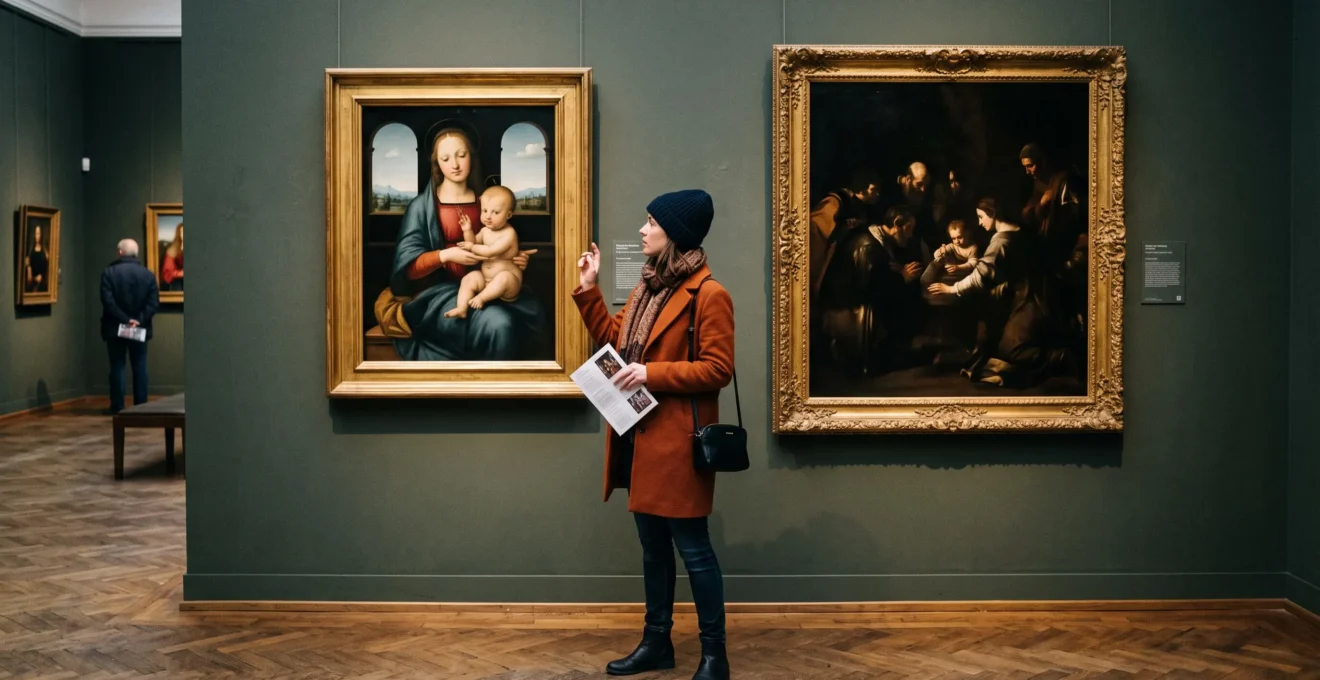
A Renaissance painting typically invites the viewer to contemplate a carefully organised world. A Baroque painting is more likely to draw the viewer into an unfolding event. This difference can be recognised through composition, light, spatial geometry and the relationship between figures and the picture frame, often before identifying the artist or subject.
Renaissance painters generally favoured coherent proportions, controlled perspective and harmonious figure arrangements. Baroque artists frequently exploited diagonals, abrupt illumination, compressed space and expressive movement. Yet these are tendencies rather than absolute rules. A Renaissance painting may be exceptionally dark, while a Baroque composition may retain remarkable symmetry.
For collectors, auction specialists and connoisseurs, the distinction matters beyond art-historical terminology. An incorrect period attribution can distort an artwork’s scholarly classification, provenance research, insurance assessment and potential market value.
The most reliable first-glance approach is therefore comparative: examine how the painting organises movement, directs attention, models form and positions its audience. These observations establish a stylistic hypothesis, not an authentication.
Renaissance vs Baroque: Three Essential Visual Differences
- Composition: Renaissance painting generally favours balanced, self-contained arrangements; Baroque painting often introduces diagonals, cropping and implied movement beyond the frame.
- Lighting: Renaissance modelling frequently relies on gradual tonal transitions, while Baroque artists may use concentrated illumination and deep shadow to intensify drama.
- Authentication: Neither lighting nor composition establishes an artwork’s date. Materials, provenance and technical examination must corroborate stylistic observations.
- Why Do Renaissance Compositions Feel Orderly While Baroque Paintings Seem Chaotic and Dynamic?
- How Do You Distinguish Leonardo’s Sfumato From Caravaggio’s Tenebrism Without Reading Labels?
- Static Symmetry vs Dynamic Diagonals: Which Era Organised Space Around Stable Geometry?
- The Misattribution Trap: When a ‘Raphael’ Turned Out to Be an Early Caravaggio
- The Five Visual Clues That Demand Laboratory Dating for Uncertain Renaissance-Era Paintings
- Why Can Visually Similar Paintings Date Centuries Apart Despite Perfect Stylistic Matching?
- God-Focused vs Human-Focused: How Did Renaissance Art Visually Represent This Philosophical Shift?
- How Do Tonal Contrasts Create Depth and Solidity on Flat Canvas Surfaces?
Why Do Renaissance Compositions Feel Orderly While Baroque Paintings Seem Chaotic and Dynamic?
Renaissance compositions often feel orderly because their figures belong to a balanced visual structure, typically contained within a coherent pictorial space. Baroque compositions frequently appear more dynamic because gestures, diagonals and cropped forms suggest action continuing beyond the frame. The distinction concerns how movement is organised, not simply how many figures occupy the painting.
In many High Renaissance works, the eye moves through connected groups before returning to a principal figure or stable focal area. Pyramidal arrangements, repeated gestures and measured intervals between figures establish relationships that remain intelligible even in densely populated scenes.
Leonardo da Vinci‘s The Virgin of the Rocks offers an instructive example. The Virgin, Christ Child, infant Saint John and angel form an interconnected group within a complex rocky landscape. Their gestures guide attention between figures without dispersing the composition. The painting’s organisation is documented in the National Gallery‘s analysis of Leonardo’s The Virgin of the Rocks.
Baroque artists often favour a different visual experience. Rather than repeatedly returning the gaze to a settled centre, the composition can propel attention along an extended arm, twisting body or receding diagonal. Figures approaching the picture edge may appear to enter or leave an event already in progress.
Consider the difference between Leonardo’s Last Supper and Caravaggio’s The Supper at Emmaus. Both depict significant religious encounters around a table, but Leonardo uses architectural order and carefully distributed reactions, whereas Caravaggio intensifies physical immediacy through gestures and proximity to the spectator.
The frame-continuation test is useful: imagine extending the canvas in every direction. Does the action seem comfortably complete, or might a gesture, movement or figure continue beyond the present boundaries?
Density alone is misleading. A crowded Renaissance narrative can remain rigorously structured, while a relatively sparse Baroque work may convey exceptional movement.
The first assessment should identify the painting’s underlying organisation. Its geometric structure then offers a second, more precise way to test the initial impression.
How Do You Distinguish Leonardo’s Sfumato From Caravaggio’s Tenebrism Without Reading Labels?
Leonardo’s sfumato is recognisable through exceptionally subtle transitions between light and shadow, allowing contours to soften or dissolve. Caravaggio‘s characteristic tenebrist lighting instead isolates illuminated forms against extensive darkness. The practical distinction is whether light gradually models an object or dramatically exposes selected figures, although neither technique alone establishes an artwork’s date or attribution.
Sfumato derives its effect from carefully controlled tonal transitions. Faces, hands and surrounding atmosphere merge through almost imperceptible changes in value. Edges may remain visible, but they rarely resemble hard lines separating one form from another.
In The Virgin of the Rocks, Leonardo allows figures to emerge softly from the grotto’s darkness. The National Gallery identifies subtle transitions between illuminated and shadowed passages as central to this effect. Importantly, the painting itself is substantially dark, demonstrating why darkness cannot function as a reliable chronological shortcut.
Tenebrism places a stronger structural emphasis on shadow. Dark passages may dominate much of the composition, while concentrated light defines the most important bodies, expressions and gestures.
The distinction from ordinary chiaroscuro is one of emphasis. Chiaroscuro models three-dimensional forms through differences in illumination; tenebrism uses particularly pronounced contrasts and extensive darkness to direct attention and intensify the scene.
A useful viewing scale moves from soft, atmospheric modelling through conventional chiaroscuro to concentrated, theatrical illumination. Most paintings occupy intermediate positions rather than representing perfectly isolated categories.
The edge test is best undertaken with a clear view of the original surface or a high-quality reproduction. Examine the transition around a face or hand. Does the form seem to emerge through continuous tonal gradation, or does illumination abruptly establish its presence against a much darker field?
Candlelit subjects, night scenes and later paintings influenced by Caravaggio can all produce similar darkness. A conservator’s examination may reveal how paint was applied, but stylistic labels should not be inferred from one lighting condition or photographic reproduction.
Once the handling of light is understood, the painting’s geometry can help determine whether that lighting reinforces stability or directs an unfolding action.
Static Symmetry vs Dynamic Diagonals: Which Era Organised Space Around Stable Geometry?
High Renaissance painting is particularly associated with stable geometric organisation, including triangular figure groupings, controlled perspective and balanced architectural settings. Baroque compositions more often exploit oblique viewpoints, energetic diagonals and spatial extension to involve the spectator. Nevertheless, both periods use geometry, and late Renaissance Mannerism complicates any attempt to date a painting from diagonal lines alone.
Renaissance spatial organisation reflects a strong interest in measured relationships between bodies, architecture and viewpoint. Symmetry can reinforce stability, while triangular compositions create a hierarchy in which supporting forms direct attention towards a central subject.
Linear perspective provides another organising mechanism. When architectural orthogonals converge towards a calculated vanishing point, a rational and coherent pictorial environment emerges. The viewer can often imagine occupying a relatively fixed position before that space.
Not every Renaissance painting uses a central vanishing point. Landscape settings, atmospheric perspective and irregular arrangements can accomplish coherence without symmetrical architecture. Leonardo’s exploration of aerial perspective is an important reminder that mathematical construction represents only one Renaissance solution to spatial depth.
In Baroque painting, diagonals can direct attention into a space that appears less self-contained. Cropped bodies and oblique views can make the spectator feel physically close to the represented action.
A particularly useful transitional example appears in the Met‘s collection record for The Conversion of Saint Paul. This late-sixteenth-century drawing, catalogued under Ludovico Carracci, combines receding diagonals, cropped forms, agitated movement and expressive lighting. Its attribution has also been disputed, illustrating the limits of connoisseurial certainty.
A Five-Step Compositional Examination
- Mark the dominant axis. Identify whether the picture is organised primarily by verticals, horizontals or diagonals. Deliverable: one annotated composition image.
- Locate the spatial focus. Trace architectural perspective lines, if present, and identify their convergence. Deliverable: a marked focal or vanishing-point diagram.
- Trace the eye path. Follow repeated gestures, gazes and highlighted forms. Deliverable: a sequence of numbered visual focal points.
- Inspect the boundaries. Record cropped bodies, interrupted gestures or movements apparently continuing beyond the picture. Deliverable: a short list of frame interactions.
- Record competing interpretations. Note features consistent with Renaissance, Mannerist or Baroque organisation. Deliverable: a provisional classification with its principal uncertainties.
These observations must be interpreted together. Late Renaissance Mannerist painters already used elongated forms, unstable arrangements and unusual perspectives. The distinction is often whether distortion is deliberately artificial or whether diagonal movement establishes convincing physical action.
Geometry clarifies stylistic affinities, but it cannot certify authorship. That distinction becomes particularly important when an attribution carries significant financial consequences.
The Misattribution Trap: When a ‘Raphael’ Turned Out to Be an Early Caravaggio
A supposed Raphael later identified as an early Caravaggio would represent a dramatic change in attribution, period classification and market interpretation. However, no documented Raphael-to-Caravaggio reattribution is established by the available sources. The title therefore illustrates a hypothetical attribution trap rather than a verified historical transaction or a demonstrable financial result.
Such scenarios matter because Renaissance and early Baroque artistic languages overlap. Painters entering the seventeenth century inherited established Renaissance practices while experimenting with more naturalistic figures, theatrical illumination and dynamic composition.
A work may consequently display balanced groupings alongside pronounced contrasts or contain idealised forms within an unusually immediate pictorial environment. These combinations do not automatically indicate deception, workshop production or incorrect attribution.
For the auction specialist, the essential distinction is between an artwork’s visual resemblance and the evidence that supports a named artist. A convincing resemblance to Raphael establishes neither Raphael’s authorship nor the painting’s production date.
Hypothetical Case: A Disputed Old Master Attribution
Imagine an unsigned religious painting presented as a Renaissance workshop production. Its measured figure arrangement initially supports that description, but examination also reveals dramatic directional lighting and figures positioned unusually close to the picture plane.
These observations justify investigating a possible later origin or subsequent stylistic imitation. They do not justify naming Caravaggio, changing the catalogue attribution or assigning a different market value without further evidence.
A historical example of the underlying uncertainty appears in the Met’s Conversion of Saint Paul drawing. The museum records an attribution to Ludovico Carracci and a published challenge proposing Cavedone. This is a documented scholarly disagreement, not a Raphael-to-Caravaggio case or evidence of any specific auction loss.
Attribution affects catalogue descriptions, insurance assessments, proposed exhibition loans and market expectations. A material revision may change a painting’s commercial standing substantially, but the extent of any change depends on evidence, condition, provenance, market demand and the terms of a particular transaction.
The appropriate investigation combines documentary provenance, physical examination, comparative scholarship and, when warranted, technical analysis. An old signature or historic inventory description should be evaluated as evidence rather than accepted as decisive.
For unsigned, altered or restretched works, the most defensible expert opinion begins as a qualified hypothesis. Material evidence determines whether that hypothesis can withstand closer scrutiny.
The Five Visual Clues That Demand Laboratory Dating for Uncertain Renaissance-Era Paintings
Five visible warning signs can justify technical examination of a painting attributed to the Renaissance: an unexpected support, inconsistent craquelure, unusual pigment behaviour, suspicious preparatory features and anachronistic imagery. None independently proves age or authenticity. Their value lies in identifying contradictions that material analysis, conservation records and documentary research may be able to explain.
For an owner or auction specialist, these features should be treated as screening indicators rather than a substitute for scientific examination.
- Support: Identify whether the work is painted on wood, canvas or another material. Historical support preferences varied by place, date and workshop. A wooden panel is not automatically Renaissance, and canvas does not automatically indicate Baroque production.
- Craquelure: Examine the distribution of surface cracking and its relationship to the underlying material. Cracks may reflect ageing, environmental change, restoration or artificial intervention; appearance alone cannot establish chronology.
- Pigment behaviour: Look for unexplained fading, discolouration or inconsistent paint passages. Such features can motivate pigment analysis, but visible colour changes seldom identify a material conclusively.
- Preparatory features: Investigate apparently exposed drawing or compositional revisions where these are visible. Infrared reflectography or other imaging may disclose information unavailable under ordinary lighting.
- Historical anachronisms: Examine costume, architecture and depicted objects for features inconsistent with the proposed date. Later additions, copies and intentional historicism must also be considered.
The choice of examination depends on the suspected inconsistency. Dendrochronology studies tree-ring sequences in suitable wooden supports, establishing constraints on the wood’s chronology rather than directly dating every paint layer. Radiocarbon dating estimates the age of suitable organic material within the limits of sampling and calibration; it does not automatically establish when a painting was executed.
Pigment analysis can identify materials incompatible with a claimed production period. However, a historically appropriate pigment does not establish that an artwork was painted when that pigment first became available.
Technical Evidence: Stephan Lochner’s Panel Paintings
Researchers investigating panel paintings associated with Stephan Lochner examined wooden supports, preparatory materials, underdrawing, pigments and binding media.
As documented in the National Gallery’s technical study of Stephan Lochner’s panel paintings, dendrochronological findings established that two panels originated from the same tree and supported dating to the 1440s. The investigation demonstrates how independent physical evidence can strengthen a historical assessment without making stylistic comparison redundant.
Forgery adds another complication. A skilled imitator may select old materials or incorporate apparently authentic ageing. A single material contradiction may therefore be more informative than numerous stylistically plausible details, although apparent contradictions must first be checked for restoration or later intervention.
Technical examination becomes particularly valuable when an attribution affects a significant sale, insurance decision or contested ownership history. The appropriate investment depends on the painting’s potential importance, the uncertainty being resolved and whether a proposed test can meaningfully address that uncertainty.
Technical dating is strongest when independent observations converge. This matters especially because convincing historical styles can be reproduced long after their original period.
Why Can Visually Similar Paintings Date Centuries Apart Despite Perfect Stylistic Matching?
Two paintings may look remarkably alike yet have been made centuries apart because artistic styles can be studied, copied and revived. Historical workshop training, academic practice and later historicist movements encouraged close imitation of earlier masters. Stylistic resemblance establishes compatibility with a tradition, not the physical date of an object, which requires material and documentary corroboration.
Copying was central to artistic education for generations. Pupils studied established compositions, repeated successful figure types and absorbed established methods of representing drapery, anatomy and landscape.
A later painter could therefore reproduce a Renaissance arrangement without belonging to the Renaissance. Neoclassical and nineteenth-century academic traditions also renewed interest in earlier ideals of proportion, finish and classical subject matter.
Such resemblance is not necessarily fraudulent. Legitimate copies, workshop exercises and retrospective artworks can possess considerable artistic and historical interest when correctly described.
Forgery becomes a different problem when materials, signatures or documentary claims are manipulated to present a later production as an original work from an earlier period.
The distinction between stylistic evidence and material evidence is fundamental. Style can be learned; a painting’s physical construction provides a separate record of its manufacture and subsequent history.
For example, two visually matched devotional paintings might use comparable figures, compositions and tonal treatment while differing in support construction, preparation layers or pigment composition. Those differences could support further investigation, although they would not necessarily establish precise dates by themselves.
Even historically plausible materials do not guarantee authenticity. Older supports may be reused, and later interventions may complicate analytical results. Conversely, a seemingly incongruous feature might belong to a documented restoration rather than the original execution.
Accordingly, experts should attach greater significance to verifiable inconsistencies than to overall stylistic familiarity. A convincing general appearance cannot cancel a well-established chronological contradiction.
Visual comparison is most useful for defining what needs investigation. Religious iconography and the treatment of the human figure provide further context, but they, too, must be read historically rather than as fixed stylistic signatures.
God-Focused vs Human-Focused: How Did Renaissance Art Visually Represent This Philosophical Shift?
Renaissance humanism placed greater emphasis on human experience, classical learning and the observable natural world. In painting, this encouraged anatomically plausible bodies, individualised faces, convincing landscapes, portraiture and renewed classical subject matter. Religious imagery remained central, however; the important visual change was often how sacred figures were represented, not whether they appeared at all.
Earlier religious traditions frequently employed visual hierarchies that distinguished sacred figures through scale, placement and symbolic convention. Renaissance artists increasingly explored how divine subjects might inhabit coherent physical settings and express recognisably human emotion.
Christ, the Virgin and saints could appear within measured architectural spaces or naturalistic landscapes. Their bodies exhibited weight, their gestures described relationships, and their faces conveyed attention, tenderness or grief.
Leonardo’s The Virgin of the Rocks exemplifies this reconciliation. The subject is explicitly Christian, yet the figures interact through natural gestures within a carefully observed, atmospheric environment.
Humanism also expanded the cultural importance of secular portraiture and subjects from classical mythology. These developments reflected engagement with human identity and antiquity rather than a wholesale abandonment of religion.
Baroque artists subsequently brought different expressive priorities to many of these inherited subjects. The Catholic Counter-Reformation encouraged forms of sacred art capable of communicating devotion with clarity and emotional force, although Baroque visual culture extended far beyond that religious context.
Caravaggio provides an influential example of intensified religious naturalism. As discussed in the Metropolitan Museum of Art’s essay on Caravaggio and his followers, he brought figures towards the picture plane and used light to heighten dramatic impact. His treatment of contemporary models made sacred episodes appear unusually immediate.
At first glance, a useful distinction is whether the viewer observes idealised individuals inhabiting an ordered world or encounters figures apparently caught in an urgent event. Neither treatment is exclusive to one period, but their different emphases can guide the initial classification.
The underlying purpose of light and modelling brings these observations together: both periods sought convincing form, but frequently directed its expressive power towards different ends.
Key Takeaways for Connoisseurs and Collectors
- Analyse visual relationships rather than isolated features: a dark background or strong diagonal is more meaningful when interpreted alongside composition and spatial organisation.
- Separate the artistic effect from the historical claim: tonal modelling may support a stylistic assessment without proving a painting’s period or authorship.
- Use image-based examination to refine the question: tonal patterns can reveal a painting’s structure before documentary and technical evidence is consulted.
How Do Tonal Contrasts Create Depth and Solidity on Flat Canvas Surfaces?
Tonal contrast creates the impression of three-dimensional form because the human visual system interprets variations in brightness as cues to shape, illumination and spatial relationships. Renaissance painters often used gradual transitions to establish continuous volume, while many Baroque artists employed concentrated illumination and deep shadow to intensify both depth and drama. Both approaches build on the same perceptual principle.
A painted object remains physically flat, but its light-facing areas, halftones and shadows can imitate the behaviour of an illuminated solid. The viewer consequently perceives rounded cheeks, projecting hands and folds of fabric.
Renaissance tonal modelling frequently emphasises continuity. A face develops through successive values, allowing its contours to appear integrated with the surrounding atmosphere. This contributes to the impression of sculptural solidity characteristic of many High Renaissance paintings.
Leonardo’s sfumato represents a particularly refined application of this principle. Rather than describing volume through prominent outlines, he uses delicate tonal relationships to suggest the gradual turning of form.
Baroque tonal organisation can operate more dramatically. Selected figures emerge from dark surroundings through concentrated illumination, creating strong separation between visually important elements and their setting.
Caravaggio’s treatment of light illustrates how illumination can perform two functions simultaneously: defining physical bodies and directing attention towards a narrative event.
The contrast should not be understood as an absolute division between softly lit Renaissance paintings and harshly illuminated Baroque ones. Both traditions contain a wide range of approaches, and lighting conventions vary considerably between artists, regions and subjects.
A practical way to examine an unfamiliar work is to reduce the distraction of colour.
- Study a colour-accurate reproduction under neutral viewing conditions.
- View a greyscale version or narrow the eyes to emphasise large tonal masses.
- Identify whether the composition relies primarily on continuous modelling or strong light-dark separation.
- Compare that tonal organisation with the painting’s geometry, figure placement and apparent spatial depth.
This is a useful visual exercise, not a validated authentication procedure. Reproduction quality, varnish discolouration, restoration and photographic exposure can all affect the apparent tonal structure.
Most importantly, tonal analysis should strengthen or challenge an existing stylistic hypothesis rather than replace physical or documentary investigation.
For an unidentified artwork, record the lighting, geometry, figure relationships and any contradictory features in a concise examination note. If the classification has consequences for attribution, acquisition, sale or insurance, seek an independent specialist assessment supported by provenance and appropriate technical research.
Can the colour palette alone reveal whether a painting is Renaissance or Baroque?
No. Colour preferences varied across artists, regions, workshops and subjects. Pigments may also have changed through ageing or restoration. Tonal organisation, spatial construction and figure relationships provide a stronger combined stylistic assessment than colour alone, although none independently proves date or authorship.
Does a painting on wooden panel necessarily predate a painting on canvas?
No. Panel and canvas supports were used across overlapping historical periods, with preferences influenced by geography, workshop practice, function and format. Identifying the support can guide further research, but chronological conclusions require additional evidence. Suitable wooden panels may be investigated through dendrochronology, subject to the method’s limitations.
Why is Mannerism sometimes mistaken for Baroque painting?
Late Renaissance Mannerism can feature elongated figures, unconventional spatial arrangements, expressive gestures and strong diagonals. These qualities may resemble later Baroque dynamism. The distinction often depends on whether a composition emphasises deliberate artificiality and distortion or a more physically immediate dramatic event. Transitional works may combine both approaches.
Can infrared examination identify the original artist of a painting?
Infrared reflectography may reveal preparatory drawing, revisions and certain working methods, depending on the materials and examination conditions. Such findings can assist comparisons with documented practices, but they do not automatically identify an artist. Authorship requires interpretation alongside provenance, comparative scholarship and other technical findings.
What should an auction buyer do when an Old Master painting has conflicting stylistic and technical evidence?
The buyer should seek clarification of the catalogue attribution, review the available provenance and condition documentation, and obtain qualified independent advice before treating the proposed identity as established. Where an unresolved material inconsistency could materially affect attribution or value, targeted scientific examination may be appropriate. Any assessment should distinguish demonstrated facts from scholarly opinion.