
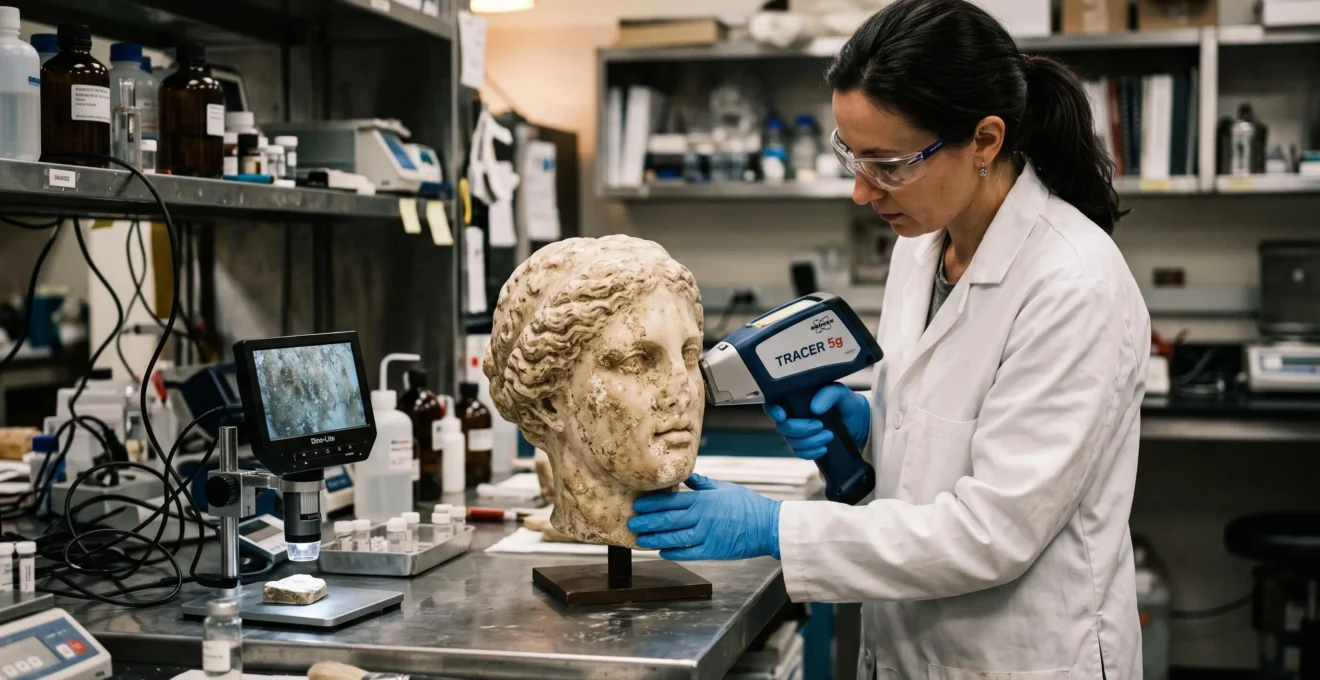
A marble statue can reproduce the proportions, expression, and surface finish of an ancient Greek masterpiece without having been carved in antiquity. For collectors and museum authenticators, the distinction between genuine classical art and nineteenth-century Neoclassical reproductions therefore cannot rest on visual resemblance alone.
Authenticity depends on establishing when, how, and under what historical circumstances an object was made. Material composition, manufacturing traces, documented ownership, stylistic conventions, and evidence of restoration must support the same attribution. A Roman copy of a Greek original, for example, is an authentic ancient Roman sculpture, even though its design originated centuries earlier. A nineteenth-century reproduction may be historically significant without being an ancient artefact.
Distinguishing these categories requires a disciplined assessment of competing explanations. Scientific examination can expose chronological contradictions, while archival research tests whether the object’s documented history supports its claimed identity. Neither approach, undertaken in isolation, guarantees a definitive attribution.
Essential principles of classical art authentication
- Style does not establish age: ancient Roman workshops and modern Neoclassical sculptors both reproduced established Greek artistic models.
- Scientific tests establish material evidence: pigment identification, support analysis, microscopy, and other techniques can constrain dates but rarely identify the artist independently.
- Provenance completes the assessment: documented ownership and historical references help distinguish a substantiated attribution from a convincing but unverified narrative.
- Why Do Visually Identical Sculptures Date 2,000 Years Apart Despite Perfect Stylistic Matching?
- How Do Art Forensics Labs Date a Painting to Within 20 Years Using Microscopic Evidence?
- Greek Idealism vs Roman Realism: Which Statues Prioritised Beauty Over Accurate Likeness?
- The £12 Million Greek Kouros That Scientific Testing Proved Was Carved in 1930
- The Three Red Flags That Demand Laboratory Testing Before Buying Supposed Classical Antiquities
- The Five Visual Clues That Demand Laboratory Dating for Uncertain Renaissance-Era Paintings
- How Do You Trace a Painting’s Location When Ownership Records Have Disappeared?
- How Does Documented Provenance Increase an Artwork’s Value by 300% at Auction?
Why Do Visually Identical Sculptures Date 2,000 Years Apart Despite Perfect Stylistic Matching?
Visually identical sculptures can be separated by two millennia because artistic style is reproducible whereas an object’s manufacturing history is not. Roman sculptors copied earlier Greek models, and nineteenth-century Neoclassical artists revived the same conventions. Establishing an individual sculpture’s age consequently requires evidence from its materials, carving techniques, surface condition, and documented history rather than resemblance alone.
A particularly revealing historical precedent comes from the Metropolitan Museum of Art‘s essay on Roman copies of Greek statues. Roman workshops produced closely measured reproductions of Greek masterpieces, sometimes using plaster casts made from existing sculptures. Marble copies could preserve poses and proportions originally conceived in bronze while introducing structural supports needed for the different material.
These objects demonstrate why the familiar opposition between original and imitation is insufficient. A Roman sculpture made after a Greek prototype may be an authentic Roman antiquity. A nineteenth-century sculpture following the same prototype may instead belong to the history of Neoclassical revival. Their artistic models may coincide while their historical classifications differ fundamentally.
Material examination addresses questions that stylistic comparison cannot resolve. Specialists investigate mineral composition, tool marks, surface deposits, fractures, repairs, and the relationship between exposed and protected stone. Geological weathering and alterations acquired during burial may provide contextual evidence, although cleaning, restoration, environmental conditions, and deliberate artificial ageing can complicate interpretation.
Perfect stylistic correspondence is not proof of forgery. Ancient copying practices make that conclusion untenable. Nevertheless, an exceptionally standardised object, lacking convincing construction details or displaying suspiciously uniform treatment, warrants closer comparison with securely dated examples. Irregularities and repairs may be informative, but their absence is not itself evidence of modern manufacture.
Once the prototype has been identified, the next question concerns the physical evidence capable of establishing when the surviving object was actually manufactured.
How Do Art Forensics Labs Date a Painting to Within 20 Years Using Microscopic Evidence?
Art forensics laboratories can sometimes constrain a painting’s possible production period to a few decades by combining support dating, pigment identification, microscopy, and imaging. However, a twenty-year dating window is not a routinely achievable scientific standard. Results depend on the materials present, the preservation of original layers, and the availability of reliable chronological reference data.
The foundation of technical dating is the distinction between the age of individual materials and the date of artistic execution. Each examination may contribute an independent chronological constraint, but those constraints must be interpreted within the painting’s physical history.
Common methods include:
- Dendrochronology: compares growth-ring sequences in wooden panels with established chronologies. It can establish when the youngest surviving ring formed, but the panel may have been used considerably later.
- Pigment analysis: investigates the chemical composition of paint layers. Identifying a pigment introduced after a proposed historical period can challenge an attribution, provided the sample comes from original paint rather than later restoration.
- Microscopic examination: reveals layer structures, pigment particles, cracks, and restoration boundaries. Craquelure characteristics support technical interpretation but cannot function as a universal age-measuring clock.
- Radiocarbon analysis: may help investigate suitable organic supports or binding materials, subject to sampling, contamination, calibration, and the possibility of reused historic materials.
For instance, zinc white, Prussian blue, and phthalocyanine pigments have different historical introduction periods. Their identification must be assessed against the proposed date, manufacturing history, and precise location within the stratigraphy. Finding a modern pigment in a later retouch does not establish that the entire painting is modern.
The Getty’s APPEAR project methodology illustrates how microscopy, ultraviolet fluorescence, infrared imaging, X-radiography, elemental mapping, and chemical analysis contribute complementary evidence. The project examines ancient painted objects, demonstrating analytical principles without establishing a universal dating precision for paintings of every period.
The analytical objective is to construct a defensible creation window rather than produce an impressive-looking date. A terminus post quem establishes the earliest possible date consistent with a particular piece of evidence. A securely identified later material may exclude an earlier attribution, while evidence of an old support cannot independently prove that the painting itself is equally old.
Related principles apply to classical sculpture and decorative arts. Marble isotope analysis can inform geological sourcing, while thermoluminescence may help date the last significant heating of suitable ceramics. Neither technique automatically identifies the object’s maker or establishes authenticity by itself.
Laboratory results become most persuasive when interpreted alongside period-specific artistic conventions, workshop practices, and documented object histories.
Greek Idealism vs Roman Realism: Which Statues Prioritised Beauty Over Accurate Likeness?
Classical Greek sculpture frequently prioritised idealised proportions, harmonious anatomy, and exemplary beauty, while certain Roman portrait traditions emphasised individual likeness, ageing, and distinctive facial characteristics. Yet neither civilisation adhered exclusively to one approach. Greek artists also created expressive portraits, and Roman sculptors regularly adopted idealising models, particularly for religious, imperial, and heroic representations.
The contrast is most useful when narrowed to specific artistic genres. Greek representations of gods, athletes, and exemplary youths often employed idealised bodies. Roman Republican portraiture is particularly associated with veristic depictions of age and individuality, whereas Roman imperial portraits could combine identifiable features with highly idealised physiques.
This distinction provides a preliminary framework for assessing an object’s intended meaning, but it should not become a rigid authentication formula.
One further complication is the survival of Greek sculptural types through later Roman reproductions. Some celebrated compositions originally executed in Greek bronze are primarily understood through surviving Roman marble copies. In such cases, scholars distinguish the prototype, sculptural type, surviving replica, and possible workshop variations rather than treating every reproduction as an illegitimate imitation.
Nineteenth-century Neoclassical sculptors could adopt the same idealised anatomy, balanced poses, and restrained expression. Consequently, an object that appears classically Greek may have been produced in ancient Greece, Roman antiquity, or a much later artistic environment.
The following comparison offers initial visual indicators, not definitive authentication criteria.
| Feature | Historical tendency | Authentication consideration |
|---|---|---|
| Facial expression | Idealisation in many Greek sculptural types; individualisation in some Roman portraits | Compare the object with securely attributed examples of the same genre and period. |
| Hair and pupils | Rendering conventions varied across periods, media, and workshops | Examine cutting patterns, drilling, and consistency with the proposed date. |
| Drapery | Conventions range from structured geometric folds to more naturalistic treatment | Compare fold construction and material-specific techniques. |
| Hands and feet | Finishing practices reflect artistic choices, construction, and preservation | Inspect anatomical details, joins, repairs, and tool finishing. |
| Surface treatment | Original finishes may be altered by environment and restoration | Assess deposits, weathering, surviving finishes, and intervention history. |
No single row supplies a reliable dating test. Hair treatment or drapery that appears inconsistent with an attribution may indicate another period, a workshop variation, or restoration. The strength of connoisseurship lies in recognising patterns across multiple independent observations.
When visual observations and material evidence disagree, a disputed object’s investigation can remain unresolved even after extensive scholarly and scientific examination.
The £12 Million Greek Kouros That Scientific Testing Proved Was Carved in 1930
The Getty Kouros is a celebrated example of disputed authenticity, but scientific testing has not proved that it was carved in 1930. The museum’s documented position has identified the sculpture as potentially dating to approximately 530 BCE or representing a modern forgery. Its precise date of manufacture remains unresolved, making the case an important warning against presenting suspicion as scientific certainty.
The statue, accession number 85.AA.40, represents a standing nude youth in the Archaic Greek tradition. Its material is dolomitic marble, and the proposed ancient attribution situates it within a recognisable sculptural type associated with idealised youthful figures.
The controversy centres on whether this convincing formal vocabulary belongs to an authentic ancient object or a later imitation. Scholars have questioned combinations of stylistic details and the geological provenance of the marble, whose association with Thasos appears unexpected for the proposed ancient date.
Such inconsistencies raise substantial questions. They do not, however, automatically prove modern manufacture: an unusual feature can reflect an incomplete understanding of ancient production rather than deliberate deception.
The proposed £12 million valuation and a definitive carving date of 1930 are not established by the supplied institutional evidence. Neither figure should be treated as a verified finding. The financial importance of the controversy lies instead in the substantial difference between the market treatment of an authentic ancient masterpiece and an object whose original attribution cannot be substantiated.
Case study: The Getty Kouros and unresolved attribution
The J. Paul Getty Museum’s disputed kouros has been examined through stylistic and scientific approaches. Its marble provenance and unusual combination of characteristics have contributed to continuing questions about its proposed Archaic Greek origin.
The institutional record acknowledges unresolved authenticity rather than demonstrating a confirmed modern production date. The documented case illustrates how converging concerns can seriously undermine confidence without producing a definitive explanation of manufacture.
The case also demonstrates why provenance matters. A convincing sculptural appearance and technical material assessment cannot independently reconstruct an object’s movements before its emergence on the art market. Where early ownership documentation is incomplete, the evidentiary burden becomes greater.
The proper conclusion is uncertainty, not a falsely precise attribution. Market participants must distinguish between a confirmed forgery, an object probably produced later than claimed, and an artefact whose authenticity remains genuinely contested.
For an acquisition decision, that uncertainty becomes an actionable risk. Potential buyers should identify warning signs before committing funds and specify which independent examinations could materially change the attribution.
The Three Red Flags That Demand Laboratory Testing Before Buying Supposed Classical Antiquities
Three warning signs justify heightened scrutiny before purchasing a purported classical antiquity: incomplete or recently emerging provenance, suspiciously uniform surface ageing, and stylistic details inconsistent with the claimed period. None independently establishes forgery. Their significance is that they expose uncertainties requiring documented investigation, appropriate scientific testing, and a purchase agreement that addresses unresolved authenticity risks.
First, incomplete provenance. An object appearing on the market with no substantiated history before its most recent owners raises questions about earlier possession, export, restoration, and attribution. Researchers should request dated ownership records, catalogue references, invoices, and supporting documents rather than accepting an unsupported account of long-standing family ownership.
For antiquities, a provenance investigation should also examine the circumstances of archaeological discovery where ascertainable, potential illicit excavation, and applicable cultural-property requirements. These questions are distinct from stylistic authenticity and can remain relevant even where ancient manufacture is securely demonstrated.
Second, questionable patina or surface condition. Surfaces may display uniform staining, artificial-looking deposits, inconsistent weathering, or finishing traces that warrant closer examination. However, neither a clean surface nor uniform colour proves manipulation. Historic cleaning, conservation, storage, and environmental conditions can produce unexpected appearances.
Conservators may compare protected recesses, exposed surfaces, deposits, fracture edges, and tool marks. Where suitable, microscopic or compositional investigation can help distinguish surface materials and detect interventions.
Third, contradictions in period-specific details. An implausible combination of sculptural conventions, manufacturing techniques, repairs, or material choices deserves further analysis. A discrepancy must be evaluated against dated comparanda rather than judged merely unusual.
The appropriate response is not to demand every possible test. It is to commission examinations capable of resolving the specific uncertainty. An isotopic investigation may inform marble sourcing, whereas a technical study of tool marks or a documented conservation assessment may address different questions.
Five verifiable actions before acquiring a disputed antiquity
- Request the ownership history: compile a dated provenance chronology identifying each documented owner and every unresolved gap.
- Document physical condition: obtain a photographic condition report covering all surfaces, joins, repairs, and suspicious deposits.
- Identify period comparanda: prepare a comparison file with securely attributed museum examples and the features relevant to the proposed dating.
- Commission targeted independent examination: obtain a written scientific assessment stating methods, observations, limitations, and conclusions.
- Protect the transaction: arrange for the purchase documentation to address satisfactory due diligence, unresolved findings, and available remedies before completion.
Examination costs may be justified by the potential consequences of a mistaken attribution, but the relative cost depends on the object, the tests required, and the transaction. No universal rule establishes that scientific testing guarantees resale liquidity or acceptance by insurers and auction houses.
Legal protections also vary between jurisdictions. Buyers should evaluate contractual representations, authenticity guarantees, cultural-property restrictions, and potential remedies under the law governing the transaction rather than assume a common legal standard throughout English-speaking markets.
Comparable caution is required for historical paintings, where convincing old materials and apparently appropriate surfaces may conceal much later artistic interventions.
The Five Visual Clues That Demand Laboratory Dating for Uncertain Renaissance-Era Paintings
Five visual clues should trigger further investigation of a painting attributed to the Renaissance: inconsistent craquelure, questionable support or edge construction, suspicious pigment exposure, anachronistic inscriptions or signatures, and potentially extensive restoration. These features cannot independently establish a painting’s date. They help conservators select appropriate examinations and determine whether the visible image belongs to the claimed historical period.
Visual examination begins with the relationship between the picture’s surface and its underlying structure. A convincing Renaissance appearance may conceal later paint layers, replacement supports, or a nineteenth-century reconstruction over surviving older material.
- Craquelure patterns: investigate whether cracks correspond to the underlying materials, painting technique, and structural changes. Artificially induced cracking is possible, but natural crack networks vary considerably and cannot be dated reliably by appearance alone.
- Edges and support condition: examine panel joins, canvas edges, fastening evidence, wood damage, and alterations. A genuinely old support may have been reused for a later painting.
- Visible pigment inconsistencies: inspect exposed paint layers, losses, and retouches for differences in texture or colour. Suspicious areas may warrant non-invasive elemental mapping or carefully justified sampling.
- Signatures and inscriptions: assess whether their placement, letterforms, and relationship to underlying paint are consistent with the proposed attribution. Signatures may have been added or altered after a painting’s creation.
- Restoration under specialised lighting: raking light can reveal surface irregularities, while ultraviolet examination may distinguish certain coatings and interventions. Neither method automatically establishes the age of all materials present.
These clues are most informative when used to investigate clearly defined alternatives. Is the painting a Renaissance original with later restoration? A period workshop production? A substantially repainted historical object? Or a later work executed on an older panel?
Such distinctions explain why correctly dating a support does not authenticate the painted image. A wooden panel originating in the sixteenth century could have received its principal painted composition much later. Conversely, modern restoration materials may appear on an otherwise authentic Renaissance work.
Attribution to a named master introduces another evidentiary problem. Scientific compatibility with an artist’s lifetime does not prove autograph authorship. Workshop paintings, followers’ works, and later copies can share materials and compositional conventions.
Technical findings must therefore be compared with historical documentation and a specialist assessment of the painting’s execution, quality, construction, and relationship to securely attributed works.
Once the physical object has been investigated, reconstructing its earlier ownership can provide an independent route toward evaluating the claimed period and attribution.
How Do You Trace a Painting’s Location When Ownership Records Have Disappeared?
A painting’s former locations can sometimes be reconstructed by linking physical marks, archival photographs, exhibition references, sales catalogues, and ownership records. Researchers typically work backwards from the documented present, identifying dated evidence for each transfer or appearance. Missing records do not necessarily make reconstruction impossible, but every proposed link must be distinguished from an established historical fact.
The starting point is the object itself. Labels, stamps, inventory numbers, inscriptions, and marks on the reverse may identify former collections, galleries, exhibitions, or storage locations. Each clue should be photographed, transcribed, and investigated without assuming that a label proves ownership during a particular period.
External records can then provide independent corroboration. Relevant resources include historical auction catalogues, catalogues raisonnés, exhibition publications, estate inventories, notarial archives, dealer correspondence, and institutional collection records.
The Getty Museum’s documentation of provenance research describes the use of sales catalogues, personal papers, inventories, and other archival materials to reconstruct ownership histories. The museum also distinguishes established provenance information from uncertainties that require continuing investigation.
A robust reconstruction follows an evidentiary sequence:
- Record the object’s dimensions, materials, identifiable inscriptions, and physical marks.
- Establish the earliest currently verified appearance in a dated document.
- Compare archival photographs and catalogue descriptions to determine whether they depict the same object.
- Investigate former owners, dealers, sales, exhibitions, and changes of location.
- Document confirmed links, plausible identifications, contradictory evidence, and remaining chronological gaps separately.
Identity matching requires particular caution. Similar compositions, historic replicas, altered dimensions, and changing titles can cause different objects to be confused. A matching title or description is weaker evidence than a combination of distinctive visual features, dimensions, and independent archival references.
Ownership gaps spanning 1933–1945 require especially careful research because of the historical significance of Nazi-era persecution, confiscation, and forced sales. The Washington Principles provide an important international framework for addressing Nazi-confiscated art, although their application does not by itself create identical legal obligations in every jurisdiction.
A gap during this period is not proof of unlawful dispossession. It is a reason to investigate the circumstances of ownership and transfer more closely, including potential restitution claims and the limitations of surviving evidence.
Where an ownership chain cannot be completed, the objective should be a transparent reconstruction rather than an artificially continuous history. Carefully referenced partial provenance has research value because subsequent investigators can verify the evidence, reassess uncertain links, and incorporate newly discovered documents.
A substantiated chronology can also affect commercial confidence, particularly when it supports attribution and helps prospective purchasers assess unresolved ownership risks.
Key takeaways before valuing an authenticated artwork
- Evaluate documentation quality rather than assuming that an impressive ownership story guarantees authenticity.
- Keep scientific findings, attribution opinions, and ownership evidence distinct so that each claim remains independently verifiable.
- Treat unresolved historical gaps as valuation considerations requiring explicit disclosure, not as deficiencies that can be concealed by persuasive presentation.
How Does Documented Provenance Increase an Artwork’s Value by 300% at Auction?
Documented provenance can increase an artwork’s auction value by strengthening confidence in its identity, attribution, ownership history, and marketability. However, a 300% increase is not an established universal effect. The financial impact depends on the artist, object, market conditions, documentation quality, and whether the provenance resolves a material uncertainty or establishes an important historical association.
Provenance affects valuation through several distinct mechanisms. First, a credible history may support the identification of an object and reduce uncertainty about its claimed attribution. Second, documented transfers can help prospective purchasers evaluate ownership and restitution risks. Third, an association with an important historical collection or exhibition may contribute to an object’s cultural significance.
These mechanisms can influence bidding interest, but they do not operate independently of an artwork’s quality, condition, rarity, and attribution. An exceptional provenance does not transform a demonstrably modern reproduction into an authentic Greek antiquity.
A strong documentary record may include:
- Catalogue raisonné references: where the catalogue is relevant, reliable, and identifies the particular object.
- Historical exhibition records: dated references supported by descriptions or reproductions that establish the object’s identity.
- Significant collection history: independently documented ownership by identifiable historical collectors or institutions.
- Chronological continuity: a succession of ownership and transaction records with clearly identified uncertainties.
Consider an explicitly hypothetical example. Two sculptures reproduce the same classical composition and appear comparable in condition. One has a securely documented nineteenth-century workshop origin, while the other is presented as an ancient Greek original without reliable early provenance. The first has a defensible historical identity; the second carries an unresolved attribution risk. Their market values cannot be predicted from appearance alone.
Alternatively, two genuinely comparable paintings with equally secure attributions may attract different bidding interest if one has an exceptional historical collection history and the other does not. The effect would depend on actual buyer demand and cannot be assigned a fixed percentage without relevant market evidence.
A claimed 300% increase could describe a specific hypothetical or observed transaction, but not an industry-wide valuation rule. Even the calculation requires clarity: a 300% increase means a final value four times the original baseline, rather than three times that baseline. No verified auction comparison in the supplied research establishes such an uplift for the artworks discussed here.
Scientific authentication and provenance research address complementary questions. Technical analysis helps establish what an object is made from and whether the materials and construction are compatible with its proposed period. Provenance research investigates documented possession, movement, and historical identity.
Neither eliminates the need for the other. A convincing laboratory report cannot establish lawful ownership throughout an object’s history. An uninterrupted-looking paper trail cannot independently prove that the object described in those records is correctly attributed.
For collectors, preserving documentation is therefore a form of responsible collection management. Invoices, conservation reports, exhibition correspondence, condition photographs, expert opinions, and historical research should be retained in an organised archive. Any uncertainty, revision, or disagreement should remain visible rather than being removed from the record.
Before acquiring or selling a work attributed to antiquity, assemble its documentary and technical evidence into a single reviewable dossier, identify unresolved claims, and obtain appropriate independent specialist advice. A defensible attribution is more valuable to informed decision-making than an unsupported promise of a particular auction premium.
Can an authentic Roman copy be more historically significant than a later Greek-style sculpture?
Yes. An authentic Roman copy can preserve important evidence of a lost Greek prototype and document ancient collecting practices. A later Greek-style sculpture may also be historically significant within Neoclassicism, but its period, authorship, and cultural context are different. Historical importance should not be confused with being the earliest surviving version of a composition.
Does identifying ancient marble prove that a sculpture was carved in antiquity?
No. Geological analysis may identify the stone’s composition or suggest its quarry of origin, but ancient marble can be carved in a later period. Surface characteristics, manufacturing traces, context, and provenance must also be assessed. Quarry compatibility is one piece of evidence rather than a definitive production date.
Can a painting be authentic if scientific testing detects modern pigments?
Yes, depending on where those pigments occur. Modern materials may be present in later retouching or restoration of an authentic older painting. Their detection becomes more damaging to an early attribution when they are securely demonstrated to form part of the original painted composition. Stratigraphic context is essential.
What happens when an artwork’s provenance contains a gap during 1933–1945?
The gap warrants focused investigation into Nazi-era ownership, transfers, possible forced sales, and potential restitution concerns. It does not automatically prove theft or unlawful dispossession. Researchers should document available evidence, distinguish established facts from uncertainties, and assess applicable legal and ethical requirements.
Should a collector accept an authenticity certificate without supporting research?
A certificate should be evaluated according to its issuer, scope, supporting evidence, and any contractual guarantees. A bare declaration is weaker than an assessment explaining the object’s materials, stylistic comparanda, provenance, examination methods, and unresolved issues. Independent verification is particularly important for acquisitions involving significant attribution or ownership uncertainties.