
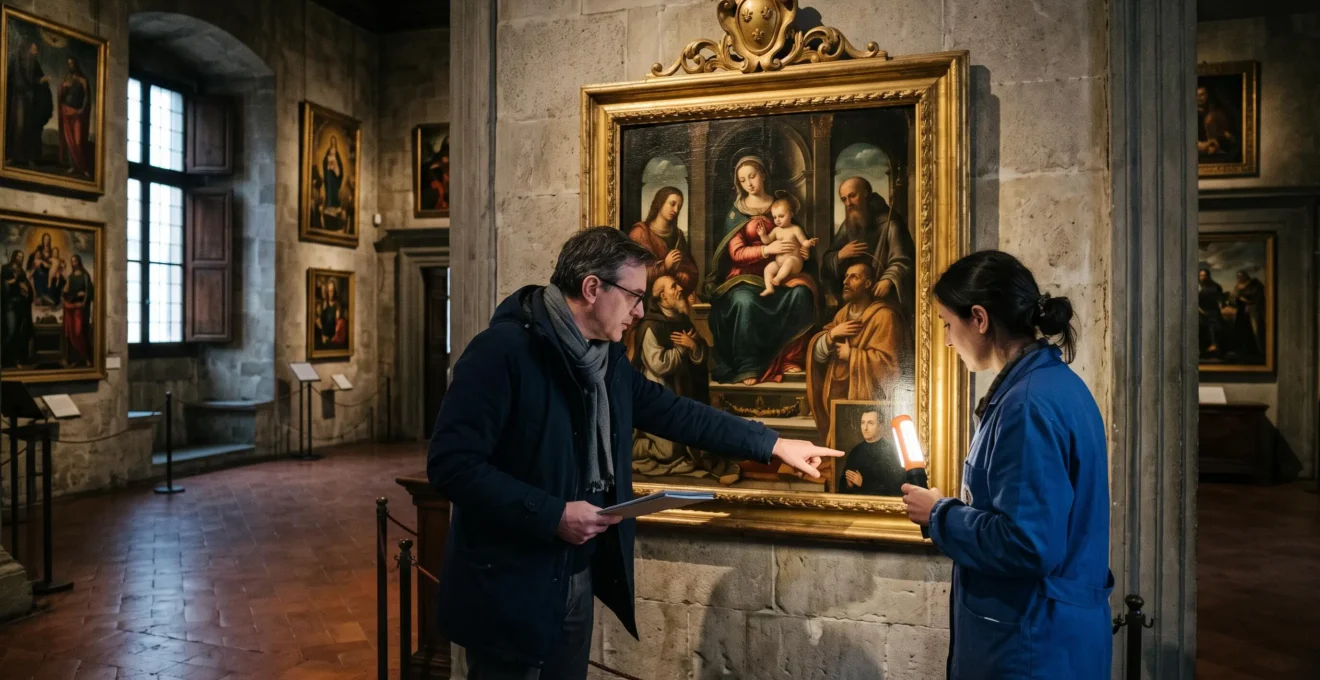
Renaissance artists did not decide independently what the public could see. Their opportunities depended on wealthy patrons, religious institutions, civic authorities and political rulers who financed artworks, approved their subjects and controlled their placement. A painting could be technically accomplished yet rejected because its imagery challenged expectations concerning religious dignity, social hierarchy or dynastic prestige.
Political censorship therefore operated through more than formal prohibitions. Contracts, preparatory drawings, patron approval and access to prestigious spaces shaped artistic decisions before a finished work existed. Artists frequently adapted their representations to institutional expectations while preserving room for innovation within those limits.
The boundaries also shifted with location. A mythological nude might be welcomed in an elite private residence but deemed inappropriate for a church. An unconventional religious painting could attract criticism without producing formal charges of heresy. Royal portraits carried political implications that extended beyond artistic likeness.
Understanding these distinctions reveals a fundamental characteristic of Renaissance visual culture: artistic visibility was negotiated through relationships of power, and those relationships continued to influence later artistic movements.
How political power shaped artistic freedom
- Patronage contracts and institutional approval influenced artistic subjects, compositions and opportunities for public display before paintings were completed.
- Religious authorities, royal courts and private collectors imposed different restrictions; greater freedom in one setting did not guarantee freedom elsewhere.
- Controversies involving Caravaggio, royal portraiture and later avant-garde movements show that artistic innovation developed through continuing negotiations with political authority.
- Why Do So Many Renaissance Artworks Contain Hidden Propaganda for Their Wealthy Patrons?
- How Did Caravaggio Criticise the Church in Altarpieces Without Being Excommunicated?
- Secular Courts vs Church Commissions: Which Patrons Allowed Artists Greater Creative Liberty?
- The Portrait That Destroyed Velázquez’s Rival After He Painted the Wrong Noble Family
- The Revolutionary Moments When Censored Art Suddenly Became Politically Essential
- How Did Futurist Manifestos Use Art Rhetoric to Promote Fascist Political Ideology?
- Why Did Reading Ancient Greek Philosophy Make Artists Stop Painting Only Religious Scenes?
- Why Did Artists Systematically Reject Their Predecessors’ Rules With Each New Movement?
Why Do So Many Renaissance Artworks Contain Hidden Propaganda for Their Wealthy Patrons?
Many Renaissance artworks communicated the status, religious devotion and political legitimacy of their patrons because commissioning an image also meant influencing its content. Donor portraits, heraldic emblems and privileged placement could associate wealthy individuals with sacred authority. However, there is no defensible statistical basis for claiming that 90% of Renaissance artworks contained hidden propaganda.
The relationship between artistic patronage and political communication began long before a painting reached its intended audience. Commissioning agreements could specify dimensions, subject matter, expected imagery and conditions for approval. These provisions were not automatically political censorship, but they established a framework within which an artist’s decisions were evaluated.
According to the Metropolitan Museum of Art‘s research on Renaissance drawings and commissions, legally binding contracts could incorporate preparatory drawings establishing the designs agreed upon by artists and patrons. Models presented for approval further connected artistic experimentation to patron expectations.
Political influence was particularly visible when patrons appeared within religious compositions. A donor kneeling near a sacred figure could communicate personal devotion while simultaneously making wealth and social standing visible to worshippers. Family emblems could strengthen associations between a religious institution and its financial supporters.
These devices did not always constitute propaganda. A donor portrait might satisfy conventional commemorative expectations without advancing a specific political campaign. The distinction depends on how symbolism, placement, patron identity and intended audience interact.
Ambiguity could make political representation more effective. A religious image openly celebrated as an expression of piety might also reinforce the authority of the family financing it. Such overlapping meanings make political interpretation possible without proving that every devotional image concealed a deliberate strategy of manipulation.
How to investigate patron influence in a Renaissance artwork
- Identify the commissioner through a museum catalogue or surviving archival record; produce a documented patron identification.
- Examine contracts, preparatory drawings and approval records where available; create a short inventory of documented artistic requirements.
- Locate donor portraits, heraldic devices and signs of social hierarchy; prepare an annotated image identifying each visible element.
- Establish the original location and intended audience; write a brief account of how display conditions influenced possible interpretations.
- Separate documented evidence from political interpretation; produce a conclusion labeling each claim as confirmed, plausible or unsupported.
There is no reliable universal percentage measuring the prevalence of patron propaganda across Renaissance art. The more productive question is whether particular visual decisions can be connected to identifiable patron interests through documentary and contextual evidence.
Contractual influence provides the first mechanism of artistic control. The next is institutional acceptance: even paintings completed under prestigious patronage could be refused when their representations challenged expectations of religious propriety.
How Did Caravaggio Criticise the Church in Altarpieces Without Being Excommunicated?
Caravaggio challenged conventional religious imagery by portraying sacred figures with the physical presence and recognizable features of ordinary people. Some paintings were rejected, yet controversy over their appearance did not automatically constitute heresy. His career demonstrates how ecclesiastical patrons could resist particular artistic choices while continuing to support an innovative painter. A deliberate campaign of criticism against the Church is not established.
Caravaggio’s naturalism disturbed viewers who expected religious painting to communicate idealized dignity. Rather than separating saints from everyday experience through idealized bodies and settings, he frequently emphasized physical vulnerability, dramatic illumination and recognizable human characteristics.
As the National Gallery‘s biography of Caravaggio explains, the artist used ordinary working people as models for religious figures. His distinctive approach generated criticism while also attracting powerful supporters, including Cardinal Francesco del Monte.
Two disputed paintings illustrate the boundaries of acceptance. The Death of the Virgin encountered rejection in connection with its presentation of Mary’s body, while Madonna dei Palafrenieri was removed from its intended ecclesiastical setting. These episodes show how patron expectations and the suitability of images for particular spaces could determine their fate.
However, neither episode establishes that Caravaggio intended to attack Catholic doctrine. A painting may violate expectations of decorum without making an explicit theological argument.
Rejection, doctrinal condemnation and excommunication were distinct outcomes. Refusal of an altarpiece could result in a lost commission, changed ownership or relocation. Formal religious proceedings involved different institutional mechanisms.
Paolo Veronese provides a useful contrast. In 1573, he was questioned by the Venetian Inquisition about figures and details included in a large painting of a sacred meal. The work became known as The Feast in the House of Levi. His experience demonstrates that ecclesiastical concerns about representation could become matters of formal scrutiny, without making every rejected painting equivalent to an inquisitorial prosecution.
Caravaggio’s escape from Rome in 1606 followed his killing of a man, not a documented excommunication for painting controversial altarpieces. His legal crisis should therefore not be retroactively transformed into evidence of punishment for artistic dissent.
Rejection could also produce an unexpected consequence: a painting might remain in circulation outside its original institutional setting. Controversy did not necessarily eliminate a work’s audience, although evidence is insufficient to treat scandal as a dependable route to commercial success.
His experience shows why censorship should be studied as a sequence of decisions rather than a single prohibition. The authority to commission, approve, reject and display artworks varied between institutions, making the identity of the patron decisive.
Secular Courts vs Church Commissions: Which Patrons Allowed Artists Greater Creative Liberty?
Neither secular courts nor religious institutions consistently offered Renaissance artists greater creative liberty. Church commissions imposed requirements concerning devotional meaning and religious decorum, whereas princely courts prioritized dynastic prestige, political loyalty and diplomatic representation. Private collectors could accommodate subjects unsuitable for public worship, but their preferences also restricted artistic choices. Freedom depended on the commission, audience and patron’s objectives.
The familiar opposition between a restrictive Church and an artistically permissive court overlooks the political interests shared by both. Religious institutions could encourage ambitious visual innovation when imagery served devotional objectives. Secular rulers could impose rigorous controls when art represented royal authority or family legitimacy.
A comparison across patronage environments helps distinguish these pressures.
| Criteria | Ecclesiastical commissions | Princely and royal courts | Civic institutions and private collectors |
|---|---|---|---|
| Subject freedom | Generally aligned with religious purpose and institutional expectations. | Often connected to dynastic narratives, prestige and political interests. | Could include civic, devotional, classical and personal subjects. |
| Treatment of nudity | Evaluated through sacred context, propriety and intended setting. | Could accommodate classical or allegorical nudity within courtly conventions. | Varied substantially according to venue, patron and audience. |
| Political allusion | Could support religious authority and influential institutional patrons. | Often constrained by loyalty, hierarchy and diplomatic sensitivities. | Dependent on civic allegiances and individual patron interests. |
| Consequences of failure | Possible rejection, revision or institutional controversy. | Possible loss of favor, access or future employment. | Possible refusal, financial disagreement or reputational damage. |
These categories describe characteristic pressures rather than fixed legal systems. Renaissance Venice, for example, combined republican civic institutions, aristocratic households, religious commissions and international artistic commerce. Its political arrangements cannot be reduced to a single model of artistic freedom.
Titian’s career is especially revealing. His work for Venetian patrons and powerful European rulers demonstrates how a successful artist could operate across different environments by adjusting subject matter, presentation and symbolic emphasis.
A religious commission required attention to devotional function. A ruler’s portrait emphasized recognizable authority and social position. A mythological painting destined for an elite residence could accommodate a different vocabulary of the body and classical narrative.
Artists often exchanged one set of constraints for another rather than escaping censorship altogether. The ability to move between patrons expanded opportunities, but each commission still involved expectations concerning what could appropriately be represented.
The structural distinction concerned accountability. Ecclesiastical patrons operated within religious institutions and their doctrines, while sovereigns managed dynastic legitimacy, reputation and relationships with political rivals. Both systems could welcome artistic invention when it advanced their interests.
The consequences became especially apparent in court portraiture, where representation served not simply to record appearances but to construct the public identity of political authority.
The Portrait That Destroyed Velázquez’s Rival After He Painted the Wrong Noble Family
The story of a portrait that supposedly destroyed a rival of Diego Velázquez after he depicted the wrong noble family cannot be established from the available evidence. What is documented is the political importance of royal portraiture at the Spanish court. Velázquez’s representations of Philip IV helped construct the monarchy’s official image, illustrating how access to prestigious subjects shaped artistic authority.
Velázquez entered the Spanish court in 1623 and became a painter to Philip IV. His proximity to the monarch gave him opportunities unavailable to many competing artists, including repeated access to the sovereign as a portrait subject.
A royal portrait was not merely a faithful record of physical appearance. Dress, posture, setting and ceremonial attributes established how a ruler should be perceived by courtiers, diplomatic partners and wider audiences.
According to the Metropolitan Museum’s catalogue entry for Velázquez’s Philip IV, formal representations of the Spanish king circulated as official images across Europe and the Americas. The museum explains how these portraits projected an image combining political power and religious devotion.
One particularly useful documentary detail concerns a portrait dated probably 1624. The museum records payment to Velázquez by the courtier Don García Pérez de Araciel for a replica on December 4, 1624.
A documented royal portrait transaction in 1624
The Metropolitan Museum of Art identifies a portrait of Philip IV, dated probably 1624, and records payment for a replica by Don García Pérez de Araciel on December 4 of that year.
The transaction demonstrates that royal portrait copies could circulate through identifiable patronage arrangements. It does not establish a universal prohibition on private ownership, a legally enforceable monopoly over royal likenesses or a rival’s punishment.
This evidence complicates claims that Velázquez alone possessed an absolute right to reproduce the king’s image. His privileged position within the court is historically significant, but exclusivity should not be converted into an undocumented legal restriction.
The alleged professional destruction of an unnamed competitor presents a separate problem. To treat it as historical fact would require identifying the supposed artist, the portrait, the offended family and contemporary records connecting the event to a specific sanction.
No such chain of evidence is established by the available source material. Court rivalry is a plausible subject for historical investigation, but plausibility is not proof.
Royal portraiture nevertheless demonstrates political management of visibility. The selection of an artist, the authorization of a recognizable likeness and its circulation could strengthen a ruler’s public identity.
This resembles later forms of official image management in political purpose, although an analogy does not demonstrate identical regulations or uninterrupted institutional continuity.
Velázquez’s career also belongs primarily to the seventeenth-century Baroque world rather than the Renaissance in its narrower chronological definition. His inclusion is useful because the political mechanisms of elite representation continued beyond conventional period boundaries.
The distinction between legend and archival evidence matters whenever an artist’s reputation becomes entangled with political power. It also prepares a broader question: how does an artwork’s political significance change when the institutions controlling its reception are transformed?
The Revolutionary Moments When Censored Art Suddenly Became Politically Essential
Artworks can move from marginal or controversial positions into official cultural prominence when political authority, public taste and institutional priorities change. A work previously associated with unacceptable beliefs may later serve national prestige or historical identity. Such reversals do not necessarily prove that the artwork itself changed; rather, the institutions interpreting and displaying it acquired different reasons to value it.
Artistic reputations are not fixed at the moment of production. They develop through ownership, exhibition, criticism, preservation and the changing priorities of collectors and institutions.
Sandro Botticelli offers a revealing Renaissance example, although his career should not be simplified into a story of straightforward political censorship followed by rehabilitation.
His mythological paintings are associated with the cultivated environment of Florentine elite patronage. They demonstrate how classical subjects could gain legitimacy within particular social settings while remaining distinct from works intended for religious worship.
Florence’s changing political and religious atmosphere during the period of Girolamo Savonarola subsequently encouraged different attitudes toward luxury, morality and visual culture. Botticelli’s later religious interests have often been interpreted in connection with that environment.
However, it would be inaccurate to claim without specific evidence that his mythological paintings were systematically banned or that a documented political order directly prohibited their display. The relationship between artistic development and ideological change requires examination at the level of individual works.
Botticelli’s later reputation also underwent substantial transformation. His works eventually gained prominent positions within the history and public presentation of Renaissance art, illustrating how institutional valuation can differ dramatically across historical periods.
Three mechanisms help explain such changes in visibility:
- National or civic identification: artworks become valuable because institutions associate them with a celebrated cultural past.
- Diplomatic and institutional prestige: collecting and exhibiting historical works can communicate cultural authority.
- Changing interpretation: imagery once connected with controversial circumstances may acquire meanings less threatening to later audiences.
These are interpretive criteria, not a predictive formula. Their usefulness depends on evidence that a particular institution actively reinterpreted or promoted a work.
A further complication concerns the relationship between preservation and political control. A work may survive because powerful owners protect it, even if its imagery accommodates readings that do not entirely coincide with those owners’ interests.
Later celebration can also diminish historical complexity. When a painting becomes a generalized emblem of national achievement, its original audience, religious tensions and patronage conditions may recede from public interpretation.
The broader lesson is that control over art does not end with its production. Institutions also exercise influence by deciding which works to preserve, promote and interpret—a dynamic that became particularly explicit when modern artistic movements began writing political programs for themselves.
How Did Futurist Manifestos Use Art Rhetoric to Promote Fascist Political Ideology?
Futurist manifestos helped transform artistic innovation into a confrontational political language by celebrating rupture, technological speed, aggression and the rejection of inherited cultural authority. Filippo Tommaso Marinetti‘s rhetoric anticipated themes later associated with Italian Fascism, and his political involvement strengthened those connections. Nevertheless, Futurism began before Fascism became a governing regime, and its participants did not share a single political trajectory.
The relationship between Futurism and political authority represents an important transformation from the patronage systems of the Renaissance.
Where a Renaissance commissioner might establish conditions for an individual work, a modern artistic movement could publicly declare the principles through which society and culture should be reorganized.
Marinetti published the founding Futurist manifesto in February 1909 in the French newspaper Le Figaro. Its international presentation demonstrated how the manifesto could function as more than a statement of aesthetic preferences: it was also an instrument for attracting attention and building a collective identity.
The Metropolitan Museum of Art’s essay on twentieth-century printed art documents this publication and Futurism’s rejection of inherited artistic conventions. It also describes Marinetti’s later experiments with language, including his development of parole in libertà in 1912.
The manifesto’s political significance emerges from its treatment of conflict. Speed, machines and modern urban energy were not simply visual motifs; they became elements in an aggressive vision of historical transformation.
The celebration of violence and war in early Futurist rhetoric created ideological affinities with aspects of the political culture that later accompanied Italian Fascism. Yet ideological affinity should not be mistaken for proof that the 1909 manifesto was created on behalf of Mussolini’s regime, which came to power much later.
Marinetti subsequently aligned himself with Mussolini’s political movement. That relationship provides a concrete historical bridge between Futurist cultural agitation and Fascist politics, while leaving open the different positions taken by individual artists.
Futurism’s relationship with Fascism was negotiated rather than uniform. The movement’s early anti-clerical tendencies, divergent artistic priorities and later accommodation with established institutions created tensions within its political identity.
It is therefore misleading to treat every Futurist as an interchangeable representative of Fascist ideology. Claims that particular artists were persecuted by the regime also require individual documentation rather than generalization from the movement’s internal disagreements.
The comparison with Renaissance censorship reveals a structural reversal. Patronage traditionally offered resources in exchange for influence over representation. Futurist rhetoric showed how artists themselves could actively seek political relevance, contributing artistic language to ideological mobilization.
This did not eliminate external power. It complicated the relationship by making artistic movements potential collaborators in the construction of political authority.
Futurism thus demonstrates that the political shaping of art can originate within artistic institutions as well as outside them. The Renaissance had already provided an earlier example of how new intellectual authorities could challenge established expectations about legitimate subjects.
Why Did Reading Ancient Greek Philosophy Make Artists Stop Painting Only Religious Scenes?
The renewed study of Greek philosophy and classical literature expanded the intellectual resources available to Renaissance patrons and artists, helping legitimize mythological, historical and allegorical subjects. Religious imagery did not disappear, nor had earlier artists painted exclusively sacred scenes. Humanist culture instead strengthened alternative grounds for artistic patronage and made the appropriateness of imagery increasingly dependent on its intended audience and location.
Renaissance humanism involved renewed engagement with classical texts, languages, rhetoric, history and philosophical traditions. These materials circulated through scholars, libraries, educational networks and elite patronage.
The significance for visual culture was not that Greek philosophy directly instructed artists to abandon Christian imagery. Rather, the recovery and interpretation of classical culture offered patrons a larger repertory of stories, virtues and intellectual references through which artworks could communicate meaning.
Mythological painting could demonstrate learning, aesthetic sophistication and social distinction. Classical narratives also provided contexts for representations of the human body that differed from the requirements of devotional imagery.
The distinction between public and private settings was therefore crucial. A painting intended for a cultivated household operated within different conventions from an altarpiece designed for congregational worship.
Consider the difference between a nude figure representing a classical deity in a private mythological composition and a sacred figure represented in a church. The physical body might occupy a central role in both images, yet patrons and audiences could evaluate its appropriateness through different theological, cultural and social expectations.
Humanism diversified artistic authority rather than abolishing censorship. Classical expertise could justify subjects that were not primarily devotional, but wealthy patrons still controlled access to commissions and the spaces in which artworks appeared.
Moreover, Renaissance humanists frequently integrated classical scholarship with Christian commitments. Classical learning and religious patronage were not necessarily opposing systems.
The emergence of alternative subjects therefore reflects an expansion of legitimate artistic possibilities, not a simple liberation from religious authority.
Access to classical culture was itself socially unequal. Education, collecting and patronage concentrated many opportunities among elites, meaning that wider thematic freedom for artists could coexist with continuing dependence on powerful commissioners.
The result was a more complex geography of acceptable images. Artistic meaning depended increasingly on the interaction between subject matter, place, patron and audience.
The expansion of artistic possibilities also altered expectations concerning style and authority. Once established conventions could be questioned, later generations repeatedly redefined which artistic rules deserved to survive.
Key takeaways for interpreting artistic change
- Identify who controlled access to commissions and exhibition spaces before interpreting stylistic innovation as unrestricted artistic freedom.
- Distinguish opposition to inherited aesthetic conventions from opposition to political or religious authority; the two could overlap without being identical.
- Examine what new institutions gained influence after an artistic rebellion succeeded, because innovation could establish fresh systems of approval and exclusion.
Why Did Artists Systematically Reject Their Predecessors’ Rules With Each New Movement?
Artists repeatedly challenged inherited conventions because artistic authority changed alongside patronage, institutional expectations and cultural values. New movements offered alternative ways to represent nature, the body, emotion and modern experience. However, successive movements did not reject every earlier principle systematically. Innovation often involved selective adaptation, and successful rebellions frequently developed conventions and institutions of their own.
The history of European art cannot be explained as a continuous progression toward artistic freedom. Changes in style reflect complex interactions among intellectual developments, technical practices, professional competition and the institutions responsible for commissioning or evaluating artworks.
Renaissance artists drew extensively on classical models while developing new approaches to perspective, anatomy and composition. These innovations became influential conventions rather than permanent guarantees of artistic independence.
Mannerist artists subsequently explored elongated figures, complex spatial relationships and cultivated artifice, often departing from the balanced compositions associated with prominent High Renaissance models.
Baroque painting introduced other possibilities through dramatic lighting, heightened movement and emotional intensity. Yet Baroque art was not simply a revolt against religious authority: numerous ambitious Baroque works were created within ecclesiastical patronage.
The development of artistic academies introduced further mechanisms through which conventions could be taught, formalized and judged. Academic institutions provided professional recognition and training while also establishing standards that later artists challenged.
Avant-garde movements transformed these conflicts into explicit public programs. Manifestos could reject established artistic hierarchies and promote new conceptions of the relationship between art and modern society.
Despite these confrontations, no movement operated independently of audiences, institutions or material support. Exhibition opportunities, critical endorsement, collecting and patronage remained important to artistic careers.
A useful way to interpret these transformations is to distinguish three related forms of authority: the conventions governing artistic production, the institutions controlling access to audiences and the political structures assigning cultural prestige.
A movement might challenge one while reinforcing another. Baroque painters could overturn established compositional expectations while fulfilling religious commissions. Futurists could reject academic traditions while developing political commitments that restricted their conception of legitimate culture.
The central paradox is that successful artistic rebellion can become a new orthodoxy. Once an innovative style receives prestigious commissions, institutional recognition and organized followers, its distinctive practices may become standards against which subsequent artists are judged.
Artistic history consequently records not only a succession of aesthetic breakthroughs but also a recurring redistribution of the authority to define legitimate artistic expression.
This interpretation should not reduce every formal innovation to political resistance. Artists also experiment because of intellectual curiosity, technical discovery, competition and changing ideas about visual representation. Political power matters because it shapes which experiments are financed, displayed, preserved and recognized.
To evaluate an artwork through this framework, begin with its commissioner, intended audience and original setting. Compare those conditions with its imagery and documented reception, then distinguish artistic intention from subsequent interpretation. This method reveals how censorship shaped public visibility without reducing the history of artistic creativity to a simple contest between freedom and repression.
Was Renaissance censorship enforced by one central authority?
No. Artistic control varied across religious institutions, courts, civic governments and individual patrons. These authorities operated through different mechanisms, including contracts, approval processes, institutional preferences and access to exhibition spaces. A work acceptable to one patron might face objections in another setting.
Does a patron’s appearance in a religious painting prove political propaganda?
Not necessarily. Donor portraits could express devotion, commemorate a benefactor or communicate social standing. A political interpretation becomes stronger when the imagery can be connected to documented patron objectives, heraldic symbolism, institutional relationships and the work’s original audience.
What is the difference between artistic censorship and an artwork being rejected?
Rejection means that a commissioner or institution declined to accept or display a work under particular conditions. Censorship involves restrictions on expression or circulation imposed through authority. Rejection may function as a form of artistic control, but it does not automatically demonstrate a legal prohibition, doctrinal condemnation or systematic censorship policy.
Why were some mythological paintings acceptable in private residences but controversial in churches?
Different spaces carried different expectations. Elite private residences could provide contexts for classical mythology, allegory and representations of nudity, while church commissions were evaluated according to devotional purpose and religious decorum. The acceptability of an image therefore depended partly on its intended setting and audience.
Can historical art reveal censorship when no formal ban survives?
Yes, although conclusions must remain proportionate to the evidence. Commission agreements, rejected designs, revisions, correspondence and documented display arrangements may reveal restrictions on artistic choices. These materials help reconstruct the pressures surrounding production without requiring every limitation to have taken the form of a formal prohibition.