
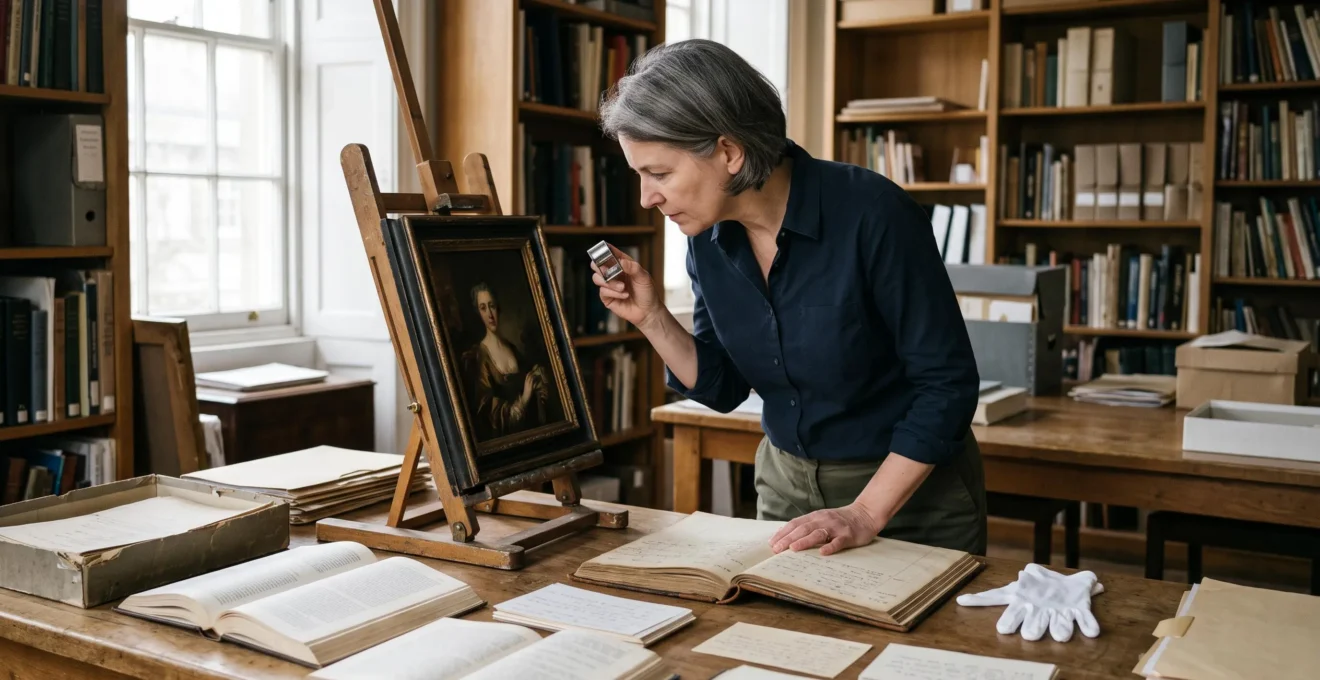
A previously undocumented painting, an exhaustive provenance reconstruction or years of archival investigation can represent substantial scholarly labour without necessarily producing a publishable journal article. The decisive distinction is between establishing information about an artwork and demonstrating how that information changes art historical understanding.
Leading academic journals assess originality in relation to disciplinary significance. A strong submission identifies an unresolved question, establishes what existing scholarship has argued, presents evidence that supports a defensible claim, and explains why that claim matters beyond the immediate object or archive. Originality may involve newly discovered material, a persuasive reinterpretation of familiar evidence, or a methodological intervention.
These standards apply to doctoral researchers, independent scholars and museum curators alike, although their access to evidence and publication opportunities differs. Understanding where documentation ends and scholarly argument begins allows researchers to choose viable questions, match manuscripts to appropriate journals and avoid investing years in projects whose contribution cannot be convincingly articulated.
What makes art historical scholarship publishable?
- Originality requires an argument: new evidence becomes journal-worthy when it advances a question that matters to an identifiable scholarly audience.
- Significance determines scope: a highly specialised study can succeed when its findings change a broader historical, interpretive or methodological understanding.
- Publication begins before writing: historiographical verification, evidence assessment and journal selection should shape the research project from its earliest stages.
- Why Do Detailed Catalogue Descriptions Fail to Qualify as Academic Research?
- How Do You Identify Art Historical Questions That Haven’t Already Been Answered?
- New Evidence vs New Interpretation: Which Research Approach Gets Published Faster?
- The Microscopic Thesis: When Hyper-Specific Research Becomes Unpublishable
- The Pivot Point: When to Commit Years to a Research Question Versus Cutting Losses
- How Do You Find Art Historical Niches With Enough Depth for a 30-Year Career?
- Why Do Researchers Without University Access Remain Locked Out of Art Historical Databases?
- How Do Specialist Curators Become Recognised Authorities on Obscure Artistic Subfields?
Why Do Detailed Catalogue Descriptions Fail to Qualify as Academic Research?
Detailed catalogue descriptions may fall short of research-journal expectations because comprehensive documentation does not automatically establish an original scholarly argument. Recording an artwork’s materials, attribution, provenance and exhibition history produces valuable knowledge, but a research article must explain how that evidence answers an unresolved question and changes an existing interpretation. The distinction concerns intellectual contribution rather than documentation quality.
Consider a carefully researched catalogue entry identifying successive owners of an eighteenth-century portrait, examining its condition and reconstructing its attribution history. These findings may establish a more reliable object record. They do not, by themselves, demonstrate why the portrait matters to a larger art historical debate.
The same evidence can acquire argumentative significance when connected to a question about workshop organisation, collecting practices or the circulation of artistic models. For example, a hypothetical provenance discovery might demonstrate that a painting entered a particular collection earlier than previously believed, challenging an established account of how an artistic style spread between regions.
The central editorial question is therefore what changes because the evidence exists?
The journal Art History explicitly identifies original, discipline-advancing research as part of its editorial scope. Its official author guidelines for Art History describe an initial editorial assessment before manuscripts proceed, where appropriate, to double-anonymised peer review. Research essays are expected to fall between 8,000 words and 12,000 words, including notes.
These are that journal’s stated requirements, not universal rules governing every leading art history publication. Nevertheless, they illustrate why a technically accomplished description can be unsuitable for a journal seeking a contribution to historical or methodological debate.
Documentation also has legitimate scholarly destinations. Museum collection catalogues, object-focused publications and specialist bulletins can accommodate work whose principal achievement is a reliable record. The Getty Foundation‘s Online Scholarly Catalogue Initiative, conducted between 2009 and 2017, supported eight museums in producing digital scholarly collection catalogues.
Documented example: scholarly catalogues as research publications
The Getty Foundation supported museums in developing digital collection catalogues that brought detailed object research into accessible scholarly formats.
According to Getty’s account, participating catalogues were used in research and teaching, and some received attention in professional journals. This demonstrates the scholarly value of collection catalogues without establishing that descriptive entries automatically satisfy research-journal acceptance criteria.
The distinction is not a hierarchy in which cataloguing is intellectually inferior. It is a difference between publication purposes: documentation establishes what can be known about an object, while an argumentative article uses that knowledge to revise, complicate or explain an art historical problem.
Once a defensible contribution is identified, the next difficulty is establishing that the question has not already been answered somewhere in the scholarly record.
How Do You Identify Art Historical Questions That Haven’t Already Been Answered?
Unanswered art historical questions emerge through systematic historiographical investigation rather than simply selecting an understudied artist or object. Researchers should compare established interpretations, identify unsupported assumptions, investigate acknowledged disputes and search beyond published journal articles. A question becomes a credible research opportunity only when its unresolved status and potential significance have both been examined.
Begin with recent surveys, review essays and major studies of the relevant subfield. Instead of compiling a conventional bibliography alone, construct a historiographical problem map: a record of established claims, the evidence supporting them and the questions those claims leave unresolved.
Pay particular attention to three types of gaps:
- Evidentiary gaps: a widely repeated attribution, date or account of artistic influence rests on limited or unexamined material.
- Interpretive disagreements: specialists accept the same evidence but disagree about its historical meaning.
- Structural omissions: an apparently settled narrative depends disproportionately on particular archives, regions, institutions or categories of objects.
Footnotes can reveal productive uncertainty. Expressions such as « further research is needed », qualified dating proposals or references to inaccessible archives may identify promising leads. Such statements are not proof that a project is original: they document uncertainty at the time of writing and must be checked against subsequent scholarship.
Verification must extend into less visible scholarly literature. Doctoral dissertations, specialist exhibition catalogues, auction essays and recent conference programmes may contain findings that have never appeared in widely indexed journal articles.
The ProQuest Dissertations & Theses Global database is particularly relevant because it indexes postgraduate research from universities internationally. Its provider describes a collection exceeding six million metadata records and four million full-text documents. These provider-reported figures describe the resource’s scale, not comprehensive coverage of every completed dissertation.
For UK-related research, EThOS may also be relevant, subject to its current service availability and coverage. No single thesis database can establish that a question is definitively unanswered.
Five actions for validating an original research question
- Identify five influential interpretations of the problem and produce a one-page comparison of their claims and supporting evidence.
- Record unresolved statements, conflicting attributions and disputed chronologies in a research-gap table with exact references.
- Search dissertations, exhibition publications and conference records; create a dated search log containing keywords, databases and relevant findings.
- Write a provisional originality statement specifying the prior interpretation, its limitation and the proposed contribution in no more than 150 words.
- Test the question against the strongest competing explanation and produce a brief evidence-and-objections memorandum.
For instance, a hypothetical researcher studying an overlooked regional sculptor might discover that the artist’s biography has been thoroughly documented but that the workshop’s material practices remain poorly understood. The original question concerns the historical implications of those practices, not the artist’s obscurity.
Once an unresolved question has survived that scrutiny, the researcher must determine whether discovering new material, reinterpreting existing material or combining both offers the strongest route to publication.
New Evidence vs New Interpretation: Which Research Approach Gets Published Faster?
Neither new evidence nor new interpretation can be shown to produce faster publication across leading art history journals on the evidence available here. Newly discovered material may offer a readily verifiable contribution, while reinterpretation may avoid lengthy archival discovery but demand more extensive historiographical argument. The more useful distinction concerns research risk, evidentiary strength and disciplinary payoff rather than presumed acceptance speed.
An archival discovery might include a dated payment record, an unpublished inventory or documentation connecting an artwork to a previously unidentified patron. Such material may help establish a concrete change in the historical record.
Its existence, however, does not settle its significance. An unfamiliar document can confirm something already generally accepted or introduce an isolated fact with little bearing on established arguments.
Conversely, a reinterpretation can work entirely with familiar images and texts. Its originality lies in demonstrating that the accepted explanation does not adequately account for the available evidence, or that a different conceptual framework reveals historical relationships previously overlooked.
This approach requires sustained engagement with competing interpretations. A claim cannot establish originality merely by presenting a novel perspective without explaining why that perspective is historically justified.
The practical differences become clearer when the two approaches are compared.
| Assessment criterion | New evidence | New interpretation |
|---|---|---|
| Primary contribution | Previously unknown or insufficiently examined material | A revised explanation of known material |
| Principal research burden | Authenticity, dating, provenance, context and relevance | Historiography, analytical consistency and evidentiary persuasion |
| Typical vulnerability | A genuine discovery with limited interpretive importance | An innovative reading inadequately supported by evidence |
| Critical editorial question | What does this discovery change? | Why is the established interpretation insufficient? |
| Publication speed | No general comparative advantage established | No general comparative advantage established |
A hybrid strategy can be especially persuasive when feasible: a new piece of evidence provides a checkable foundation for an interpretive revision. This is a research-design recommendation, not a demonstrated formula for faster editorial acceptance.
Consider a hypothetical newly identified workshop account that contradicts a conventional division of labour between a master and assistants. The archival material supplies new evidence, while the resulting argument concerns artistic authorship and workshop organisation more broadly.
For reinterpretation without new archival discoveries, viability depends on whether the dominant reading has sufficient historiographical importance and whether the proposed alternative explains meaningful evidence better. The researcher must confront the strongest existing objections, not merely the weakest versions of prevailing scholarship.
A manuscript’s progress also depends on journal-specific review procedures, the manuscript’s readiness and the revisions requested. The available editorial guidance provides no empirical comparison of turnaround times by research approach.
Even a compelling discovery or reinterpretation may encounter another obstacle: the subject is so narrowly framed that its significance remains invisible to readers outside a tiny specialist community.
The Microscopic Thesis: When Hyper-Specific Research Becomes Unpublishable
Hyper-specific art historical research becomes difficult to publish in broad disciplinary journals when its findings concern only an isolated object, artist or commission without illuminating a wider problem. Narrowness alone is not disqualifying. A study of a single document or artwork can be consequential when that evidence changes an established chronology, attribution, historical explanation or methodological assumption.
The decisive variable is the relationship between specificity and significance. A tightly bounded case may be the most rigorous way to investigate a large question, while a survey covering centuries of artistic production may offer little original insight.
Imagine two hypothetical manuscripts studying an otherwise obscure seventeenth-century painter.
The first reconstructs the painter’s limited surviving oeuvre, documents several works and corrects minor biographical details. These achievements may be valuable, particularly for a specialist catalogue, but the manuscript does not explain why its findings should matter to a broader journal readership.
The second uses a securely dated commission to challenge an accepted chronology of artistic exchange between two regions. Although its evidentiary foundation is narrow, the consequences extend to the study of transmission, patronage and stylistic development.
The second project has a clearer argument for wider publication because a specialist finding changes the interpretation of a recognised historical problem. This illustrates possible disciplinary significance; it does not guarantee acceptance.
A practical scaling test asks researchers to finish three statements:
- This finding changes or complicates the existing understanding of…
- Scholars working beyond this particular artist or object should care because…
- If the evidence is accepted, a broader historical or methodological claim must be reconsidered because…
If none can be answered without inventing significance, the original subject may be more appropriate for a specialist bulletin, collection publication or documentary edition.
There is also an important difference between a research question that is narrow and a manuscript whose audience is narrow. Specialists may be essential to evaluating evidence, but the argument can still engage wider debates about artistic labour, ownership, gender, colonial collecting, materiality or institutional history.
Editorial scope matters. A highly specialised publication may welcome detailed findings that a generalist journal considers outside its remit. A rejection based on fit does not establish that the research itself is worthless.
When repeated attempts to establish wider significance fail, the issue may no longer be manuscript presentation but the viability of the research question itself.
The Pivot Point: When to Commit Years to a Research Question Versus Cutting Losses
Researchers should continue investing in an art historical question when its unresolved importance remains demonstrable and the principal obstacles have plausible solutions. They should consider reframing or abandoning the original argument when new evidence shows that the question has already been resolved, cannot be meaningfully tested or offers no significant contribution. The decision should depend on prospective research value, not time already invested.
Art historical projects accumulate specialised investments: languages learned, archives mastered, objects examined and relationships established with custodians or collections. These assets can be valuable independently of a particular thesis, but they can also encourage researchers to defend an increasingly untenable question.
The first task is to distinguish evidentiary barriers from structural barriers.
Evidentiary barriers include temporarily closed archives, restricted photography, unavailable conservation documentation or delays in accessing privately held works. Such obstacles may justify revising the schedule, changing methods or identifying alternative evidence.
Structural barriers are more serious. A research claim may already have been demonstrated elsewhere, the surviving material may be insufficient to distinguish competing explanations, or the proposed conclusion may have negligible significance beyond an isolated case.
A project facing an evidentiary barrier can remain intellectually worthwhile. A structurally exhausted question generally requires reformulation rather than greater persistence.
Periodic reviews can prevent sunk costs from controlling the decision. A practical approach is to reassess the project after a substantial archival phase, a comprehensive historiographical review or the completion of a draft argument.
At each checkpoint, record what has changed since the previous assessment: which claims remain defensible, which potential discoveries have been ruled out and which additional evidence could realistically alter the conclusion.
Three possible decisions follow:
- Continue: the question remains open, consequential and reasonably answerable with accessible evidence.
- Reframe: the original hypothesis weakens, but the material supports a different historical or methodological question.
- Redirect publication: the argumentative project is no longer viable, but the documentation deserves preservation in a catalogue, specialist bulletin or archival publication.
A hypothetical researcher who fails to establish a proposed attribution might still publish a methodological analysis of the evidentiary limitations that make attribution difficult. The value lies in formulating a new defensible contribution, not in treating unsuccessful research as automatically publishable.
The capacity to redirect research productively becomes especially important when choosing a specialism intended to support multiple publications and an extended academic or curatorial career.
How Do You Find Art Historical Niches With Enough Depth for a 30-Year Career?
An art historical niche has long-term research potential when it contains several independently productive questions, a substantial and accessible body of evidence, and connections to broader disciplinary debates. The fame of its artists matters less than the depth and diversity of its archives, objects, interpretive problems and scholarly networks. No niche can guarantee a 30-year career or sustained employment.
The most productive way to assess a specialty is to examine its research infrastructure rather than its apparent novelty.
An obscure artistic tradition may preserve workshop accounts, correspondence, surviving objects, collectors’ inventories, technical evidence and later reception histories. These different evidentiary strands can support distinct studies without repeatedly making the same argument.
By contrast, an internationally familiar artist might constitute a difficult research territory if essential documentation is inaccessible or the surviving evidence cannot sustain meaningful new questions.
A preliminary niche audit should investigate:
- Evidence diversity: whether objects, archival records, images, material analysis and published histories permit different forms of investigation.
- Question diversity: whether attribution, patronage, artistic labour, reception, collecting, circulation and material history offer separate lines of inquiry.
- Research access: whether relevant institutions and collection holders provide workable conditions for examination and documentation.
- Scholarly connections: whether findings can contribute to larger methodological and historical conversations.
- Publication opportunities: whether appropriate journals, museums, edited volumes and other scholarly outlets exist for different kinds of output.
A particularly important warning concerns deep but effectively closed fields. A body of privately held works can appear rich in research opportunities while offering no reliable access arrangements. Similarly, poorly resolved ownership or restrictions on documentation may make essential claims difficult to verify.
Researchers should also avoid assuming that narrow expertise necessarily leads to institutional recognition or employment. University appointments and museum positions depend on factors beyond scholarly output, including available posts, teaching requirements, institutional priorities and professional experience.
One strategic response is to combine a clearly defined object-based specialism with a broader methodological identity. A researcher of a little-studied school of sculpture might also contribute to material history, the history of collecting or debates about workshop practice.
This creates several potential audiences without sacrificing depth. The specialist remains identifiable through sustained expertise, while individual publications address questions relevant beyond the immediate corpus.
Whether that research potential can be realised depends partly on an issue that is easy to underestimate: continued access to the scholarly literature and the institutions that hold it.
Why Do Researchers Without University Access Remain Locked Out of Art Historical Databases?
Independent art historians face restricted access because many scholarly databases, journal collections and image resources operate through institutional subscriptions or licensing agreements. Free discovery tools and limited individual-access services can reduce these barriers but do not provide equivalent access to every publication. The resulting challenge is maintaining comprehensive, verifiable historiographical research without dependable university credentials.
Access restrictions operate at several levels. A database may allow public searching while reserving full texts for subscribing institutions. An image collection may display records but restrict high-resolution reproductions. A research library may admit external readers while limiting borrowing or access to particular electronic resources.
These distinctions matter because discovering that scholarship exists is not the same as being able to examine its evidence and arguments.
JSTOR provides a useful example. Its official instructions for free personal access describe registration using an email address and online reading of up to 10 eligible articles every 30 days. This is not unrestricted access to the entire platform, and online reading should not be confused with unlimited PDF downloading.
Independent researchers can nevertheless develop a layered access strategy rather than relying on a single institutional subscription.
- Search openly available metadata, institutional repositories and legitimate open-access versions of relevant research.
- Investigate public-library interlibrary loan services and document delivery, checking the eligibility, costs and borrowing arrangements applicable in the researcher’s country.
- Ask former universities whether alumni privileges include on-site reference access or selected electronic resources; such benefits are institution-specific.
- Consult national and specialist research libraries, including the British Library, the Library of Congress and museum research libraries, after checking current registration and reader-access conditions.
- Contact authors or relevant research institutions when an essential publication cannot otherwise be obtained through authorised channels.
The consequences of incomplete access are scholarly as well as practical. Missing a relevant dissertation or recent article may lead a researcher to describe an argument as original when it has already appeared elsewhere. Inability to consult full texts may also prevent accurate verification of quotations, references or interpretive context.
These are identifiable methodological risks, although the available sources do not quantify their effects on peer-review outcomes.
A documented search protocol can help establish rigour. Record consulted catalogues, access dates, search terms, bibliographic leads and publications that could not be inspected. Clearly distinguish materials read in full from works known only through citations or abstracts.
Such transparency does not eliminate informational inequality. It does, however, make the limits of a literature review visible and reduces the temptation to claim comprehensive coverage that the evidence cannot justify.
Researchers working in museums may have a different advantage: substantial direct access to collections and institutional documentation, although this access must still be converted into a recognisable scholarly contribution.
Key considerations before establishing curatorial authority
- Access to objects creates research opportunities, but recognition depends on what can be demonstrated through that access.
- Collection publications and exhibitions can build a cumulative scholarly record when they articulate evidence-based interpretations.
- A specialist’s long-term credibility strengthens when detailed object knowledge contributes to debates beyond the immediate collection.
How Do Specialist Curators Become Recognised Authorities on Obscure Artistic Subfields?
Specialist curators can establish scholarly authority by turning sustained collection expertise into verifiable, citable contributions that other researchers can use and critically assess. Exhibitions, collection catalogues, technical studies and journal articles provide complementary publication routes. Recognition develops when first-hand knowledge of objects is connected to consequential research questions and demonstrated engagement with existing historiography.
Curatorial practice can provide forms of evidence that are difficult to reconstruct from published reproductions alone. Direct examination may reveal inscriptions, construction techniques, alterations, workshop marks or physical relationships between objects that have not been adequately documented.
Institutional records can offer further opportunities through acquisition files, historical inventories, conservation histories and correspondence. Access to these sources, however, does not automatically confer authority over their interpretation.
The distinction between expertise and recognised scholarship is especially important in obscure subfields. A curator may know more about a particular corpus than almost anyone else, yet that knowledge becomes useful to the wider discipline only when it is communicated through accessible documentation and defensible arguments.
An exhibition can itself advance an art historical interpretation through the selection, comparison and contextualisation of objects. Its accompanying catalogue can make that interpretation explicit, supplying the research apparatus required for subsequent scholarly discussion.
A productive publication sequence might begin with a documented collection entry, develop through a thematic exhibition essay and culminate in a journal article addressing a wider historical question. This is a possible progression rather than a formal requirement or guaranteed career pathway.
For example, a curator studying a little-known group of carved devotional objects might first establish their material characteristics and collection histories. A subsequent publication could investigate relationships between production techniques, religious patronage and regional workshop organisation.
The resulting journal article would not need to repeat every catalogue description. It would select the most consequential evidence and explain what that material changes in the understanding of artistic production.
Academic credibility also requires engagement with interpretive frameworks. Curators should situate their findings within established historiographical debates, explain relevant methodologies and acknowledge alternative interpretations.
Collaboration with university-based researchers can be valuable where complementary expertise genuinely improves the argument, particularly in technically complex or interdisciplinary projects. Co-authorship should reflect substantive intellectual contribution rather than serve merely as an institutional credential.
There is no basis in the supplied evidence for claiming that museum curators systematically encounter greater theoretical prejudice in peer review than university academics. The defensible practical point is that manuscripts from any professional setting should make their conceptual contribution intelligible to the journal’s readership.
Ultimately, recognised authority rests on sustained scholarly usefulness: dependable evidence, transparent methods, arguments that withstand scrutiny and publications that enable other researchers to build upon the findings.
A practical next step is to select one existing catalogue entry or collection-based finding and draft a short research proposition identifying the unresolved question, the strongest evidence, the competing interpretation and the disciplinary consequence. If that proposition is persuasive, it can form the foundation of a publication-oriented manuscript.
Can a PhD dissertation chapter be submitted as a journal article?
A dissertation chapter can provide the basis for a journal article, but it normally requires adaptation into a self-contained argument suited to the journal’s readership, scope and word limits. Authors should check originality and disclosure requirements carefully. For example, Art History requires disclosure of relevant dissertations, preprints and previously published material containing substantially similar content, together with an explanation of the manuscript’s distinct contribution.
Does an art history article need newly discovered archival material?
No. Originality can arise through a well-supported reinterpretation of known objects, texts or historical relationships. The manuscript must show how its interpretation differs from established scholarship, why that difference matters and how the evidence supports the proposed revision. New archival evidence is one route to originality, not an established universal prerequisite.
Can an independent researcher publish in a leading art history journal?
Yes. University employment is not necessarily a submission requirement. Art History, for example, welcomes researchers regardless of career stage or location. Independent researchers must still satisfy the journal’s scholarly, ethical and editorial expectations. Limited access to subscription literature makes comprehensive bibliographic checking and transparent source documentation particularly important.
Should a researcher contact a journal editor before submitting a highly specialised article?
A concise presubmission enquiry may be useful when the journal explicitly welcomes such enquiries or its scope leaves genuine uncertainty about suitability. It should identify the manuscript’s question, central claim, evidence and broader disciplinary contribution. Authors should follow the journal’s stated procedures; an encouraging response is not a promise of editorial review or acceptance.
Does rejection mean an art historical research question lacks originality?
Not necessarily. A manuscript may be declined because of journal fit, inadequate demonstration of significance, unresolved evidentiary problems or weaknesses in argumentation. Researchers should distinguish criticism of the central contribution from concerns that could be resolved through reframing, additional research or submission to a more specialised outlet. Rejection alone does not establish that the underlying research has no scholarly value.