
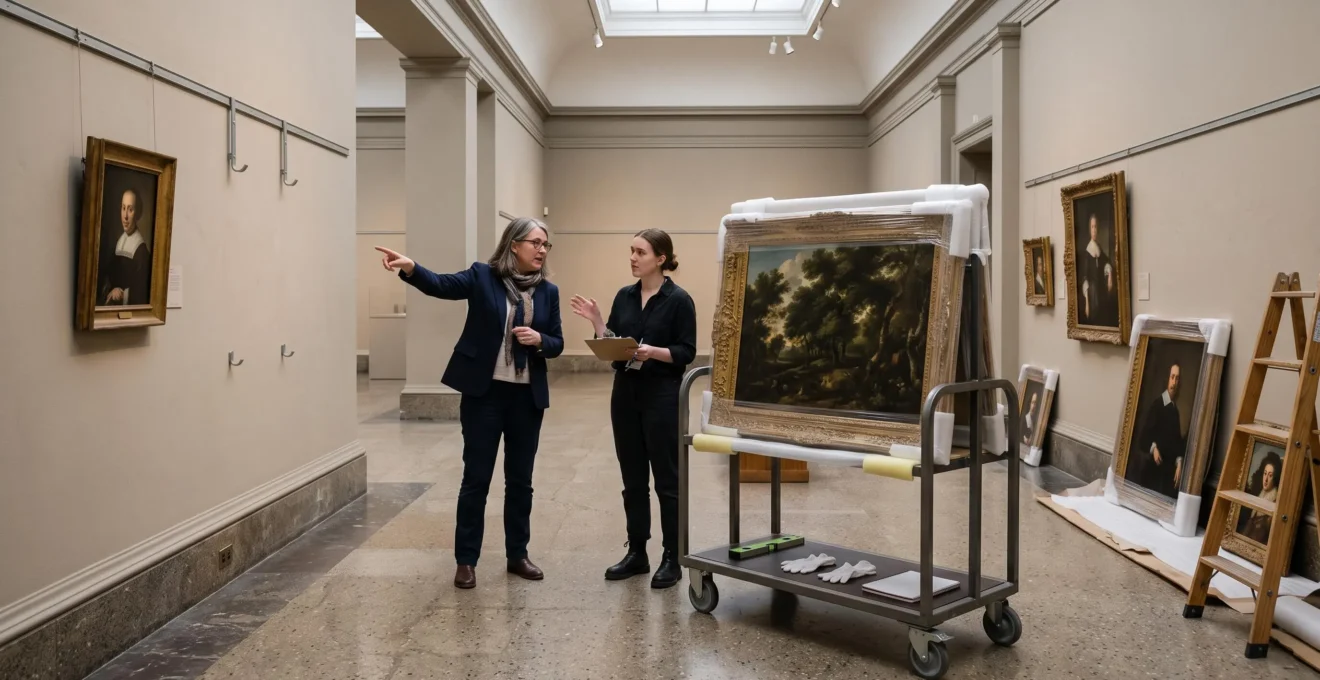
An exhibition becomes intellectually compelling when its artworks do more than illustrate a subject. They advance an argument that visitors can examine, question, and potentially carry into their encounters with art elsewhere.
The distinction is fundamental. An exhibition about artistic innovation might gather important experimental works. An exhibition arguing that innovation emerges through the reinterpretation of existing conventions must demonstrate that relationship through the selection, juxtaposition, and sequencing of particular objects. Each gallery becomes part of a developing proposition rather than another installment in a catalogue.
For museum educators, independent curators, and gallery directors, this approach changes practical decisions. Artwork selection becomes a question of evidentiary necessity. Gallery planning becomes intellectual sequencing. Interpretation becomes an invitation to test claims against visible objects.
Such exhibitions do not need to force visitors toward a predetermined conclusion. Their achievement lies in making relationships sufficiently legible and consequential that visitors can construct informed interpretations of their own. A compelling narrative changes how art can be seen by making previously unnoticed connections available for examination.
What makes an exhibition argument compelling?
- Build a proposition, not just a collection: establish what the exhibition argues and why its selected artworks are necessary.
- Sequence intellectual discoveries: organize galleries so that encounters develop, complicate, or challenge the central claim.
- Test interpretation against evidence: assess object relevance, visitor understanding, and practical constraints without confusing attention with lasting impact.
- How Do Top Curators Transform Random Artworks Into Exhibitions That Visitors Remember for Years?
- Why Do Thematic Groupings Feel Shallow Compared to Exhibitions With Clear Arguments?
- Why Do Visitors Skip Chronological Galleries but Linger in Argument-Driven Rooms?
- How Do You Choose Which 30 Objects From 500 Candidates Best Prove Your Thesis?
- Historical Timeline vs Idea Clusters: Which Exhibition Structure Delivers Stronger Arguments?
- The Overstretched Thesis: When Exhibitions Include Objects That Contradict Their Own Argument
- The Flexibility Point: When to Adapt Your Thesis Versus Waiting for Ideal Loans
- Why Do Museums Hire Unknown Specialists Over Famous Generalists for Major Exhibitions?
How Do Top Curators Transform Random Artworks Into Exhibitions That Visitors Remember for Years?
Curators create potentially memorable exhibitions by turning a collection of objects into a sequence of meaningful encounters. A concise intellectual proposition guides the selection, placement, and interpretation of artworks, while the gallery sequence allows visitors to discover its implications. Lasting memory is a possible outcome of this approach, not a guaranteed result of thesis-driven design.
The decisive curatorial question is not simply what the institution can exhibit. It is what visitors should understand differently after encountering these particular works together.
A hypothetical exhibition on portraiture demonstrates the difference. An object-led presentation might assemble distinguished portraits from several periods. An argument-led exhibition could instead propose that portraits construct social authority as much as they record personal appearance. Clothing, posture, scale, patronage, and the treatment of the sitter would become evidence.
Such a proposition also changes the planning process. A portrait that contributes nothing beyond stylistic variety becomes less necessary, even if it is historically significant.
Tom Klobe‘s discussion in the American Alliance of Museums‘ article on exhibition concept planning establishes the importance of a coherent interpretive framework for determining an exhibition’s meaning and guiding object selection. The framework can evolve as curatorial research reveals unexpected relationships.
The physical sequence should create intellectual progression. An opening gallery might establish an apparently stable convention. A subsequent gallery introduces works that expose its limitations. A pivotal encounter then reveals an unexpected relationship, requiring visitors to reconsider their initial assumptions.
This designed moment of reconsideration can become a candidate for a memorable experience. Nevertheless, a curator cannot infer long-term retention solely from an effective installation or an enthusiastic immediate response.
A useful evaluation is to ask exiting visitors to explain the exhibition’s central proposition in their own words, without repeating its title. Their responses reveal whether the argument has become intelligible and whether they can connect it to actual artworks. Follow-up interviews would be needed to investigate longer-term retention.
High-profile exhibitions at institutions such as the British Museum or MoMA should therefore be assessed by the relationships they establish, not merely by the fame of their objects. The available evidence does not support a general claim about critical divisions surrounding blockbuster exhibitions at either institution.
Once that intellectual purpose is established, the next difficulty is distinguishing a genuinely arguable proposition from a broad theme that could accommodate almost anything.
Why Do Thematic Groupings Feel Shallow Compared to Exhibitions With Clear Arguments?
Thematic groupings can feel superficial when their organizing idea identifies a shared subject without explaining a meaningful relationship between artworks. A theme such as identity or nature establishes relevance; a thesis proposes something specific that viewers can evaluate. The distinction matters because an argument makes particular objects necessary, whereas a broad category often leaves them interchangeable.
Consider the theme of power. It might accommodate royal portraits, political posters, religious architecture, and contemporary photography without establishing what these objects collectively demonstrate.
A curatorial thesis could instead propose that images of authority become most revealing when their visual conventions are challenged. Now the selection process changes: the strongest artworks are those that expose, reinforce, or destabilize established representations of power.
Thematic organization is not inherently weak. It becomes weak when the theme substitutes for interpretation. A focused thematic exhibition may be intellectually rigorous if its groupings produce comparisons that alter how each object is understood.
Turning a theme into an argument requires three connected decisions:
- Formulate a proposition: replace a subject label with a statement that can plausibly be disputed.
- Identify visible evidence: determine which formal, material, historical, or contextual features could support that proposition.
- Introduce meaningful resistance: seek objects that complicate the claim or expose its boundaries.
For example, an exhibition on landscape painting might assert that landscape images helped redefine relationships between property, environment, and cultural identity. Some works could demonstrate territorial possession, others idealized belonging, and others a challenge to those established assumptions.
The artworks would not simply share the subject of landscape. They would illuminate different consequences of representing land.
A practical diagnostic is the substitution test. If another visually similar artwork could replace a selected object without changing the exhibition’s argument, its precise role deserves reconsideration. Interchangeability is not automatically disqualifying, but widespread interchangeability suggests an underdeveloped thesis.
The distinction becomes especially consequential when the proposed narrative must be translated into spatial organization and sustained through the visitor’s physical movement.
Why Do Visitors Skip Chronological Galleries but Linger in Argument-Driven Rooms?
There is no established universal finding that visitors routinely skip chronological galleries or spend longer in argument-driven rooms. Visitor attention depends on exhibition design, content, individual interests, and visiting conditions. Chronology can provide essential historical orientation, while an explicit curatorial question can help visitors recognize why particular artworks deserve comparison and sustained attention.
The real issue is not chronology itself, but how much interpretive work visitors are expected to perform without guidance.
A purely chronological arrangement may tell visitors what happened first, next, and later without establishing why those developments matter. Visitors must construct a meaningful relationship from the sequence.
By contrast, a gallery organized around a precise question can make the purpose of comparison apparent. Visitors might encounter different solutions to the same artistic problem, or several competing interpretations of a historical event.
These are interpretive possibilities rather than demonstrated guarantees of longer engagement.
108 exhibitions
Beverly Serrell’s comparative research examined how visitors allocated time and attention across 108 museum exhibitions. The research introduced observational measures of movement and stopping behavior, but did not establish that thesis-driven galleries outperform chronological ones.
Beverly Serrell’s study of visitor attention across 108 museum exhibitions, published in Curator: The Museum Journal, 1997.
Serrell’s research offers a methodological lesson: gallery engagement should be observed rather than assumed. Movement patterns and stopping behavior provide useful information, but they cannot independently establish comprehension, intellectual transformation, or long-term memory.
Museums can evaluate the effectiveness of a chronological or conceptual arrangement through a locally designed visitor study.
- Record which gallery elements visitors approach, pause at, or bypass.
- Observe where visitors return to earlier artworks or reconsider previous displays.
- Ask visitors to explain relationships between selected objects.
- Compare intended interpretation with what visitors report understanding.
These findings can inform a revision. A gallery with little engagement may need a clearer opening question, a stronger juxtaposition, or fewer competing interpretive demands rather than simply more descriptive labels.
A well-designed chronological exhibition can also be argument-driven. Each period can address a specific artistic problem, while the overall sequence demonstrates how that problem changed over time.
Understanding where visitors engage is only one part of the problem. The deeper curatorial challenge is deciding which works deserve space in the first place.
How Do You Choose Which 30 Objects From 500 Candidates Best Prove Your Thesis?
Choosing 30 artworks from 500 candidates requires identifying the objects that make an exhibition’s argument possible, distinctive, and practically achievable. Evaluate each candidate for argumentative necessity, contribution beyond other selected works, and feasibility. Begin with indispensable objects, identify missing components of the argument, and select additional works to close those gaps rather than simply rewarding reputation or visual appeal.
A large candidate list encourages accumulation. It can also disguise the fact that several impressive artworks perform precisely the same intellectual function.
The challenge is to build a sequence of complementary evidence, not a ranking of the most attractive objects.
Consider a hypothetical exhibition arguing that artists transformed industrial materials into critiques of industrial society. Among 500 candidates, many could demonstrate the use of metal, machinery, or manufactured components. Far fewer might show a specific relationship between material choice and social criticism.
A useful selection framework distinguishes three criteria:
| Criterion | Curatorial question | Evidence to document |
|---|---|---|
| Argumentative necessity | What claim becomes harder to support if this work is removed? | Specific contribution to an exhibition proposition |
| Complementarity | Does this work introduce evidence, nuance, or resistance absent elsewhere? | Comparison with already selected objects |
| Feasibility | Can this work be borrowed, conserved, transported, and displayed responsibly? | Loan status, condition, costs, and display constraints |
These criteria constitute a proposed planning method, not a scientifically validated scoring system. Their purpose is to make selection decisions explicit and reviewable.
An effective approach is reverse elimination. Rather than gradually reducing the entire list, start with works that perform irreplaceable roles. Arrange those objects into a preliminary narrative, then identify what the current sequence cannot yet establish.
The remaining candidates can be assessed against specific gaps: a missing historical transition, an unresolved contradiction, an absent medium, or a necessary comparison.
The one-spokesperson principle provides another useful editorial discipline. Give each major argumentative segment a principal artwork capable of making its point visible. Supporting works should add a distinct dimension rather than repeat the same evidence. This is a practical heuristic, not an absolute rule.
The famous-object bias deserves particular scrutiny. A celebrated painting may attract attention while overshadowing a less familiar work that offers stronger evidence. Prestige is valuable when it serves the thesis; it should not determine the thesis.
Five actions for building a defensible artwork shortlist
- Write the central thesis in one contestable sentence. Deliverable: an approved thesis statement.
- Divide the thesis into the claims that the exhibition must demonstrate. Deliverable: an argument map identifying each required claim.
- Assign indispensable candidate objects to those claims and record their evidentiary role. Deliverable: an annotated core-object list.
- Identify repetitions and missing arguments before examining additional candidates. Deliverable: a gap-and-redundancy matrix.
- Review feasibility and remove works that do not justify their narrative or operational cost. Deliverable: a prioritized shortlist with substitutes and documented decisions.
Once the essential works have been selected, the remaining question is structural: should they be arranged to demonstrate historical progression, conceptual relationships, or some combination of both?
Historical Timeline vs Idea Clusters: Which Exhibition Structure Delivers Stronger Arguments?
Neither historical timelines nor conceptual clusters are universally stronger. Chronology is particularly useful when an exhibition must demonstrate development, influence, or historical causality. Idea clusters can be more effective when the argument concerns a recurring artistic problem, social condition, or conceptual relationship across periods. A hybrid structure works when temporal orientation and unexpected comparisons are both essential.
The structure should follow the logic of the proposition, not a general preference for chronological order or thematic experimentation.
A thesis about the gradual transformation of photographic processes requires careful attention to historical sequence. A thesis about photography’s changing relationship with personal identity may benefit from comparisons across eras, materials, and cultural contexts.
The principal trade-offs can be examined directly.
| Decision criterion | Historical timeline | Idea clusters |
|---|---|---|
| Historical causality | Makes developments and sequences easier to trace | Requires explicit explanation when comparing distant periods |
| Missing loans | A missing pivotal work may interrupt the argument | Alternative works may support the same conceptual relationship |
| Visitor orientation | Provides familiar temporal landmarks | Needs clear questions and transitions between clusters |
| Permanent collections | Supports historically organized holdings | Enables new relationships across media and collection areas |
| Interpretive risk | Can imply an oversimplified progression toward a predetermined endpoint | Can obscure historical circumstances or suggest unsupported equivalences |
MoMA’s 2019 collection reinstallation offers a concrete example of a hybrid approach. In MoMA’s curatorial discussion of Gallery 501, Ann Temkin and Jodi Hauptman explain how an overarching chronological orientation could coexist with arrangements organized around visual and conceptual connections.
MoMA Gallery 501: Chronology with conceptual relationships
During the 2019 collection reinstallation, MoMA retained broad chronological reference points while introducing new relationships among artworks. The curators discussed groupings of works by Paul Cézanne and the pairing of Vincent van Gogh’s The Starry Night with Henri Rousseau’s The Sleeping Gypsy.
The institutional account documents the curatorial reasoning behind these arrangements, including the importance of decisions made in the gallery itself. It does not establish that visitors retained more information or spent longer in these spaces than in conventional chronological displays.
The case demonstrates why a hybrid is more than an arbitrary mixture of formats. Chronology supplies orientation, while individual galleries can introduce different interpretive questions.
Its limitations also deserve recognition. Conceptual groupings can distort historical relationships if distinctions of time and context are suppressed. Conversely, an inflexible timeline may separate artworks whose juxtaposition would reveal an important insight.
A useful structural test is to ask: would the thesis become impossible to demonstrate if two related works were separated by several centuries within the exhibition sequence?
If yes, historical order may be essential. If no, an idea-driven arrangement may allow a stronger comparison. The question should test the argument’s dependence on sequence rather than serve as a mechanical rule.
Whatever structure is selected, its coherence will be tested when an attractive artwork refuses to fit the proposition it is supposed to support.
The Overstretched Thesis: When Exhibitions Include Objects That Contradict Their Own Argument
An exhibition thesis becomes overstretched when artworks are included through increasingly elaborate explanations that cannot be convincingly supported by the objects themselves. Contradiction is not necessarily a problem: an explicitly framed counterargument can deepen the narrative. The real danger arises when curators disguise weak relationships, expand the premise indefinitely, or treat prestige and availability as sufficient reasons for inclusion.
One warning sign is a wall label that spends more effort justifying an object’s presence than explaining its evidentiary significance.
Another is the repeated use of a single work to support unrelated claims without acknowledging the interpretive shifts involved. A third is a gallery section whose organizing question appears to have been invented after the works were already chosen.
These situations can emerge from intellectual uncertainty or institutional negotiation. Major loans, relationships with lenders, and expectations surrounding particularly prominent objects may create incentives to retain material that has become difficult to accommodate. Such pressures are plausible planning risks, not documented universal patterns.
The solution is not to eliminate complexity. It is to distinguish between a productive counterexample and an object requiring an implausible justification.
Consider a hypothetical exhibition arguing that twentieth-century abstraction systematically rejected representation. An artwork combining abstract and recognizable imagery might initially seem inconvenient. Yet, if placed deliberately, it could reveal the limitations of the original proposition and introduce a richer argument about the changing relationship between abstraction and representation.
That work would be valuable precisely because it challenged the exhibition’s initial framework. By contrast, including it while continuing to claim that all abstraction abandoned representation would produce an inconsistency.
One practical editorial method is to review every label from the perspective of a skeptical visitor. Highlight statements that merely assert relevance, especially those relying on vague associations or explanations invisible in the artwork.
For each flagged object, determine whether its evidence supports a sharper thesis, whether it should be staged as a counterargument, or whether it should be excluded.
Removing an object may improve intellectual clarity even when the work is aesthetically compelling. Equally, revising a thesis in response to a strong counterexample may produce a more substantial exhibition than defending the original formulation.
In practice, this judgment becomes more difficult when the availability of essential objects changes, forcing curators to decide what must remain fixed and what can legitimately evolve.
The Flexibility Point: When to Adapt Your Thesis Versus Waiting for Ideal Loans
Curators should revise an exhibition thesis when the loss of an essential artwork makes its central claim impossible to demonstrate convincingly. When a missing work provides replaceable evidence, a suitable substitute may preserve the original argument. The goal is neither rigid loyalty to an initial concept nor indiscriminate flexibility, but a defensible relationship between available objects and intellectual ambition.
This decision begins by distinguishing between an artwork that represents a claim and one that makes the claim demonstrable.
If several objects can establish the same relationship, an unavailable loan may create a manageable substitution problem. If one work is the only available evidence for a pivotal connection, losing it may require restructuring the exhibition or narrowing the thesis.
The distinction is practical as well as intellectual. Exhibition loans involve institutional approval, conservation conditions, transportation, insurance, costs, and deadlines.
According to The Metropolitan Museum of Art‘s artwork loan guidelines, requests must be submitted at least 12 months before an exhibition opens. Borrowers must explain the exhibition’s purpose and how the requested objects contribute to it. This is a Met-specific requirement rather than a universal deadline for all lending institutions.
12 months
The Met’s stated minimum advance notice for incoming requests to borrow objects from its collection. Its published policy also provides for curatorial and conservation review and further display-related approvals.
The Metropolitan Museum of Art, Guidelines for Requesting Loans.
Because essential loans can require substantial advance planning, the thesis should be developed early enough to support formal requests. However, the exhibition’s internal structure should preserve reasonable opportunities for substitution and refinement.
A proposed decision framework can distinguish three circumstances:
- Unique evidence becomes unavailable: reconsider the claim or the segment that cannot be demonstrated without it.
- Comparable evidence remains available: evaluate potential substitutes for argumentative strength and interpretive consequences.
- New evidence challenges the premise: determine whether refining the thesis produces a more accurate proposition instead of a less meaningful one.
Waiting indefinitely for an ideal object carries its own risks. The project may become dependent on conditions outside the organizing institution’s control, while the proposed intellectual framework remains insufficiently tested against objects that can actually be exhibited. These are project-management risks, not documented frequencies of cancellation or postponement.
A useful distinction is between precision and dilution. Revising a thesis from a universal claim to one supported within a defined artistic context can improve it. Expanding a focused thesis into an untestable statement about an entire movement merely to accommodate several available artworks usually weakens the proposition.
Managing that distinction requires a combination of subject expertise, practical negotiation, and interpretive judgment—qualities that should influence how institutions select the people responsible for their exhibitions.
Key takeaways for curatorial leadership
- Recruit for intellectual depth: the curator must understand the objects and scholarly debates well enough to distinguish strong evidence from convenient illustration.
- Require accessible interpretation: specialist knowledge becomes publicly valuable when its central argument can be communicated without sacrificing accuracy.
- Evaluate the proposed exhibition: a demonstrable thesis, credible object strategy, and clear visitor experience reveal more about project suitability than reputation alone.
Why Do Museums Hire Unknown Specialists Over Famous Generalists for Major Exhibitions?
A museum may choose a relatively unknown specialist over a prominent generalist when the exhibition requires exceptional knowledge of particular artworks, historical sources, or scholarly disputes. Specialist expertise can support a more precise and defensible thesis. However, reputation and specialization alone do not establish curatorial effectiveness, and the available evidence does not demonstrate that museums systematically prefer unknown specialists.
The underlying institutional decision concerns the expertise required to produce a credible exhibition, rather than the public visibility of its curator.
A major exhibition proposing a new interpretation of a narrowly defined artistic practice may depend on attribution research, technical knowledge, archival evidence, and familiarity with disagreements in the scholarly literature.
A specialist closely engaged with those questions may be better equipped to identify overlooked objects, distinguish established interpretations from speculative claims, and recognize where a proposed argument exceeds the evidence.
Yet scholarly depth is only one dimension of successful curatorship. An exhibition can be historically sophisticated while remaining unintelligible to non-specialists. Research terminology, compressed references, and assumptions about prior knowledge can prevent visitors from understanding why the artworks matter.
The strongest curatorial appointment therefore combines subject knowledge with the ability to design a persuasive public encounter.
When assessing candidates, institutions can request a concise exhibition proposition, a preliminary object rationale, and an explanation of how the visitor’s understanding is expected to develop through the galleries.
A useful interview exercise might ask candidates to describe their argument first to a specialist panel and then to an audience unfamiliar with the subject. The objective is not to reward oversimplification, but to test whether candidates can distinguish essential insights from disciplinary shorthand.
Rigorous research may also contribute to an exhibition catalogue that remains useful beyond the temporary presentation. Such publications can document objects, evidence, and new interpretations. Claims that specialist-led catalogues necessarily become enduring scholarly references or automatically attract rarer loans, however, would require additional institutional evidence.
For curatorial directors, the relevant comparison is not famous versus unknown. It is whether the candidate has the intellectual authority, collaborative competence, and interpretive skill required by the proposed exhibition.
Before approving the next exhibition proposal, ask its curator to present a one-sentence thesis, identify the artworks without which it cannot stand, and explain the intellectual discovery that visitors should be able to articulate when they leave. Those three documents provide a practical starting point for turning ambitious research into a compelling public experience.
Can an exhibition have more than one intellectual argument?
Yes. An exhibition can develop several subsidiary arguments if they contribute to an intelligible overarching proposition. Each gallery may investigate a different aspect, limitation, or consequence of the main claim. The difficulty arises when those arguments remain disconnected and visitors cannot understand why they belong within the same exhibition.
How early should exhibition educators participate in curatorial planning?
Ideally, educators should participate while the exhibition’s conceptual framework and object selection remain open to revision. Early collaboration allows the team to test whether the central proposition is intelligible, identify interpretive barriers, and design opportunities for visitors to examine evidence. The American Alliance of Museums’ professional guidance recognizes the complementary contributions of curators, educators, and designers to exhibition development.
Should wall labels explicitly state the exhibition’s thesis?
An introductory statement should make the main proposition accessible, but individual labels need not repeat it. Their more valuable function is to explain what a particular artwork contributes, which details visitors should examine, and where the object introduces a complication. The labels should help visitors evaluate the claim rather than merely receive it as an established conclusion.
How can museums measure whether an exhibition changes visitors’ understanding of art?
Institutions can combine gallery observation, exit interviews, and follow-up research. Observation records patterns of attention, while interviews investigate visitors’ understanding of the proposed relationships between artworks. Comparing interpretations before and after the visit may help assess immediate change. Claims about lasting transformation require later follow-up and careful consideration of alternative explanations. Dwell time alone is not sufficient evidence.
Can a permanent collection support thesis-driven exhibitions without acquiring new artworks?
Yes, provided the existing collection contains sufficient evidence for the proposed interpretation. Reinstallation can reveal new relationships through different groupings, juxtapositions, and interpretive questions. MoMA’s 2019 reinstallation illustrates the potential of combining historical orientation with conceptual relationships, although each institution must evaluate what its own holdings can substantiate.