
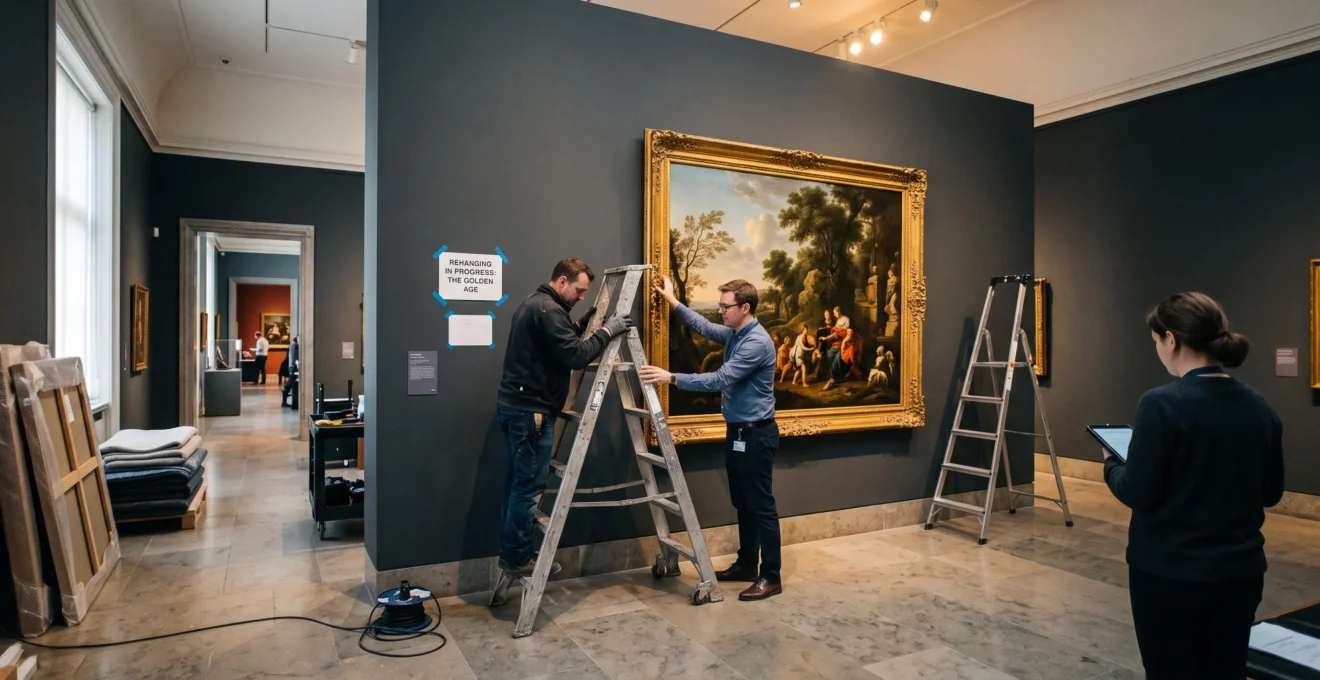
A visitor enters a gallery containing thirty remarkable paintings. Twenty minutes later, they remember only one. Another visitor encounters a smaller, less celebrated collection and leaves with a question that changes how they look at art. The difference may lie less in the artworks themselves than in how the exhibition connects them.
Effective exhibition design transforms individual objects into a sequence of discoveries. Curators establish a meaningful argument, arrange works to reveal relationships, control the pace of encounters, and provide interpretation without dictating every response. The physical gallery becomes a medium for storytelling: sightlines introduce questions, thresholds create anticipation, and carefully chosen contrasts invite visitors to reconsider their assumptions.
For museum curators, exhibition designers, and gallery managers, the challenge is not simply to increase dwell time. It is to create worthwhile attention across audiences with different levels of knowledge, cultural backgrounds, and motivations. That requires a narrative visitors can enter, challenge, and carry beyond the museum.
What makes an exhibition memorable?
- Build an argument, not just a theme: each room should advance a question that the artworks help visitors investigate.
- Design the emotional journey: transitions, visual contrasts, and moments of pause shape how visitors encounter important works.
- Measure meaningful engagement: combine observations of visitor behaviour with evidence of understanding, conversation, and recall.
- Why Do Many Visitors Skip Chronological Galleries but Linger in Thematic Rooms?
- How Do Exhibition Designers Use Room Transitions to Build Anticipation and Emotional Impact?
- Thematic Connections vs Artist Monographs: Which Layout Keeps Visitors Engaged Longest?
- The Wall Text Error That Makes Educated Visitors Feel Excluded and Confused
- The Optimal Display Cycle: When to Refresh Galleries Without Disappointing Repeat Visitors
- Why Do Thematic Groupings Feel Shallow Compared to Exhibitions With Clear Arguments?
- How Do Western and Chinese Viewers Interpret the Same Painting Completely Differently?
- What Makes Exhibition Narratives Compelling Enough to Change How Visitors See Art?
Why Do Many Visitors Skip Chronological Galleries but Linger in Thematic Rooms?
Thematic galleries can hold visitors’ attention because they offer an immediately understandable question, emotion, or human experience through which to interpret unfamiliar artworks. Chronological displays often require greater background knowledge to connect dates, movements, and influences. Yet neither structure guarantees engagement: the quality of interpretation, visitor motivation, and strength of the curatorial argument matter more than the organising principle alone.
Chronology provides an intellectually coherent framework. It demonstrates artistic development, reveals historical influence, and helps specialists identify turning points. Its weakness emerges when the sequence assumes that visitors already understand why successive periods matter.
A room labelled “European Painting, 1850–1880” communicates a date range. A room asking “What happens when painters stop idealising industrial cities?” gives visitors a problem to explore. The latter can make individual artworks meaningful before visitors learn their historical relationships.
This distinction is not evidence that visitors universally prefer thematic displays. The frequently repeated suggestion that 60% skip chronological galleries while spending 40 minutes in thematic rooms is not established by the research supplied for this article.
108 exhibitions
Beverly Serrell’s 1997 comparative investigation examined how visitors allocated time and attention across museum exhibitions. Most visitors observed did not stop at more than half the exhibition elements. The study does not establish that thematic layouts outperform chronological ones.
Beverly Serrell’s study of visitor attention across 108 exhibitions
Before redesigning a chronological gallery, establish an observational baseline. Map voluntary stops, record time spent in each room, compare different visitor groups, and conduct short exit interviews. A gallery that attracts school groups may produce different patterns from one primarily visited by returning members or art historians.
The most practical solution is frequently a hybrid: a chronological backbone organised into thematic chapters. Historical sequence supplies context while each room addresses a compelling question. A collection spanning a century might follow developments in portraiture while using successive rooms to investigate status, identity, resistance, and self-representation.
Beware, however, of mistaking a thematic label for an interpretation. “Light”, “Nature”, or “Portraits” may organise a gallery without explaining why the objects belong together beyond superficial resemblance.
The strongest organising principle is whichever helps the collection ask a question worth answering. Once that structure is established, the movement between rooms becomes part of the narrative itself.
How Do Exhibition Designers Use Room Transitions to Build Anticipation and Emotional Impact?
Exhibition designers use transitions to guide attention between narrative chapters. Changes in scale, light, acoustics, colour, and sightlines can signal that visitors are approaching a new idea or significant work. An effective transition combines a clear threshold, sufficient space to reset attention, and a visual or conceptual promise about what comes next, without making the experience unnecessarily theatrical.
Consider a hypothetical exhibition about artistic responses to conflict. An opening gallery presents documentary images and archival material. A short passage then reduces visual complexity before visitors encounter a large, emotionally demanding painting. The passage creates a moment of perceptual separation, allowing the central work to receive more concentrated attention.
Three design elements shape this experience:
- Threshold: a doorway, change in wall colour, altered ceiling height, or shift in lighting communicates a transition between ideas.
- Pause: a quieter area, generous turning space, or deliberately restrained wall gives visitors a moment to absorb the preceding room.
- Promise: a partial sightline, introductory question, or glimpse of an artwork encourages visitors to move forward.
Not every transition should heighten emotion. Some should clarify information, especially where visitors must choose between routes or move from an unfamiliar historical period into another. Designers can select between two approaches according to narrative purpose.
| Design decision | Emotional transition | Informational transition |
|---|---|---|
| Primary purpose | Focus attention or create anticipation | Clarify context and orientation |
| Typical elements | Controlled views, lighting contrast, spatial pause | Maps, timelines, introductory questions |
| Best placement | Before a carefully chosen emotional or interpretive peak | Before complex sections or branching routes |
| Main design risk | Sensory fatigue or theatrical manipulation | Information overload or disrupted pacing |
Emotional peaks deserve particular care. A memorable reveal is more likely to feel earned when previous rooms have established its significance. Dramatic lighting alone cannot rescue an artwork whose connection to the exhibition remains unclear.
Excessive darkness, repeated surprises, and unnecessarily narrow passages can also undermine accessibility or exhaust visitors. Maintain safe circulation, adequate orientation, readable interpretation, and suitable lighting for both people and objects.
A successful transition should make the next encounter feel purposeful. That purpose also determines whether the exhibition is better structured around a single artist or relationships between several artists.
Thematic Connections vs Artist Monographs: Which Layout Keeps Visitors Engaged Longest?
Neither thematic exhibitions nor artist monographs consistently keep visitors engaged longer. Monographs offer a natural structure through an artist’s development, while thematic exhibitions create dialogue across artists, periods, or cultures. The best choice depends on the available works, the audience’s prior knowledge, and whether the exhibition can sustain a coherent argument that rewards attention rather than simply encouraging visitors to spend more time.
A monographic exhibition has an immediate narrative advantage: the central subject is clear. Visitors can follow an artist from experimentation through significant changes in technique, ambition, or public reception. This format is particularly effective when the collection includes enough variety to challenge a simplified account of the artist.
Its limitation is equally important. An exhibition built entirely around a celebrated name may reinforce an established canon and overlook the collaborators, contemporaries, and historically marginalised makers who shaped the artist’s work.
A thematic exhibition can correct that imbalance. By assembling artworks from different creators, it can expose unexpected connections and give less familiar voices equal interpretive importance. But the format also carries a risk: artworks separated from their historical circumstances can become interchangeable illustrations of a broad idea.
Use the collection and audience to determine the format:
| Criterion | Artist monograph | Thematic exhibition |
|---|---|---|
| Strongest collection asset | Varied, substantial work by one artist | Meaningful relationships across several creators |
| Core narrative | Development, contradictions, legacy | Comparison, disagreement, shared concerns |
| Audience entry point | Interest in an artist or recognisable name | Interest in a question or human experience |
| Typical weakness | Heroic biography and canonical exclusion | Loss of historical specificity |
| Possible remedy | Include contemporaries and critical counterpoints | Provide precise object histories and context |
A hybrid layout may provide the most compelling option. Imagine an exhibition tracing one painter’s career, followed by a room comparing the artist’s approach to related works by lesser-known contemporaries. Visitors retain the clarity of an individual biography while encountering alternative interpretations.
Judge performance through a combination of indicators: voluntary stops, conversations between visitors, returns to previously viewed works, and exit responses explaining the exhibition’s central idea. These are proposed evaluation measures, not validated proof that one format produces greater emotional impact.
Whichever structure is selected, its success depends heavily on the words visitors encounter beside the artworks. An otherwise sophisticated exhibition can lose its audience through the wrong kind of interpretation.
The Wall Text Error That Makes Educated Visitors Feel Excluded and Confused
The most damaging wall text error is assuming that every visitor arrives with the same knowledge. Specialist language can exclude thoughtful non-specialists, while oversimplified explanations can frustrate curious and experienced visitors. Effective gallery interpretation offers layered access: an immediate proposition, a clear reason for each artwork’s inclusion, and optional depth for those who want to investigate further.
Consider an introductory label describing a painting as “a destabilisation of post-Enlightenment scopic regimes”. A specialist might recognise the theoretical reference; another visitor may understand the individual words without knowing what to look for in the artwork.
At the opposite extreme, “Artists painted what they saw” can erase complexity and leave visitors wondering why the work deserves attention.
The problem is not education level alone. Prior knowledge is specific to subjects, traditions, and individual artworks. A highly educated visitor with no experience of twentieth-century art can benefit from the same clear entry point as a younger visitor, without requiring the underlying interpretation to be simplified.
A practical solution is three-layer interpretation:
- Entry statement: offer a short, clear proposition that can be understood in under a minute. Lead with a question, tension, or observable detail rather than specialist terminology.
- Object-level label: explain why this particular work matters to the room’s argument. Connect visual evidence to interpretation rather than merely summarising the artist’s biography.
- Optional depth: provide additional historical, technical, or scholarly context through longer labels, printed guides, or accessible digital material.
Sentence length should serve comprehension rather than follow an arbitrary numerical rule. Use concrete nouns and active verbs for essential explanations. Introduce specialist terms only when they offer something important, and define them in context.
The British Museum‘s visitor research and evaluation programme describes front-end research into audience knowledge, formative testing of interpretation before installation, and evaluation after opening. These approaches help institutions avoid relying exclusively on curatorial assumptions.
For a low-cost label test, recruit readers who reflect the intended audience but are unfamiliar with the exhibition. Ask them to read a draft, identify the main claim, and explain why the displayed artwork belongs in the room. Revise where their interpretation consistently differs from the intended message.
Confusion can lead visitors to disengage without complaining. A visitor may assume that the problem lies in their own knowledge rather than the presentation. Clear texts therefore support confidence and participation, not merely basic accessibility.
Interpretation also changes over an exhibition’s life. When objects rotate, labels and room arguments should evolve with them rather than remain fixed around an increasingly different selection.
The Optimal Display Cycle: When to Refresh Galleries Without Disappointing Repeat Visitors
There is no universally optimal interval for refreshing museum galleries. The appropriate schedule depends on object conservation, the exhibition’s narrative purpose, visitor expectations, and reinstallation resources. Curators can preserve familiar anchor works while introducing rotating selections and new interpretive chapters, provided conservation constraints are met and visitors understand which objects may change.
Conservation is the first constraint. Works on paper, certain textiles, photographs, and other light-sensitive materials may require rotation or restricted display. Material condition, cumulative light exposure, environmental requirements, and conservation advice should determine the practical limits.
The Metropolitan Museum of Art: a documented rotation
In its 2016 exhibition Drawings and Prints: Selections from the Permanent Collection, The Met displayed European and American works on paper in the Robert Wood Johnson, Jr. Gallery.
Because these materials were sensitive to light, the museum described installations lasting approximately 13 weeks. The example documents a conservation-driven display strategy at a particular time and gallery; it does not establish a universal rotation interval.
Once conservation requirements are established, decide which elements should remain stable and which should change. A useful planning framework distinguishes three categories:
- Anchor works: signature objects that provide continuity and help returning visitors recognise the gallery’s identity, where conservation permits continued display.
- Rotating works: complementary objects whose introduction can reveal new relationships or previously unseen aspects of a collection.
- Conservation- or loan-driven changes: substitutions required by material care, loan agreements, or collection availability.
The common planning mistake is to replace objects while leaving the narrative unchanged. Returning visitors may notice different pictures without discovering any new question worth exploring.
Instead, treat a partial rehang as another chapter. A portrait gallery might initially explore social status, then use a revised selection to examine how artists challenged conventions of representation. The continuity supports recognition; the new argument encourages another visit.
Communication matters. Announce notable rotations, explain conservation-related absences, and indicate when visitor favourites are expected to return if that information is confirmed. Avoid promising a return date before scheduling and conservation decisions are final.
Evaluate each refresh against its actual objective: protecting vulnerable objects, making more of the collection accessible, improving interpretation, or encouraging repeat engagement. These purposes require different success measures.
Whether an exhibition is new or refreshed, the decisive question remains the same: do its groupings convey an argument, or do they merely sort artworks into categories?
Why Do Thematic Groupings Feel Shallow Compared to Exhibitions With Clear Arguments?
Thematic groupings feel shallow when they identify a shared subject without explaining why that relationship matters. An exhibition about “the sea” gathers similar imagery; an exhibition arguing that painters used the sea to explore uncertainty, power, and identity invites visitors to compare meanings. A clear argument turns artworks into evidence, creates productive tension, and gives audiences something to question or reconsider.
Curators often begin with a promising category: migration, landscape, the body, the city. These subjects provide a useful selection framework, but they are not narratives in themselves.
The difference is between classification and interpretation. Classification explains what objects have in common. Interpretation proposes what their similarities and differences reveal.
One diagnostic question is particularly useful: could a thoughtful visitor disagree with the exhibition’s central claim? If the answer is no because the theme merely names a category, the curatorial proposition may need strengthening.
For example, “Artists have depicted gardens throughout history” is descriptive. “Private gardens became spaces where artists negotiated the boundary between domestic freedom and social control” is arguable. It invites supporting examples, exceptions, historical context, and alternative readings.
Once a proposition exists, resist the temptation to choose only works that confirm it. An artwork that complicates the claim can become one of the exhibition’s most valuable objects. Visitors may remember a productive contradiction more clearly than a room full of illustrations that all repeat the same point.
A practical exhibition argument should therefore include visual evidence, meaningful counterexamples, and room-to-room development. Each chapter should alter or complicate the visitor’s understanding of the previous one.
This also clarifies why thematic framing can sometimes support sustained attention: not because shared subjects automatically attract longer visits, but because a well-developed proposition gives visitors relationships to investigate.
An argument becomes more compelling when it acknowledges that visitors may approach the same evidence through very different cultural and interpretive traditions.
How Do Western and Chinese Viewers Interpret the Same Painting Completely Differently?
Visitors familiar with different artistic traditions may notice different meanings in the same painting, but nationality does not determine interpretation. Someone trained in Chinese literati painting may attend closely to brushwork, inscriptions, historical references, and poetic associations, while another visitor may begin with landscape composition or atmosphere. Curators should reveal these interpretive possibilities without treating either response as culturally inevitable.
Traditional Chinese painting offers a useful example because appreciation can involve reading relationships between image, calligraphy, poetry, ownership marks, and artistic lineage. A landscape may be understood not simply as a representation of a place but also as a statement about scholarship, personal values, historical memory, or an artist’s relationship to earlier masters.
In The Met‘s essay on interpreting traditional Chinese painting, the museum discusses how works such as Han Gan’s Night-Shining White acquired layers of meaning through inscriptions and ownership seals accumulated over time.
These conventions offer visitors interpretive possibilities beyond a painting’s immediately visible subject. Yet they do not imply that every contemporary Chinese visitor recognises them, or that Western visitors cannot.
A cross-cultural exhibition can make these frameworks visible through complementary labels. One interpretation might introduce the painting’s landscape and visual composition; another might explain the significance of a particular inscription or brushwork convention. Neither needs to be presented as the only legitimate reading.
Comparative hangings can extend the conversation. A Chinese landscape scroll and a European seascape might introduce different conventions of pictorial space, artistic authorship, or the relationship between image and text. The comparison should be historically precise rather than suggest that two individual artworks represent entire civilisations.
The same approach applies beyond this example. Curators can investigate what different audiences expect from a finished artwork, how they understand originality, what they recognise as artistic authority, and which historical references they are likely to know.
Interpretation should provide enough context to enable an encounter, not turn every artwork into an anthropology lesson. Invite visitors to compare the evidence and construct their own responses.
When an exhibition reveals that the same artwork supports several informed readings, it gives visitors something more enduring than information: a new way to look.
Key takeaways for curators
- Define what visitors should reconsider: a compelling exhibition challenges an assumption rather than merely organising objects.
- Locate the decisive encounter: choose where the narrative’s most consequential contrast or revelation should occur, then build the preceding rooms around it.
- Make interpretation transferable: give visitors an accessible question or observation method they can apply to artworks beyond the exhibition.
What Makes Exhibition Narratives Compelling Enough to Change How Visitors See Art?
A compelling exhibition narrative changes how visitors see art by giving them an interpretive method they can use independently. Its impact comes from a defensible central argument, deliberate spatial pacing, accessible interpretation, and encounters that challenge familiar assumptions. The goal is not simply to communicate more information, but to make future encounters with artworks richer and more questioning.
Consider a visitor who arrives believing portraiture is primarily about resemblance. An exhibition might gradually reveal portraits as instruments of status, negotiation, exclusion, and resistance. If the visitor later approaches an unfamiliar portrait and asks who controlled its representation, the exhibition has offered a transferable way of looking.
That possibility depends on several design decisions working together.
The argument gives the exhibition its intellectual direction. The room sequence develops that proposition instead of repeating it. A carefully prepared peak encounter allows an important contrast to become tangible. Layered texts give visitors a way into the complexity, while cross-cultural interpretation makes clear that different perspectives can be legitimate and productive.
None of these elements independently guarantees lasting memory or behavioural change. Museum evaluation can establish what visitors noticed, understood, discussed, or recalled within a measured period, but long-term transformation requires more demanding evidence.
For practical planning, translate the narrative ambition into five reviewable outputs.
Five actions for building a memorable exhibition narrative
- Write the central argument: produce a single sentence stating what the exhibition proposes and what evidence visitors will encounter.
- Map the chapters: prepare a floor plan annotating the question, key artworks, and narrative purpose of each room.
- Design the emotional peak: identify one pivotal encounter and document its approach, threshold, sightline, and accessibility requirements.
- Test interpretive clarity: ask representative readers to paraphrase draft room texts and record where their understanding differs from the intended argument.
- Define evaluation evidence: create an observation and interview sheet covering voluntary stops, visitor interpretations, unexpected insights, and the exhibition’s main takeaway.
Use those outputs during curatorial review, design development, and formative testing. After opening, compare actual visitor responses with the intentions recorded during planning. A successful evaluation may reveal that audiences discovered an unexpected but equally meaningful interpretation.
Not every display needs this level of narrative ambition. A focused conservation presentation, compact archival display, or specialist study collection may legitimately prioritise access, close examination, or documentation over emotional transformation.
The central curatorial decision is therefore not whether every exhibition should tell a dramatic story, but whether a narrative approach genuinely serves the collection and its audiences.
For the next exhibition proposal, begin with one artwork and one question: what might this object help a visitor see differently? Build the surrounding narrative only after that answer is compelling enough to deserve a room.
How can small museums create engaging exhibition narratives with limited budgets?
Small museums can focus on a strong curatorial argument, thoughtful object selection, clear sightlines, and accessible interpretation rather than expensive installations. Rearranging existing works, refining introductory labels, and testing visitor understanding can improve narrative coherence without major construction. Start with one gallery, identify its central question, and evaluate whether visitors understand the intended relationships between artworks.
How should exhibition teams measure engagement beyond visitor dwell time?
Combine behavioural observations with qualitative evidence. Record where visitors voluntarily stop, which works prompt discussion, whether people return to earlier objects, and how they describe the exhibition’s argument during exit interviews. These indicators reveal different dimensions of engagement, but none alone establishes emotional impact or learning. To investigate lasting influence, consider voluntary follow-up interviews or recall studies conducted after the visit.
Can a non-linear exhibition still communicate a coherent narrative?
Yes. A non-linear exhibition can organise several routes around one clearly expressed central question. Each room should contribute a distinct perspective while providing enough context to make sense independently. Repeated visual reference points, accessible orientation information, and clear interpretive connections can help visitors understand the exhibition without following a mandatory sequence. This approach is especially useful where gallery architecture encourages multiple entry points.
How can curators accommodate different levels of art knowledge without oversimplifying an exhibition?
Use layered interpretation. Begin with an accessible observation or question, explain why each important artwork contributes to the exhibition’s argument, and provide optional historical or specialist material for deeper exploration. Test the interpretation with visitors who have different levels of familiarity with the subject. The aim is to offer multiple entry points to the same intellectual complexity rather than separate exhibitions for experts and beginners.
When should an exhibition prioritise object discovery rather than a strong narrative argument?
Object discovery may be the more appropriate priority when the main purpose is to make rarely displayed holdings accessible, document conservation findings, or support close specialist examination. In these circumstances, accurate object information, appropriate viewing conditions, and opportunities for independent exploration may matter more than a dramatic sequence. Curators should establish the exhibition’s primary purpose before deciding how much narrative structure the display requires.