
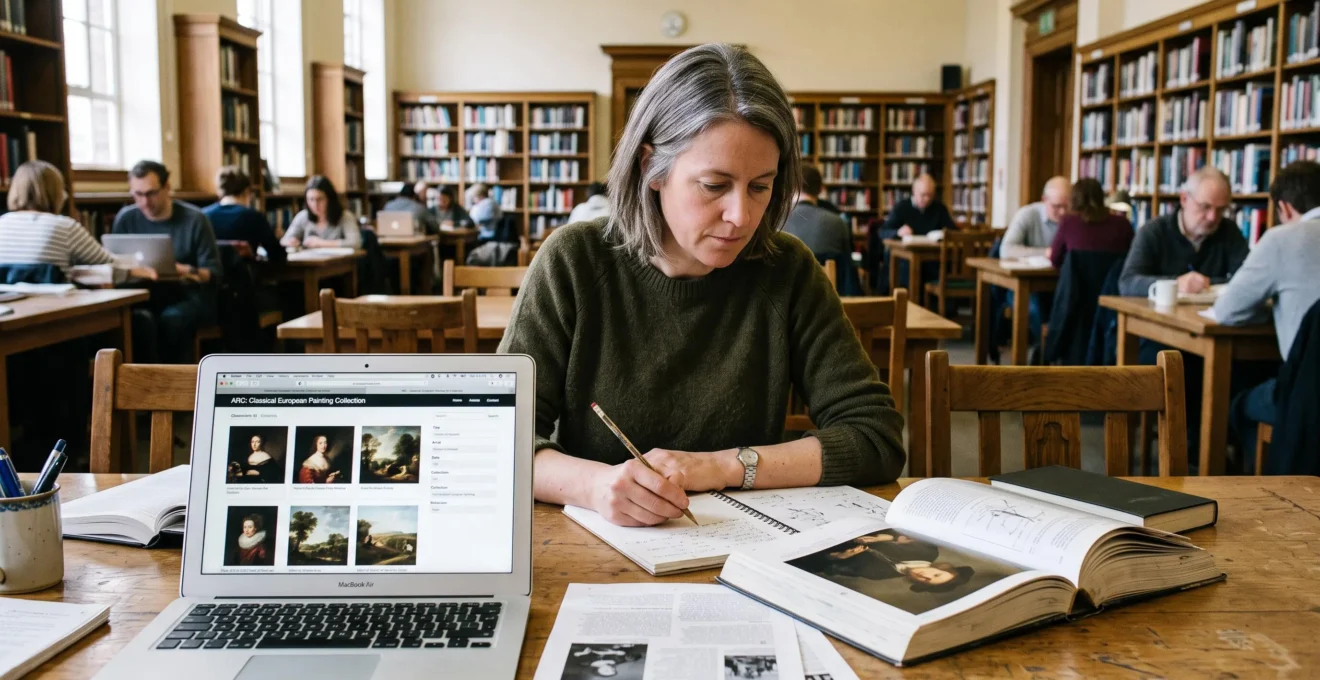
A researcher investigating a nineteenth-century painting once needed access to specialist libraries, institutional photographic collections and museum catalogues that might be distributed across several countries. Today, substantial parts of that research can begin from a public library or home computer. Digitised collections, searchable catalogue records and shared metadata systems have made previously difficult-to-locate material discoverable beyond university campuses.
Yet open access is not the same as effective research access. A collection can be available online while its images remain unsuitable for close examination, its records cannot be searched systematically, or its licensing conditions prevent meaningful reuse. Subscription databases and institutional research privileges introduce further distinctions between what can be viewed and what can be investigated thoroughly.
Building a genuinely democratic digital art archive therefore requires more than publishing photographs. It requires interoperable descriptions, accessible interfaces, dependable identifiers, transparent rights information and sustainable preservation. These decisions influence not only who can research art history, but which artworks become visible enough to attract scholarly attention.
What makes digital art archives genuinely research-ready?
- Accessible records and images: Public availability must be accompanied by usable research materials, understandable permissions and realistic routes to specialist resources.
- Interoperable discovery: Shared identifiers, controlled vocabularies and metadata mapping allow researchers to investigate collections across institutional boundaries.
- Scholarly reliability: Stable citations, contextual descriptions, appropriate image quality and verified evidence turn online discovery into defensible research.
- Why Do Researchers Without University Access Remain Locked Out of Art Historical Databases?
- How Do You Tag Artworks So Researchers Can Find Them Across 200 Museum Databases?
- Individual Museum Sites vs Aggregated Portals: Which Model Serves Researchers Better?
- The Unusable Archive: When Perfect Digitisation Meets Terrible Search Interface
- The Migration Moment: When Do Old Digital Archives Need Complete Rebuilding?
- Why Do Museum Websites’ Images Look Sharp but Lack Detail for Academic Research?
- Why Do Detailed Catalogue Descriptions Fail to Qualify as Academic Research?
- What Makes Art Historical Research Publishable in Top-Tier Academic Journals?
Why Do Researchers Without University Access Remain Locked Out of Art Historical Databases?
Independent art researchers face two different access barriers: institutional restrictions on specialist publications and images, and technical barriers that make nominally public archives difficult to use. Subscription privileges, inadequate indexing, limited image resolution and unclear permissions can all restrict research. Removing a paywall addresses only one part of the problem; meaningful access also requires discoverable, usable and citable evidence.
The first barrier is contractual. Art historians frequently depend on journal literature, reference publications and research databases distributed through institutional subscriptions. Platforms such as JSTOR and Oxford Art Online offer resources whose availability can depend on the user’s subscription or institutional entitlements. An independent scholar may discover that a relevant publication exists without receiving the same access enjoyed by an eligible university researcher.
Nevertheless, access is not necessarily a binary choice between university affiliation and complete exclusion. According to JSTOR’s official free-access instructions, individuals can register personal accounts and read up to 10 articles online every 30 days under its free-reading arrangement. This does not confer unrestricted access to the entire platform or replace subscription-based privileges.
10 articles per 30 days
JSTOR’s documented allowance for reading eligible articles online through a free personal account. The allowance is not equivalent to a full institutional subscription.
JSTOR, official account and access guidance, updated September 2026.
The second barrier is less visible. A museum might publish thousands of object records but omit usable subject indexing, bulk retrieval options or explicit reproduction conditions. A researcher can theoretically reach the collection while remaining unable to identify all relevant works or assemble a reproducible corpus.
Image licensing creates another distinction. Some institutions provide low-resolution browsing images publicly while administering research-quality reproductions through separate request services. Others publish eligible images under open instruments such as CC0 or CC BY. CC0 facilitates reuse without requiring attribution as a licence condition, whereas CC BY imposes attribution and other applicable licence requirements. Neither designation should be assumed for an artwork whose rights statement is missing or ambiguous.
An unaffiliated scholar can assess practical access by examining public-library authentication programmes, eligibility for national or specialist research-library reader cards, visiting-researcher arrangements and open-content initiatives across galleries, libraries, archives and museums. Each route has its own requirements; none should be presumed universally available.
Access restrictions may also affect the composition of research corpora. If the evidence for one collection can be examined remotely while comparable material elsewhere requires travel or institutional credentials, the more accessible collection becomes easier to investigate. This is a plausible selection mechanism, not a quantified conclusion that independent scholars necessarily favour particular artworks.
Once access is established, the next challenge is finding comparable works across institutions that describe their holdings in fundamentally different ways.
How Do You Tag Artworks So Researchers Can Find Them Across 200 Museum Databases?
Finding artworks across 200 museum databases requires more than attaching consistent keywords. Institutions must connect local descriptions to shared authority identifiers, map records into interoperable data structures and retain links to their original catalogues. Controlled vocabularies and linked open data make cross-collection searching technically possible, but reliable results still depend on careful mapping, contextual interpretation and quality checks.
Museum metadata is fragmented because collections developed different cataloguing traditions, languages and information systems. One institution may describe a work using the Getty Art & Architecture Thesaurus (AAT), another may apply Library of Congress Subject Headings (LCSH), while a third relies on Iconclass or its own local subject terms.
These systems do not always represent the same concepts or levels of specificity. A search for portraits can miss works indexed by sitter, object type or a local historical classification, even where a researcher would reasonably consider them relevant.
Authority identifiers provide a stronger connection than text matching alone. Getty‘s Union List of Artist Names (ULAN), the Virtual International Authority File (VIAF) and Wikidata can help connect variant personal names to identifiable entities. Getty’s geographical vocabulary can similarly assist with place-name relationships, while AAT supports concepts relating to materials, techniques and object types.
The Getty Vocabularies data and services documentation describes reconciliation through OpenRefine, SPARQL access, reusable record URIs and machine-readable vocabulary representations. These services support alignment work; they do not automatically validate every match across independent databases.
Aggregating records typically involves extracting source metadata, mapping local fields into a common representation and linking recognised entities to stable identifiers. Standards and models such as LIDO, CIDOC CRM and the Europeana Data Model address different aspects of describing and exchanging cultural heritage information. An archive architect should select mappings according to the actual source material and intended research questions rather than assuming that any model guarantees uniform meaning.
For example, a local field containing a historically specific place of production might be mapped to a broader geographic category. That improves retrieval across systems but can remove distinctions essential to attribution or historical interpretation. Likewise, the label “Netherlands” may refer to different territorial or historical concepts depending on the record.
Two forms of error therefore require active monitoring: false positives, where unrelated objects are returned, and silent omissions, where relevant records fail to appear. A useful reconciliation workflow retains the source value, the proposed authority identifier, the basis of the match and a review status.
Professional cataloguing can also be supplemented by community transcription, moderated tagging and collaborative identification projects. Such contributions are particularly valuable where handwritten inscriptions, local terminology or under-described subjects resist automated classification. Contributor-supplied information should remain identifiable and reviewable rather than silently replacing established catalogue statements.
Interoperable metadata makes broad discovery possible, but researchers still need to decide where the most authoritative and detailed information resides.
Individual Museum Sites vs Aggregated Portals: Which Model Serves Researchers Better?
Neither individual museum websites nor aggregated cultural heritage portals serve every research need equally well. Aggregators are valuable for discovering material across collections, while institutional catalogues are often better places to investigate detailed records, object histories and current attribution statements. The strongest scholarly workflow uses aggregation to locate candidates and original collection records to verify evidence before citation.
An individual museum catalogue can preserve information that becomes abbreviated during aggregation: acquisition history, provenance qualifications, conservation observations, bibliography, exhibition histories and changes in attribution. Its usefulness nevertheless depends on whether those details are actually published and searchable.
Aggregated platforms, including Europeana, Google Arts & Culture and national collection portals, make dispersed objects easier to find through a shared discovery environment. Their breadth does not by itself establish equivalence in catalogue quality, image rights or scholarly functionality.
The Europeana Data Model technical documentation explains the model’s classes, properties, mapping guidance and validation mechanisms. It shows how cultural heritage metadata can be transformed into interoperable representations without establishing that every source record becomes equally complete or accurate.
A practical evaluation must consider what the researcher can inspect and document, rather than how many objects appear in a search result.
| Research criterion | Individual museum catalogue | Aggregated portal |
|---|---|---|
| Collection coverage | Focused on an institution’s holdings | Potentially spans numerous institutions |
| Catalogue depth | May include detailed object histories and bibliographies | Depends on exported fields and provider mappings |
| Image quality | May offer specialised viewers or original files | Often depends on the supplying institution |
| Reuse permissions | Established through the object’s published rights information | Requires attention to item-level rights and provider terms |
| Advanced searching | May support collection-specific fields and filters | May facilitate cross-institutional discovery |
| Persistent references | Should provide stable object-record identifiers | Should retain durable links to the original provider |
| Record currency | Potentially closer to local catalogue updates | Dependent on provider updates and ingestion schedules |
Record currency deserves particular attention. Consider a hypothetical painting whose attribution changes after further conservation research. If its museum record is updated before the revised metadata reaches an aggregator, the same object could appear under different artist names. This illustrates a potential synchronisation problem, not an assertion that a named portal contains such an error.
The researcher should therefore record both the discovery route and the verified institutional source. Collection object numbers, persistent URIs or DOIs, where supplied, are more useful than relying exclusively on temporary search-result addresses.
A third model is also important: research-oriented digital infrastructure operated by libraries, archival consortia or academic collaborations. Such systems can combine aggregated discovery with scholarly capabilities, including structured datasets, downloadable metadata and richer provenance relationships.
These approaches are complementary. Aggregation increases the likelihood of discovering unexpected material, institutional catalogues support source verification, and research infrastructure can enable systematic analysis across both.
Regardless of where records are hosted, an archive becomes academically useful only when its interface lets researchers retrieve and inspect them systematically.
The Unusable Archive: When Perfect Digitisation Meets Terrible Search Interface
An archive with excellent digitised images can still fail researchers if its search interface prevents systematic discovery, comparison and citation. Scholarly usability depends on meaningful filters, dependable text searching, linked catalogue records and reproducible result sets. An attractive browsing experience may serve casual visitors while leaving researchers unable to establish whether they have examined all relevant evidence.
A public-facing collection website may prioritise featured exhibitions, thematic galleries and visual exploration. Those are legitimate design goals. Problems arise when the same interface must support exhaustive corpus-building without offering specialised research functions.
Consider a researcher investigating portraits produced between uncertain historical dates. A system that accepts only an exact year can exclude records catalogued as “circa,” date ranges or broad periods. A database that searches only a preferred spelling of an artist’s name may similarly overlook variant transliterations or historical forms.
Faceted search can address part of this difficulty by combining artist, chronology, object type, technique and provenance. Boolean operators support more precise inclusion and exclusion. Unicode-aware indexing matters for multilingual inscriptions and non-Latin scripts. None of these features replaces the need for a clear description of what fields the search actually covers.
Typical warning signs include:
- Results paginated without a meaningful relevance or catalogue-field sort option.
- Digitised images displayed without direct connections to their object records.
- Personal-name searching that ignores common aliases or spelling variants.
- No way to export record identifiers, metadata or a reproducible result list.
- Unclear handling of date uncertainty, missing values and historical place names.
Researchers can sometimes compensate through targeted external search-engine queries, public collection APIs or direct object identifiers. These are contingent workarounds: external engines may not index every record, an API may expose only selected fields, and identifiers are useful only if they can be resolved reliably.
Five checks before relying on a digital art archive
- Test search coverage: Run a known artwork title and one alternative artist spelling; save a two-query result comparison.
- Check research filters: Test date, technique and creator filters; produce a short list of supported and missing functions.
- Inspect record connections: Open three image results and verify their catalogue links; record the corresponding object identifiers.
- Assess reproducibility: Attempt to export a search set or preserve its query and identifiers; create a reusable search log.
- Verify citation stability: Test stable record addresses and rights statements; complete a three-record citation audit.
A useful archive evaluation should distinguish inconvenience from methodological risk. Extra navigation adds time; missing records and undisclosed search limits may change the conclusions a researcher can reasonably draw.
Even a well-designed interface must remain maintainable. Without sustainable technical infrastructure, today’s usable archive can become tomorrow’s inaccessible research dependency.
The Migration Moment: When Do Old Digital Archives Need Complete Rebuilding?
Digital archives need substantial rebuilding when their underlying systems can no longer preserve, describe, retrieve or serve collections reliably. Obsolete software, unsupported data formats, inadequate metadata structures and unstable record URLs are important warning signs. Yet replacing an archive should not automatically mean replacing its identifiers or rewriting its scholarship; preservation, technical migration and editorial revision require separate decisions.
Technical obsolescence can be obvious, as with interfaces dependent on discontinued browser technologies such as Flash. It can also be less visible: fragile database exports, undocumented proprietary formats, inconsistent character encoding or metadata that cannot represent newly required relationships.
The transition described in Getty’s vocabulary documentation provides a concrete infrastructure example. Getty reports the discontinuation of its legacy XMLweb services and the end of new XML and relational-table vocabulary releases, with final archived legacy datasets drawn on January 30, 2026. Its continuing linked-data and reconciliation services illustrate how technical access methods evolve while the underlying need for dependable authority data remains.
Institutions should distinguish three operational questions. Can existing information be transferred without losing meaning? Can researchers still resolve previously published references? And does the catalogue’s scholarship itself need review?
Technical migration and scholarly revision are not interchangeable. A database can be transferred perfectly while retaining outdated attributions or unresolved provenance statements. Conversely, a curatorial revision can improve object records without requiring wholesale replacement of the technical platform.
Persistent identifiers are particularly important because published scholarship may reference individual object pages for years. Rebuilding a website without redirects or identifier-resolution arrangements can sever those references from their evidence. A migration plan should therefore inventory existing URLs, map them to stable destinations and test redirection before retiring the original system.
Web-archiving services, dated catalogue exports and versioned records can preserve historical context, subject to their technical coverage and applicable permissions. They do not eliminate the need for an institution to maintain authoritative current records.
Researchers should also protect the documentation on which their work depends. A dated research log can record the collection title, institution, object number, accessed URL, consultation date, relevant catalogue text and image-rights statement. Where permitted, saving a local copy or timestamped capture provides evidence of what the catalogue stated during the research process.
This is especially relevant when an article takes months to prepare. A stable citation may still lead to a record whose interpretation has changed; the researcher needs to distinguish the evidence consulted from subsequent revisions.
Sustainable infrastructure protects access over time, but another constraint remains immediate: the distinction between an image designed for online viewing and an image adequate for visual analysis.
Why Do Museum Websites’ Images Look Sharp but Lack Detail for Academic Research?
Museum images can appear sharp on a screen while lacking the information required for academic examination because display quality and research resolution serve different purposes. Web derivatives may be compressed, resized or subject to restricted zoom. They can support identification and general visual comparison without reliably revealing fine inscriptions, paint surfaces or other details needed for technical and attribution research.
Digital imaging usually involves several stages. A museum may produce high-quality master files through professional photography, specialised scanning or photogrammetry, depending on the object and documentation requirements. These files can then generate smaller derivatives optimised for web delivery, previews and collection interfaces.
A smaller web file can be entirely appropriate for browsing while omitting information that exists in a master capture. Resampling reduces available pixel detail; compression may introduce artefacts; and access interfaces can restrict magnification. Some derivatives also lack the technical metadata needed to understand capture conditions or subsequent processing.
For a painting, such limitations become significant when the research question concerns fine craquelure, small inscriptions, surface adjustments or material characteristics. A visually convincing image at ordinary screen size is not evidence that these features have been recorded at sufficient resolution for analysis.
Researchers can investigate several routes to better documentation: freely downloadable high-resolution files where institutions provide them, specialist imaging services, formal research-image requests and existing technical documentation made available by collections departments. Conditions and eligibility differ among institutions, so image availability should be verified at the level of the object and intended use.
More pixels do not automatically establish material authenticity. Lighting, colour management, focus, capture method and processing history affect what an image can legitimately demonstrate. Even a high-resolution photograph may not answer questions requiring examination of the original object or specialised scientific imaging.
A defensible art historical argument should specify the observation conditions. Did the researcher examine the original painting, a calibrated research photograph, an institutional zoom viewer or a compressed web image? These categories support different degrees of confidence.
For example, an apparent signature visible only as a few blurred pixels should be described as an unresolved visual feature, not treated as secure attribution evidence. A subsequent high-quality capture or direct examination might support a stronger claim.
Once images and object records meet the required evidentiary standard, the remaining task is intellectual: transforming accessible material into an original scholarly argument.
Why Do Detailed Catalogue Descriptions Fail to Qualify as Academic Research?
A detailed catalogue description does not automatically constitute academic research because documenting an artwork and advancing a scholarly argument are different activities. Catalogue records establish identification, classification and object-level information; research uses evidence to address a question, assess competing interpretations and contribute new understanding. Rich open-access catalogues can support original scholarship, but reproducing their contents alone does not establish an original contribution.
Museum catalogue records often contain substantial scholarly work. They may document an object’s dimensions, medium, attribution, provenance, exhibition history, bibliography and relevant comparisons. Some also include extended curatorial essays or technical findings that advance interpretive arguments. The distinction therefore concerns the intellectual function of the text, not simply its length or publication venue.
Standardised object-cataloguing frameworks help collections describe objects consistently. Their core purpose is to support identification, management and retrieval. A journal article ordinarily has a different organising requirement: it must explain what scholarly problem is being addressed and why the proposed interpretation is justified.
Consider a hypothetical independent researcher studying an unsigned painting. A catalogue may identify the present attribution, approximate dating and documented ownership. Summarising these facts produces a useful description, but it does not establish why the attribution should be accepted, challenged or reinterpreted.
The researcher could instead compare the painting with related works, examine documentary evidence, assess earlier scholarship and test an alternative historical interpretation. The resulting claim would need to distinguish established catalogue facts from the author’s own observations and inferences.
This distinction also affects citation practice. A current museum record may be appropriate evidence for how an institution catalogues an object. It does not automatically prove that every attribution or date is uncontested, and citing it cannot substitute for discussing relevant disagreement in the scholarship.
A workable progression from catalogue evidence to research is to identify an unresolved problem, assemble comparable primary material, evaluate the existing literature and formulate a claim whose evidentiary basis can be checked independently.
The open archive is especially useful at the comparison stage. Searchable records can help uncover related works distributed among institutions, potentially revealing relationships that would be difficult to identify within a single collection.
However, discovery itself is not the contribution. The scholar must explain why the connection matters, what alternative explanations remain possible and how the new evidence changes existing understanding.
That shift prepares a study for consideration by academic journals, where methodological transparency, historiographical relevance and documentary accountability become decisive.
Key takeaways before preparing a journal submission
- Define the contribution: State what the research establishes beyond the existing catalogue and published literature.
- Audit the evidence: Preserve source identifiers, image provenance, observation methods and unresolved uncertainties.
- Plan for editorial requirements: Check journal scope, manuscript conventions, image permissions and peer-review procedures before submitting.
What Makes Art Historical Research Publishable in Top-Tier Academic Journals?
Publishable art historical research generally needs a clearly identifiable original contribution, a defensible method, critical engagement with previous scholarship and verifiable supporting evidence. Open digital archives can help researchers discover and document that evidence, but access alone does not satisfy editorial standards. An effective article must demonstrate what it adds to established knowledge and why its conclusions withstand specialist scrutiny.
Originality may take several forms: identifying a previously overlooked archival source, reconsidering an attribution, reconstructing an object’s historical context or advancing a new interpretation grounded in material and documentary evidence. The value of the contribution depends on its relevance to an existing scholarly discussion, not merely on whether the material was difficult to find.
A practical way to establish that relevance is to build a historiographical map. Record the principal interpretations of the object or corpus, identify the evidence supporting each position, note unresolved problems and describe precisely how the proposed research changes that picture.
Methodological transparency matters equally. Readers should be able to distinguish archival transcription from interpretation, first-hand observation from photographic analysis, and verified catalogue information from provisional metadata. An argument should acknowledge alternative explanations and the limitations of its sources.
The requirements of a particular journal can make these principles concrete. The The Art Bulletin manuscript submission requirements describe an English-language journal welcoming submissions from scholars worldwide and at different career stages. Its guidance specifies double-blind peer review, a maximum manuscript length of 16,000 words including endnotes and a limit of 20 illustrations.
The same instructions address image preparation and the author’s responsibility for determining applicable reproduction permissions or fair-use arguments. Accepted authors must be prepared to provide high-resolution images. These are requirements of that journal, not universal rules for every art history publication.
For independent scholars, the absence of a university affiliation does not by itself establish that a manuscript will be rejected. However, eligibility and review arrangements must be distinguished from practical support. The Art Bulletin‘s submission checklist asks for institutional affiliation information without explaining on that page how unaffiliated contributors should complete the field. Applicants should verify the appropriate procedure rather than assume a specific policy.
Research networks also matter. University-based scholars may have established opportunities for manuscript workshops, informal expert feedback and editorial mentoring. Independent researchers can seek comparable critical review through scholarly societies, research seminars open to external participants and appropriate prepublication workshops. An open-access journal may improve access to published work without necessarily removing submission costs or other requirements; its individual policies need examination.
Digital citability is part of evidentiary accountability. References to online objects should include institutional record identifiers where available, precise catalogue details and an access or version date when relevant. Images should be traceable to their source, with reproduction rights checked separately from any rights attaching to the underlying artwork.
Before submission, the author should be able to answer three questions: What new knowledge does the article establish? Which primary evidence sustains it? Could another specialist verify the essential observations and understand the limits of the argument?
Open-access archives help answer the third question when they preserve stable records, detailed metadata and usable visual resources. Their greatest democratic value is not merely allowing more researchers to see artworks, but enabling a wider range of scholars to produce claims that others can examine, question and build upon.
For an archive project, the next practical step is to select a representative group of artworks and test the complete research journey: public discovery, cross-collection identification, image examination, rights verification and stable citation. Documenting failures along that path provides a concrete development agenda for making serious art historical research more accessible.
Can independent art historians submit research to established academic journals?
Independent scholars can investigate submission opportunities at established journals, but each publication’s eligibility and administrative requirements must be checked individually. The Art Bulletin welcomes scholars worldwide and at different career stages, although its published checklist does not clarify how authors without an institutional affiliation should complete the affiliation field. A suitable submission still requires an original argument, supporting evidence and compliance with journal policies.
Does an open-access catalogue image automatically permit publication or commercial reuse?
No. The ability to view or download an image does not independently establish permission for every use. Researchers should inspect the image’s rights statement, distinguish rights in the underlying artwork from those relating to the reproduction, and comply with the applicable licence or legal exception. A rights statement should be recorded for each image intended for publication.
Which metadata should a small museum digitise first to support scholarly discovery?
A useful starting point is a stable object identifier, title, creator or attribution, date with uncertainty where appropriate, object type, medium, dimensions, institutional ownership or custody, image reference and rights statement. Provenance, bibliography and linked authority identifiers add substantial research value. The priority is dependable, maintainable data rather than maximum descriptive detail without consistent structure.
Can artificial intelligence replace controlled vocabularies in museum indexing?
AI-assisted tagging may suggest subjects, identify patterns or help prioritise incomplete records, but generated labels still require validation against institutional descriptions and relevant authority vocabularies. A research archive should preserve distinctions between verified catalogue information, automated suggestions and contributor annotations. Shared identifiers and provenance records remain important for evaluating search results and correcting errors.
How should researchers cite an online object record that might change?
Record the responsible institution, object title, catalogue or accession number, stable URL or persistent identifier where available, and the date or version consulted when appropriate to the citation style. For claims dependent on a particular attribution or provenance statement, preserve a dated research note or permitted capture. If the institution later revises its record, the researcher can distinguish the historical statement consulted from the current catalogue interpretation.