
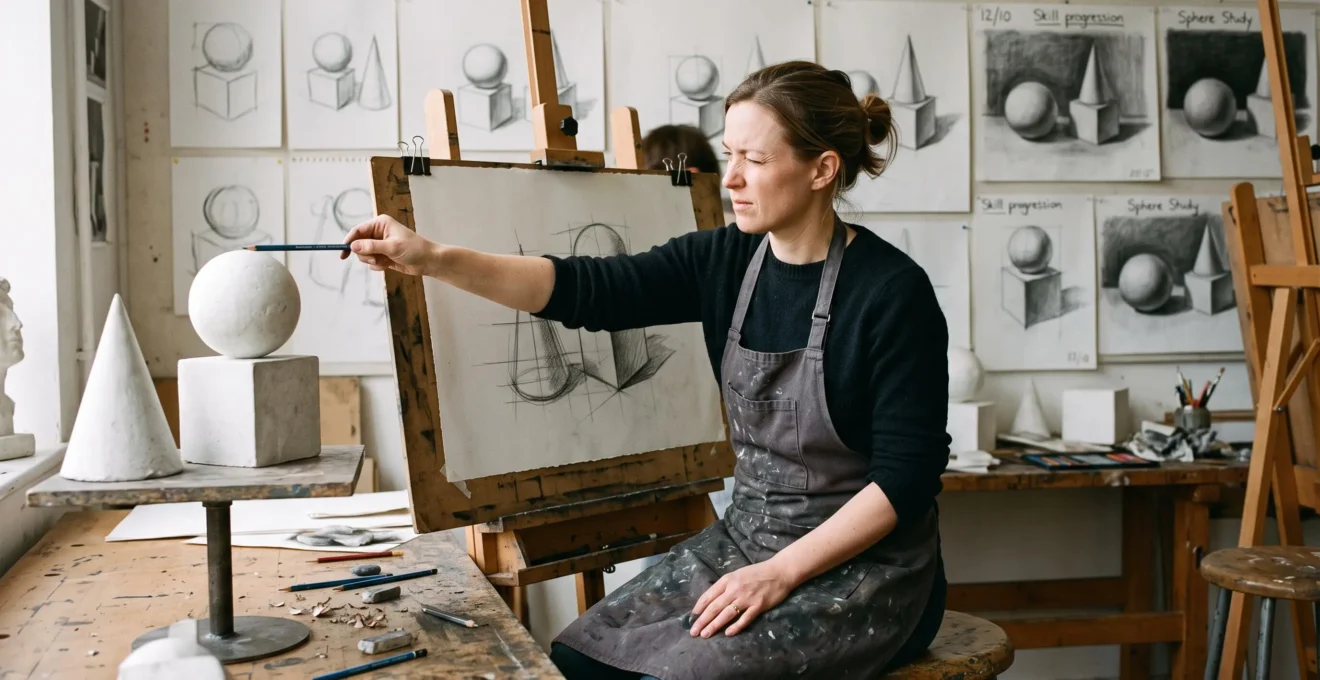
Before attempting complex anatomy, photorealistic painting, sophisticated colour harmonies, or intricate compositions, artists need dependable control of a few underlying abilities: observation, proportion, gesture, value, form, spatial relationships, and edge control. These are the skills that allow advanced techniques to produce intentional, repeatable results rather than occasional successes.
Technical readiness does not mean drawing every subject perfectly or spending years exclusively on exercises. It means recognising structural mistakes, correcting them, and applying familiar principles without exhausting all available attention. An artist can begin exploring advanced work while still strengthening these foundations, provided the complexity remains manageable.
For beginners, returning hobbyists, and self-taught artists, the most productive starting point is identifying which underlying ability currently limits progress. A convincing portrait may depend more on accurate proportions than detailed eyelashes. A believable landscape may depend more on value relationships than sophisticated colour mixing. Knowing which layer needs attention turns frustrating repetition into purposeful learning.
Essential art foundations at a glance
- Structure before detail: Develop proportion, gesture, form, perspective, and value relationships before relying on intricate rendering.
- Diagnose before practising: Use targeted visual tests and external feedback to identify the foundation behind recurring mistakes.
- Combine repetition with creativity: Practise weak skills deliberately, then apply them in personal projects until they become reliable under more demanding conditions.
- Why Do Self-Taught Artists Who Skip Fundamentals Hit Insurmountable Skill Ceilings?
- How Do You Diagnose Whether Proportion, Value, or Edge Control Is Your Weakest Foundation?
- Structured Fundamentals vs Following Passion: Which Learning Path Builds Skills Faster?
- The Unlearning Crisis: When Bad Habits From Skipped Basics Take 5 Years to Correct
- The Automaticity Threshold: When Do Basics Become Unconscious Enough for Creative Focus?
- Why Do Paintings With Perfect Colour but Wrong Values Look Flat and Unconvincing?
- Why Do Artists Practising 30 Minutes Daily Outpace Those Doing 5 Hours Weekly?
- Which Core Painting Methods Separate Amateur Attempts From Professional-Quality Results?
Why Do Self-Taught Artists Who Skip Fundamentals Hit Insurmountable Skill Ceilings?
Self-taught artists can encounter persistent skill ceilings because advanced techniques depend on abilities they have never developed systematically. Repeated practice of the advanced technique cannot reliably compensate for missing proportion, gesture, value, or spatial understanding. The resulting stall may feel insurmountable, but it often reflects an identifiable training gap rather than a permanent limit on artistic potential.
Complex artwork combines several decisions simultaneously. Drawing an expressive figure requires recognising the overall gesture, estimating proportional relationships, understanding three-dimensional form, and controlling the marks used to describe it. When one component remains unreliable, mistakes propagate into later stages.
Consider a hypothetical artist who has completed hundreds of anatomy studies but still struggles to draw convincing figures. The artist memorises muscle groups, adds increasingly sophisticated shading, and copies anatomical references. Yet the figures remain stiff because their initial gestures are weak and the torso-to-limb proportions are inconsistent.
More anatomy information cannot correct the underlying structural errors. The missing skill must be addressed at its own level.
The National Gallery of Art‘s introductory drawing techniques describe gesture and contour drawing alongside tonal techniques such as hatching and crosshatching. These provide practical ways to study overall form and mark-making separately. The resource establishes their instructional use, not a universal sequence that every artist must follow.
A useful distinction separates an ordinary learning plateau from a structural skill ceiling:
- Plateau: Performance temporarily stabilises, but focused feedback and adjustments within the same skill gradually produce improvements.
- Structural ceiling: The same type of error persists across different tasks, even after changing references, materials, or advanced exercises, suggesting that an underlying prerequisite remains weak.
To test the distinction, simplify the task. If complex figures repeatedly fail, try drawing their gesture and major proportions without anatomical details. If the simplified version also fails, the obstacle probably occurs before the anatomy stage.
Self-diagnosis remains imperfect because observation is itself a learned skill. An artist may reproduce an incorrect proportion without recognising the discrepancy. Independent critique, comparisons with references, and structured assessment can reveal patterns that familiarity conceals.
The practical goal is not to abandon ambitious artwork. It is to locate the earliest unreliable step, strengthen it independently, and then return to the original challenge with a more dependable process.
How Do You Diagnose Whether Proportion, Value, or Edge Control Is Your Weakest Foundation?
Diagnose your weakest artistic foundation by examining proportion, value, and edge control separately. Compare your drawing’s structural measurements with its reference, inspect the image in grayscale for tonal problems, and assess which contours appear sharp or soft. Recurring errors across several works provide stronger evidence than a single disappointing painting.
These three foundations contribute different information. Proportion determines whether objects and their parts relate accurately. Value establishes the relative lightness and darkness needed to describe form and illumination. Edge control regulates the clarity of transitions and helps direct visual attention.
When all three are judged simultaneously, one strong feature can disguise another weakness. Bright colours may distract from inaccurate values; detailed rendering can distract from distorted shapes.
The following diagnostic grid offers a starting point, not a validated clinical-style assessment.
| Visible symptom | Likely foundation | Practical verification |
|---|---|---|
| Faces, limbs, or objects appear stretched or misplaced. | Proportion | Compare landmarks, angles, and relative measurements with the reference. |
| The painting looks flat despite convincing colours. | Value structure | Compare grayscale versions and inspect major light-dark groups. |
| Every object looks equally sharp, busy, or visually confusing. | Edge hierarchy | Mark sharp, soft, and lost edges; assess whether they support the focal point. |
| Forms lack convincing depth even when outlines look accurate. | Form, perspective, or value | Check construction and lighting separately before deciding which causes the problem. |
For proportion, compare key landmarks rather than judging the entire image by intuition. Establish the width-to-height relationship, note the angles between important points, and, when appropriate, overlay a photograph of the drawing with its reference. Any overlay must account for camera angle and perspective differences.
For value, squint until small details disappear. A grayscale photograph or digital conversion can also help reveal whether the intended light and dark masses remain distinct. Grayscale conversion is a useful visual aid, although different colours and conversion methods can produce different apparent values.
A red viewing filter can provide another way to simplify some colour differences, but it does not produce a complete or objectively neutral value map. Compare the result with other methods rather than trusting the filter alone.
For edge control, identify every boundary that attracts immediate attention. Ask whether the sharpest transitions coincide with the subject’s intended focal area. If background objects are rendered with the same sharpness as the main subject, the composition may lack visual hierarchy.
Five actions to identify your weakest art foundation
- Select three recent artworks: Create a numbered comparison sheet showing all three at a similar viewing size.
- Check proportional accuracy: Mark three to five major landmarks on each work and record the recurring discrepancies.
- Inspect value relationships: Produce grayscale versions and annotate any areas where light and dark forms merge unintentionally.
- Map edge hierarchy: Identify the sharpest and softest transitions, then circle edges that distract from the intended focal point.
- Verify the diagnosis: Ask a qualified reviewer to assess the same works and write down one agreed training priority for your next practice cycle.
Prioritise the weakness that most consistently interferes with your intended work, not necessarily the one with the greatest number of visible errors. A painter focused on atmospheric landscapes and a portrait artist may reasonably rank the same weaknesses differently.
Once the weakest foundation is identified, the next decision concerns how to train it without sacrificing the motivation that makes regular artistic practice possible.
Structured Fundamentals vs Following Passion: Which Learning Path Builds Skills Faster?
Structured fundamentals can improve a targeted skill more efficiently by isolating weaknesses and providing feedback, while passion-driven projects encourage sustained engagement and broader experimentation. Neither approach guarantees faster progress for every artist. A combined method often offers the most practical balance: focused technical drills develop abilities that personally meaningful artwork then puts to use.
The distinction is between the efficiency of individual sessions and the sustainability of the learning process. A technically rigorous programme is ineffective when an artist consistently avoids it. Conversely, enjoyable projects may generate extensive practice without addressing the errors that limit improvement.
The two approaches also teach skills in different orders.
A structured drawing sequence might begin with observation, line, simple shapes, proportions, value studies, and spatial construction before progressing to complex subjects. A passion-first artist may begin with fantasy characters, detailed portraits, or dramatic landscapes, encountering foundational problems only when each project demands them.
The second route is not inherently invalid. However, the resulting gaps can follow a predictable pattern. A fantasy illustrator who concentrates on elaborate costumes may repeatedly avoid gesture and anatomy. A landscape painter who enjoys colour effects may postpone systematic value studies. Preferences therefore influence which fundamentals receive attention and which remain underdeveloped.
A hybrid schedule creates a deliberate connection between study and expression:
- Choose one weakness: For example, accurately measuring head proportions.
- Practise it in isolation: Make short comparative studies using simple forms or photographic references.
- Apply it immediately: Create a portrait that requires the same proportional decisions.
- Review the transfer: Compare the drill with the completed artwork to see whether accuracy survived greater complexity.
Suppose an artist wants to paint dramatic cityscapes. Rather than postponing the subject until every drawing fundamental feels secure, the artist can alternate perspective exercises with a cityscape project. The project gives the exercise a practical purpose, while the exercise reduces structural mistakes in the project.
The proportion of drills to projects does not need to be fixed. Artists preparing for an examination or seeking to repair a pronounced weakness may temporarily devote more time to structured exercises. Those rebuilding consistency after a long break may need more personally rewarding projects.
Judge the approach through observable outcomes: fewer repeated structural mistakes, better transfer to unfamiliar references, and a practice routine that remains sustainable.
Structured practice can accelerate targeted improvement, but its longer-term value depends on whether the artist also learns to use the new skill outside the controlled conditions of a drill.
The Unlearning Crisis: When Bad Habits From Skipped Basics Take 5 Years to Correct
Correcting an established artistic habit can be difficult because the old response may reappear when an artist works quickly, becomes distracted, or concentrates on creative decisions. However, there is no established five-year correction period for skipped art fundamentals. Recovery depends on the habit’s strength, continued repetition, feedback quality, and opportunities to practise the replacement behaviour.
Imagine a self-taught portrait artist who habitually draws eyes too high on the head. After recognising the problem, the artist may place them correctly during a slow measurement exercise, yet return to the familiar placement while painting an expressive portrait.
The discrepancy does not necessarily mean the correction failed. It means conscious correction and reliable execution under creative load are different achievements.
Research helps explain why these achievements should not be confused. In a scientific review on practice, habits and automaticity, Adrian Haith and John Krakauer discuss how practice can increase performance speed, strengthen habitual responses, and reduce cognitive demands. These effects do not necessarily develop together.
The review concerns skill learning and behaviour broadly. It does not measure artistic habit correction or establish how long particular drawing errors take to disappear.
For practical assessment, consider several factors:
- Habit frequency: How often does the mistake appear across sketches and completed work?
- Dependence on conscious checking: Can the artist avoid it only when measuring every decision?
- Task complexity: Does the error return when working from imagination or handling several demands simultaneously?
- Continued reinforcement: Is the artist still repeating the old approach between corrective exercises?
- Feedback: Is there a dependable method for recognising the error before it becomes embedded in the work?
A practical correction strategy begins by making the replacement behaviour unmistakable. During isolated exercises, an artist may deliberately exaggerate the opposite tendency to interrupt an established pattern. Such overcorrection is a coaching technique, not a universally validated scientific treatment, and should be adjusted to avoid forming a new distortion.
Next, restore normal proportions, increase drawing speed gradually, and reintroduce creative decisions. Check whether the old habit resurfaces as attention shifts elsewhere.
Finally, return to varied subjects. An artist who avoids portraits entirely to prevent a proportional error has reduced opportunities to practise the correction where it matters.
The objective is broader than eliminating a mistake under ideal conditions. The corrected action should remain available during sketching, experimentation, and finished work.
As a replacement behaviour becomes increasingly dependable, it may require less attention. That change leads to a more useful measure of readiness than counting how many months an artist has practised.
The Automaticity Threshold: When Do Basics Become Unconscious Enough for Creative Focus?
Artistic fundamentals become sufficiently automatic when familiar technical decisions require less deliberate attention, allowing more mental capacity for composition, expression, and experimentation. There is no universal automaticity threshold or fixed number of practice hours. The practical question is whether an artist can execute a particular skill reliably while also managing the creative demands of a more complex task.
Beginning artists often need to think consciously about every mark. They estimate angles, compare widths, adjust pencil pressure, and repeatedly check whether the subject looks correct. These decisions compete for limited attention.
With effective repetition, some operations can become faster and less demanding. An experienced artist may judge familiar shapes quickly while concentrating on the emotional character of a portrait or the rhythm of a composition.
That fluency does not mean the artist never checks their work. Instead, observation and correction become integrated into the process rather than interrupting it at every step.
Possible signs of increasing automaticity include:
- Recognising proportional mistakes relatively early, without lengthy reconstruction.
- Producing familiar forms consistently across several attempts.
- Managing technical execution while considering composition or expression.
- Recovering from small errors without abandoning the entire drawing.
- Maintaining reasonable accuracy when the task becomes moderately faster or more demanding.
Drawing while conversing may offer an informal indication that some actions require less attention, but performance under distraction is not a universal scientific test. A familiar drawing task and an unfamiliar one can create very different cognitive demands.
A more relevant exercise is to complete a short creative project while observing what occupies your attention.
For example, draw an expressive portrait. If most of the session is devoted to correcting basic facial placement, proportion still competes heavily with expression. If those structural decisions remain manageable and attention can shift toward character, emphasis, and design, the foundation may be sufficiently fluent for that type of portrait.
Importantly, automaticity is specific to the skill and context. Someone who draws frontal faces confidently may struggle with extreme angles or complex figures in perspective. Familiarity with one subject does not establish universal artistic mastery.
Automatic habits are not automatically correct, either. A repeated inaccuracy can become fluent, which makes periodic feedback important even after an artist feels confident.
Greater fluency frees attention for expression, but advanced challenges will continue to expose unfamiliar demands. Automaticity is therefore a developing, task-specific advantage rather than a final stage where fundamentals no longer need attention.
Why Do Paintings With Perfect Colour but Wrong Values Look Flat and Unconvincing?
Paintings with appealing colours can still look flat when their light and dark relationships fail to describe believable form, illumination, and depth. Hue alone cannot reliably establish these relationships. In representational painting, a coherent value structure helps distinguish illuminated surfaces from shadow, separate overlapping objects, and organise the viewer’s perception of the scene.
Value describes how light or dark a colour appears, independently of its general hue. Two colours may look dramatically different while having similar apparent lightness. If adjoining forms rely almost entirely on those hue differences, their boundaries may become less distinct when viewed in grayscale.
Consider a hypothetical painting of a red apple on a green table. The colours may be attractive, but if the illuminated and shadowed sides of the apple have almost identical values, the fruit can appear flat. Adding richer reds or more sophisticated colour harmonies does not necessarily correct the missing tonal structure.
By contrast, a monochrome study can depict convincing form using only carefully organised light and dark relationships.
The Getty‘s Understanding Formal Analysis resource distinguishes value, hue, and intensity while describing how shading and perspective can create the illusion of three-dimensional space.
This supports treating tonal relationships as an important foundation for representational painting. It does not establish that the human visual system invariably processes value before colour in every viewing condition or that all artistic styles must use realistic tonal modelling.
A practical prevention method is to plan values before developing complicated colour relationships.
- Make a small notan study: Reduce the composition to a few major dark and light masses.
- Choose a clear light arrangement: Identify the principal illuminated areas, shadows, and focal contrast.
- Create a monochrome study or underpainting: Check whether the subject reads convincingly without hue.
- Introduce colour: Preserve the important tonal relationships while varying temperature, saturation, and hue.
- Recheck the structure: Use squinting or grayscale comparisons to identify unintended value shifts.
Notan and monochrome underpainting are useful studio methods, but neither is compulsory for every medium or visual style. The underlying principle is to make value decisions consciously rather than expecting colour to repair structural uncertainty.
Value also works alongside edge control. A high-contrast boundary can attract attention strongly, while a subtle value transition may allow nearby forms to merge. The painter must therefore decide not just how light or dark an area should be, but how prominently its boundary should read.
Once values and edges can be controlled deliberately, the remaining challenge is making that control dependable through practice rather than relying on occasional successful paintings.
Why Do Artists Practising 30 Minutes Daily Outpace Those Doing 5 Hours Weekly?
Thirty minutes of daily art practice may support consistent skill development because it creates frequent opportunities for focused repetition, feedback, and revisiting earlier mistakes. However, it does not necessarily outperform five hours of weekly practice. The outcome depends on practice quality, spacing, skill difficulty, fatigue, and total effective training time rather than session frequency alone.
The numerical comparison also contains an important difference: thirty minutes every day amounts to three and a half hours per week, while the alternative provides five hours. They are not equal-duration schedules, so comparing their outcomes requires care.
Research on distributed learning offers relevant context. A 2006 meta-analysis of distributed practice by Cepeda and colleagues examined assessments examined in the 2006 meta-analysis of distributed practice 839 assessments from 317 experiments reported in 184 articles. The studies concerned verbal recall rather than drawing or painting performance.
The research found that spacing and retention intervals matter for memory. It does not demonstrate that short daily drawing sessions outperform concentrated weekly studio work, nor does it identify a universally optimal artistic schedule.
317 experiments
The number of experiments included in the 2006 meta-analysis of distributed practice and verbal recall. This is evidence about memory retention, not a direct comparison of artists using daily and weekly practice schedules.
Cepeda and colleagues, Psychological Bulletin, 2006.
In artistic training, the more useful distinction is between deliberate practice and unfocused repetition. A brief session spent correcting a specific proportional error may create a clearer learning opportunity than a long session spent repeatedly drawing familiar subjects without evaluating results.
But longer sessions have advantages of their own. Complex paintings, sustained observation, compositional experimentation, and finishing decisions often require uninterrupted periods that short exercises cannot comfortably accommodate.
A balanced weekly structure can combine both formats: short sessions for foundational drills and a longer session for integrating those abilities into demanding work.
For example, an artist might use several short sessions to practise gesture, proportion, value grouping, and edges, then reserve one extended studio session for a personal painting. The next short session can address weaknesses discovered during that project.
The structure creates a feedback loop between targeted technical work and complex application. It also avoids forcing every learning objective into the same session format.
To evaluate progress, compare drawings of similar difficulty over several weeks. Track one or two observable measures, such as proportional accuracy, clarity of major value groups, or the ability to complete a gesture study without repeated corrections.
Consistency helps establish the routine, but consistency without corrective feedback can reinforce the same mistakes. Likewise, rest and sleep may matter for learning, but the specific contribution of sleep to different artistic skills cannot be quantified from the sources considered here.
The best schedule is the one that produces observable improvement while remaining manageable. Once practice supports dependable fundamentals, artists can use those abilities within a more systematic painting process.
Key takeaways before moving into advanced painting methods
- Assess structural readiness: Confirm that major proportions and value groups work before investing effort in intricate details.
- Design visual attention: Decide where the strongest contrasts and sharpest edges belong rather than rendering every area equally.
- Use a repeatable workflow: Build paintings in stages, with checkpoints that reveal expensive errors before they become difficult to correct.
Which Core Painting Methods Separate Amateur Attempts From Professional-Quality Results?
Professional-quality painting is supported by a deliberate sequence of decisions: establishing composition, checking proportions, organising values, developing forms, and controlling edges before final detailing. These methods help reveal structural errors early and direct attention intentionally. They do not guarantee professional results, but they make execution more systematic, assessable, and repeatable.
The distinction is primarily about process rather than decorative complexity. A painting can contain beautiful brushwork and still suffer from weak composition or inaccurate proportions. Conversely, a relatively simple image can feel convincing when its structural and visual relationships are coherent.
A less controlled approach often begins with whichever passage seems most enjoyable: expressive eyes in a portrait, intricate architectural details, or colourful highlights in a landscape. By the time the artist recognises that the overall drawing is distorted, correcting it may require substantial repainting.
A planned workflow reverses that order by resolving large, consequential decisions before small ones.
| Stage | Detail-first approach | Foundation-led approach |
|---|---|---|
| Composition | Objects are arranged while painting progresses. | Major shapes and focal relationships are planned early. |
| Drawing | Details are refined before overall proportions are checked. | Landmarks, angles, and large forms are verified first. |
| Value | Light and dark relationships develop incidentally. | Principal value groups are established before detailed rendering. |
| Edges | Most boundaries receive similar attention. | Sharp, soft, and lost edges support the intended emphasis. |
| Final detail | Detail accumulates across the entire surface. | Detail is concentrated where it serves the image. |
The strongest operational differences often appear in value hierarchy and edge hierarchy.
Value hierarchy determines how the distribution of lights and darks supports the design. Edge hierarchy determines where transitions appear sharp, soft, or nearly invisible. Together, they help distinguish the focal point from supporting areas.
In a portrait, the eyes might receive carefully controlled contrast and sharper transitions, while parts of the hair merge softly into the background. In a landscape, the foreground may contain stronger separations than distant atmospheric forms. Neither arrangement is compulsory; both illustrate how hierarchy can guide attention.
The artist’s fundamental abilities make these decisions executable. Proportion allows an accurate initial drawing. Value control creates coherent illumination and massing. Edge control clarifies emphasis. Greater automaticity helps the artist maintain these relationships while concentrating on expression.
Working from general relationships toward specific details is therefore an error-management method, not simply a traditional preference. Different media and styles may require alternative sequences, but the need to manage dependencies remains useful.
Advanced techniques become meaningful when they extend these foundations. Glazing may refine colour relationships, complex brushwork may describe surfaces, and anatomical rendering may enrich a figure. None reliably replaces the underlying structural decisions those methods depend on.
For the next artwork, choose one manageable subject and begin with a small compositional sketch, a proportional check, and a simple value study. Develop the painting from large forms toward selective detail, then review whether the fundamentals remained dependable throughout. That completed comparison provides a practical basis for deciding which skill to strengthen next.
Do beginners need to master every drawing fundamental before learning to paint?
No. Drawing and painting fundamentals can develop alongside one another. Beginners can explore paint handling, colour, and composition while practising proportion, value, and observation. The important consideration is matching project complexity to current abilities and addressing recurring structural mistakes before relying on more sophisticated techniques.
Can tracing references help improve artistic fundamentals?
Tracing can be used to investigate contours, landmarks, and proportional relationships, particularly when followed by independent drawing. However, tracing alone does not demonstrate the ability to observe, measure, and reconstruct unfamiliar subjects. Compare traced studies with freehand attempts to determine whether the underlying spatial understanding is improving.
Are perspective and anatomy essential for every artistic style?
No. Their importance depends on artistic goals. Figure illustrators benefit from anatomical understanding, while artists representing architecture or believable spatial depth often need perspective skills. Abstract, decorative, and deliberately distorted styles may use different priorities. Observation, relationships, composition, and control over the chosen medium remain useful, but they can serve very different visual intentions.
How can returning artists assess skills after a long break?
Start with a few familiar exercises and one moderately challenging project. Compare the results with previous work where available, paying attention to proportional accuracy, value control, ease of execution, and error recognition. Some understanding may remain strong while speed or motor fluency feels less reliable. Use the results to select a manageable refresher programme.
When should an artist increase the difficulty of a practice exercise?
Increase complexity when the current exercise can be performed repeatedly with reasonable accuracy and mistakes can be recognised and corrected. Add one meaningful difficulty at a time, such as a new viewing angle, more complex lighting, or reduced guidance. If the new task produces widespread errors, simplify it enough to identify which foundational ability needs further practice.