
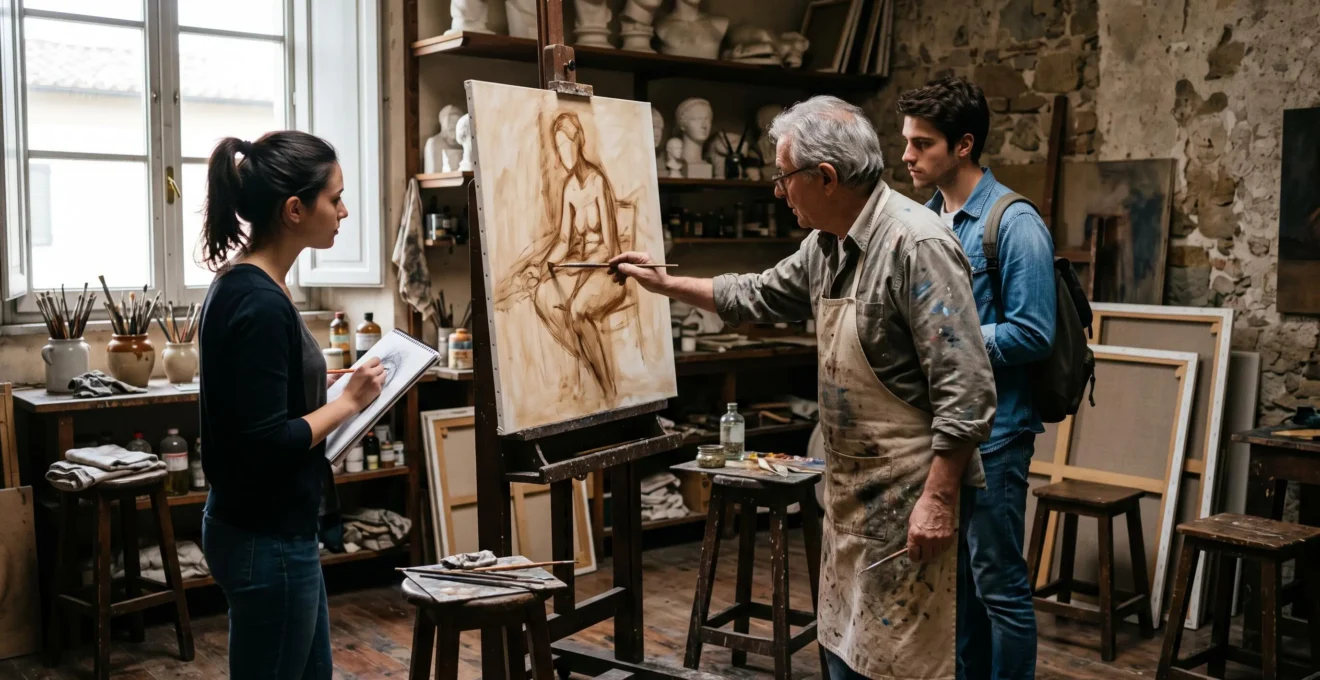
A painting student can watch a Renaissance glazing demonstration repeatedly, enlarge every brushstroke on a tablet and read a historical treatise in translation. Yet at the easel, that same student may still struggle to judge when a paint layer is sufficiently dry, how firmly to press a brush or why an apparently correct colour destroys the relationship between neighbouring values.
Passing down centuries-old artistic techniques requires more than preserving instructions. It requires preserving the conditions through which practical judgement develops: sustained observation, deliberate repetition, skilled correction and increasing responsibility for artistic decisions. Digital technology can strengthen those conditions, but cannot automatically supply them.
For art educators, academy instructors and traditional craft masters, the challenge is not to recreate a Renaissance workshop unchanged. It is to identify which elements of historical training remain educationally essential and which can be adapted without sacrificing the competence they were designed to produce.
The distinction matters because preserving the appearance of a tradition is not the same as preserving the ability to practise, evaluate and extend it.
How classical artistic knowledge survives modern education
- Protect supervised practice: technical mastery depends on repeated execution, observable standards and meaningful feedback, not simply exposure to historical methods.
- Use digital tools selectively: recordings, tablets and remote critique can support learning, provided physical practice remains central.
- Teach independent judgement: a successful apprenticeship produces artists capable of adapting inherited methods, not merely reproducing their teacher’s work.
- Why Do Three-Year Art Degrees Produce Graduates Who Cannot Execute Basic Classical Techniques?
- How Do Contemporary Ateliers Teach Oil Painting Mastery Through Five Progressive Skill Stages?
- Online Tutorials vs In-Person Mentorship: Which Builds Genuine Classical Painting Skills?
- The Demonstration Error That Creates Copyists Instead of Independent Artists
- The Skill Threshold: When to Release Students From Classical Constraints Into Creative Freedom
- Why Can’t Written Manuals Replicate the Skills Passed Through Master-Apprentice Relationships?
- Why Do Self-Taught Artists Who Skip Fundamentals Hit Insurmountable Skill Ceilings?
- Which Art Education Paths Lead to Professional Gallery Representation Versus Teaching Careers?
Why Do Three-Year Art Degrees Produce Graduates Who Cannot Execute Basic Classical Techniques?
Some three-year art degrees produce graduates with limited classical technique because their curricula prioritise broader educational objectives rather than sustained mastery of a particular craft. Critical theory, experimentation, contextual research and conceptual development can occupy time that an intensive atelier devotes to supervised drawing and painting. This reflects different educational priorities, not evidence that university graduates generally lack technical ability.
A conventional fine-art degree may rightly require students to investigate contemporary practice, document research, participate in critique and develop an independent artistic position. Classical apprenticeship, by contrast, concentrates much more heavily on practising skills under an experienced practitioner’s supervision.
Consider the demands of drawing a plaster cast. A student must repeatedly compare proportions, identify shadow boundaries, control tonal transitions and detect errors that are nearly invisible to an untrained eye. Understanding those requirements intellectually takes far less time than performing them reliably.
The decisive question is therefore not whether a university offers life drawing or a traditional painting elective. It is how much sustained, supervised practice a student receives in one discipline, and what standard must be reached before progressing.
Assessment can compound the difference. A university portfolio may appropriately reward investigation, conceptual coherence and experimentation across media. An atelier assessment may instead concentrate on whether a student’s measured drawing maintains accurate proportions, value relationships and edges. Neither criterion is intrinsically superior; each measures a different kind of achievement.
There is also a crucial distinction between knowing about a technique and independently executing it. A student may explain indirect oil painting, identify glazing media and discuss historical chiaroscuro without consistently controlling those methods in a finished painting. Written examinations cannot, by themselves, verify manual competence.
The experience of the instructor matters equally. Exhibition achievements and professional artistic recognition do not necessarily establish competence in teaching historic techniques. Equally, academic employment does not imply an absence of classical knowledge. Programmes seeking to transmit particular methods should explicitly assess whether instructors can demonstrate, diagnose and correct those methods.
A documented alternative: sustained atelier instruction
The Florence Academy of Art describes a full-time Drawing & Painting programme lasting three years, with daily practical work involving the figure, casts, portraits and still life alongside lectures in anatomy, art history and materials.
Its published curriculum provides a concrete example of an institution organising education around sustained technical practice. It does not establish that its graduates outperform university-trained artists or that its approach is appropriate for every artistic objective.
Programme details: The Florence Academy of Art’s Drawing & Painting curriculum.
Before recommending an institution, educators should ask how many supervised hours each week are dedicated to a specific discipline, how corrections are delivered and whether technical assessments require consistent independent execution. Published course titles are less informative than the actual learning conditions.
Once those conditions are established, the next challenge is organising technical instruction so that increasingly demanding skills build upon genuinely secure foundations.
How Do Contemporary Ateliers Teach Oil Painting Mastery Through Five Progressive Skill Stages?
Contemporary classical ateliers often teach oil painting through progressively demanding drawing and painting exercises. A practical five-stage model moves from charcoal cast drawing to grisaille, limited-palette painting, full-palette still life and figure painting. Students advance when essential skills are sufficiently reliable, rather than simply because a predetermined period has elapsed. Individual schools organise these stages differently.
This sequence follows a principle familiar to traditional workshops: complex tasks become manageable when their component skills have already been trained. The student is not expected to solve proportion, anatomy, colour temperature, brush handling and composition simultaneously from the beginning.
The five stages can be understood through their distinct learning objectives:
- Charcoal cast drawing: develop observational measurement, proportion, contour accuracy and tonal organisation without the additional complexity of colour.
- Grisaille painting: translate observed forms into monochromatic paint, learning opacity, value control and brush handling.
- Limited-palette painting: introduce controlled colour relationships while keeping mixing decisions sufficiently restricted for errors to remain identifiable.
- Full-palette still life: manage broader colour relationships, surfaces, edges and composition within a comparatively stable subject.
- Figure painting: integrate drawing, anatomy, values, colour and direct observation in a subject with greater structural complexity.
These five stages form a useful teaching model, not a universal historical curriculum. Some ateliers introduce Bargue drawings before casts, teach figure drawing alongside cast work or vary the order of painting exercises.
Digital tools can serve each stage without becoming substitutes for physical competence. A tablet can support preliminary gesture analysis, magnified photographs can reveal form relationships and recorded demonstrations can help students review an unfamiliar procedure before entering the studio. The educational condition is straightforward: observations made on a screen must be tested through actual drawing or painting.
Progression criteria matter more than promotional timelines. A student leaving the grisaille stage should demonstrate consistent value organisation and satisfactory paint handling across different subjects. Completing one convincing painting with extensive instructor intervention is weaker evidence than producing several competent studies independently.
When visiting an atelier, inspect the student work rather than looking exclusively at the instructor’s portfolio. Does the work reveal different levels of development? Are corrections made at the easel? Can teachers explain why one student advances while another repeats an exercise?
A five-step atelier verification checklist
- Request a weekly timetable and mark the hours devoted to supervised drawing or painting. Deliverable: a calculated weekly studio-hours total.
- Ask for the progression criteria used between two named exercises. Deliverable: a written list of observable advancement standards.
- Inspect student work from at least three training levels. Deliverable: a short record of visible differences in technical complexity.
- Observe an instructor demonstrating and correcting a practical exercise. Deliverable: one documented example of a specific, actionable correction.
- Ask how students who need additional practice are supported. Deliverable: a description of the school’s reassessment or repeat-exercise procedure.
Commercial pressures may encourage institutions to advertise accelerated progress. Such claims deserve scrutiny, but a shorter programme is not automatically inferior. The meaningful distinction is whether advancement depends on demonstrated competence and whether the advertised outcomes are realistic for the students admitted.
Even an exceptionally structured sequence can lose effectiveness when students practise extensively without receiving useful feedback. That is where the distinction between online instruction and direct mentorship becomes decisive.
Online Tutorials vs In-Person Mentorship: Which Builds Genuine Classical Painting Skills?
In-person mentorship offers particular advantages for classical painting skills requiring close observation and correction of physical actions. Online tutorials are well suited to explanations, demonstrations and preparation, but typically provide less immediate, personalised feedback. Neither format guarantees mastery: learning quality depends on instructional expertise, deliberate practice and the frequency and usefulness of correction.
The principal difference is often not access to information but the feedback available while a skill is being practised. A recorded demonstration may show the correct brush angle clearly. It cannot necessarily detect that an individual learner is applying too much pressure, misjudging paint consistency or repeating an inaccurate construction.
An in-person instructor may observe these problems as they occur. An online student may discover them only after submitting photographs or receiving scheduled critique. However, immediate intervention is not always optimal: students also need opportunities to recognise and correct their own mistakes.
A 2021 systematic review of feedback in motor-skill learning examined 23 studies across 11 countries involving school physical education. Ten of the thirteen studies comparing feedback with no feedback reported significantly improved motor-skill learning with feedback. These findings support the importance of instructional correction in practical learning, but they do not directly establish which feedback format works best for adult painting students.
A useful allocation of instructional resources distinguishes knowledge that can be studied remotely from physical performance that benefits from closer supervision.
| Learning requirement | Remote instruction | In-person mentorship |
|---|---|---|
| Historical methods and terminology | Suitable for lectures, reading and recorded explanations | Useful for discussion and contextual interpretation |
| Colour theory and composition | Suitable for structured exercises and image-based critique | Helpful for demonstrating relationships under consistent lighting |
| Brush pressure and paint consistency | Possible to demonstrate, harder to assess fully through ordinary recordings | Allows direct observation of movement and material behaviour |
| Edge handling and surface transitions | Useful for analysis with sufficiently detailed visual feedback | Allows direct comparison between observed subject and painted result |
| Independent artistic decisions | Can develop through assignments and live critique | Can develop through supervised decision-making and discussion |
For remote learners, a structured correction routine can reduce the disadvantages of unsupervised repetition. Record a practical session, stop at planned intervals, compare the actual painting with its subject, annotate suspected errors and bring the record to a qualified instructor for critique when possible.
Tuition fees are only one part of the educational cost. Inexpensive tutorials may require more independent diagnosis and repeated attempts, whereas mentorship costs more directly but can offer tailored guidance. There is no reliable universal calculation showing which format produces faster mastery or lower total expenditure.
Instructor credibility deserves scrutiny in either setting. Seek evidence of sustained practice, clear demonstrations of the skills being taught, student progress over time and a willingness to identify errors. An impressive finished painting or polished video is not sufficient evidence of teaching effectiveness.
A hybrid arrangement often offers a sensible educational structure: remote resources prepare students for studio practice, while direct correction focuses on the difficult physical and perceptual decisions that general demonstrations cannot resolve for every individual.
The Demonstration Error That Creates Copyists Instead of Independent Artists
The demonstration error occurs when an instructor repeatedly completes an entire artwork while students imitate the same decisions without understanding why they were made. Learners may become proficient at reproducing a teacher’s procedure yet remain dependent on that procedure when the subject, lighting or materials change. Effective demonstration must therefore teach artistic judgement alongside physical technique.
Traditional craftsmanship is not preserved simply because students can reproduce a recognisable style. A painting method survives meaningfully when practitioners understand the principles that make it effective under different circumstances.
Imagine a master demonstrating a portrait underpainting. The instructor selects the dominant shadow mass, establishes the principal proportions and adjusts the paint mixture while students follow each action. The finished result may be educationally impressive, but students have not necessarily practised making those choices themselves.
A more demanding method is to interrupt the demonstration at decision points. The master might establish the first major shapes, then ask students which value relationship should be corrected before proceeding.
In a hypothetical limited-palette lesson, three students receive the same still-life arrangement. Before the instructor reveals the next mixture, each student must propose a solution for bringing a warm midtone into the correct relationship with a cooler surrounding shadow. The instructor then compares the proposals, demonstrates a choice and explains the reasoning.
This teaches more than the selected mixture. It teaches students to identify the problem, weigh alternatives and test an outcome against what they can observe.
The corrective method can follow a repeatable pattern:
- Demonstrate the initial procedure without completing the entire problem.
- Pause when a meaningful technical or visual judgement becomes necessary.
- Require students to choose and explain their next action.
- Demonstrate a reasoned solution and compare alternatives.
- Assign a variation in which students cannot simply repeat the demonstrated arrangement.
Student portfolios can reveal whether an institution encourages independent decisions. A wall filled with nearly identical paintings deserves questions about the assignments and the amount of choice permitted, although uniform studies can be entirely appropriate during foundational training. At advanced levels, stylistic variation becomes more informative.
Technical independence does not require rejecting a master’s methods. It requires understanding them well enough to decide when to apply, modify or deliberately depart from them.
Once students learn to make defensible technical decisions, the educator must determine when disciplined imitation has served its purpose and greater creative freedom can begin.
The Skill Threshold: When to Release Students From Classical Constraints Into Creative Freedom
Students should gain greater artistic freedom when they can demonstrate reliable control of essential techniques while making and correcting decisions independently. The release point is an observable level of competence, not a birthday, graduation date or fixed number of practice hours. Classical constraints are most valuable when they prepare students to work beyond those constraints.
A student who can produce an accurate cast drawing only when an instructor continually corrects it has not yet achieved the same independence as one who recognises proportion errors and resolves them without prompting. Likewise, a painter who handles a familiar limited palette confidently may still need guidance when introducing unfamiliar pigments or changing lighting conditions.
Technical readiness can be evaluated through varied assignments rather than a single polished outcome. Instructors might ask students to:
- Construct a convincing figure study without tracing, then compare it with observation or reference material.
- Mix an assigned tonal value within three attempts, using the exercise as a diagnostic rather than a universal mastery threshold.
- Maintain consistent value relationships under a defined time constraint.
- Explain the reasoning behind adjustments to an unsuccessful painting.
- Produce two distinct compositions using the same foundational technical methods.
These are proposed teaching assessments, not historically documented certification standards. Drawing from memory is particularly useful for revealing weaknesses in construction, although an artist who specialises in direct observation need not reproduce every subject accurately from memory to demonstrate professional competence.
Two educational errors surround the transition. Releasing students too early can leave weaknesses in drawing, value or materials handling unresolved. Yet maintaining rigid restrictions indefinitely can produce students who fear decisions not explicitly approved by their teacher.
Historically, workshop production could bring technical execution and practical responsibility together. The precise arrangements differed across periods and trades, but work intended for patrons offered a different form of challenge from copying an exercise solely for instruction.
A contemporary equivalent is an independently planned project with defined technical expectations. For example, a student might develop a composition using an unfamiliar subject while demonstrating sound drawing, controlled values and appropriate paint handling. The instructor critiques the outcome without prescribing every choice.
Students accustomed to digital undo functions may initially regard irreversible marks and restricted palettes as frustrating. Educators can make constraints more intelligible by explaining their purpose, defining exit conditions and allowing experimentation alongside disciplined exercises.
The goal is not to prohibit tools that make revision easier. It is to ensure students can diagnose visual problems and make deliberate choices even when those tools are unavailable.
This transition depends heavily on knowledge that cannot be fully reduced to written instructions. Understanding that limitation is essential when adapting historical apprenticeships for contemporary education.
Why Can’t Written Manuals Replicate the Skills Passed Through Master-Apprentice Relationships?
Written manuals preserve descriptions, sequences, materials and artistic principles, but cannot fully reproduce the individual correction and contextual judgement provided by an experienced master. Practical knowledge often involves subtle changes in movement, pressure, timing and material response. Manuals remain valuable; their limitation is that reading an instruction is not equivalent to demonstrating competence in applying it.
Historical texts such as Cennino Cennini‘s accounts of artistic practice provide important evidence of materials, workshop procedures and established techniques. Yet a written instruction concerning brush handling or pigment preparation cannot reproduce every physical condition encountered by a learner.
Consider the instruction to apply paint thinly. Its meaning depends on pigment behaviour, the prepared surface, the medium, brush loading and the desired visual effect. An experienced painter adapts these variables through observation and accumulated judgement. A novice may understand the phrase while repeatedly choosing the wrong consistency.
This is the problem of tacit knowledge: relevant competence is expressed through skilled action and situational response, rather than through instructions alone.
Traditional apprenticeship also transmitted expectations about materials, quality and professional conduct. Students could observe how a workshop conserved expensive supplies, maintained tools, evaluated unfinished work and organised production. These practices are not identical across historical periods or cultures, but they illustrate why a working community transmits more than technical recipes.
UNESCO‘s account of traditional craftsmanship as intangible cultural heritage emphasises the transmission of skills and knowledge to future generations. Its framework recognises apprenticeship practices while also distinguishing the survival of craft knowledge from the preservation of finished objects.
Modern recording technology significantly expands the possibilities for documenting practical work. High-resolution video can capture movement, tool position and the visible progression of a painting. Such recordings may preserve information that would otherwise disappear when an experienced practitioner retires.
Nevertheless, a recording cannot automatically determine whether a particular student’s failure arises from a drawing error, unsuitable material behaviour or misunderstanding of the intended effect. That diagnosis requires either an appropriately skilled person or a reliable feedback process.
A workable digital apprenticeship should therefore combine recorded demonstrations with regular critique from a competent practitioner, sustained physical exercises and a peer community that maintains shared standards. Students also need opportunities to compare their work with real subjects and materials, not only digital reproductions.
Historical reconstruction demands additional caution. Certain preparation methods may be difficult to reproduce accurately from surviving documentation, but the supplied evidence does not establish that any particular varnish or pigment recipe is definitively unrecoverable. Living practitioners can contribute valuable comparative evidence without guaranteeing that their methods have remained unchanged for five centuries.
Heritage transmission may also involve community-specific knowledge and restrictions on who is authorised to practise or teach particular traditions. Responsible preservation must respect those contexts rather than treating every inherited technique as unrestricted instructional material.
When that corrective relationship is absent, independent learners can still progress. The critical question is whether their practice exposes and resolves foundational weaknesses or allows them to remain concealed.
Why Do Self-Taught Artists Who Skip Fundamentals Hit Insurmountable Skill Ceilings?
Self-taught artists can encounter persistent skill ceilings when unresolved weaknesses in drawing, construction or tonal control begin to limit more advanced work. Greater complexity exposes deficiencies that simpler subjects or familiar techniques may conceal. Such ceilings are not necessarily insurmountable, however: targeted foundational practice, critical feedback and revised working methods can enable substantial progress.
Consider an artist who achieves attractive results by combining photographic references with confident colour choices. The work may be successful within that approach. Difficulty emerges when the artist attempts to invent an unfamiliar figure pose, change the direction of light or construct a complex arrangement without relying on an existing image.
If the underlying problem is weak spatial construction, adding more colour knowledge may not resolve it. If value organisation is uncertain, increasingly elaborate surface detail can make the painting more complex without making the forms more convincing.
This creates a potential compensation spiral. Artists develop additional procedures to avoid a persistent difficulty rather than addressing it directly. Tracing, photographic reference and stylisation may become part of that pattern, although none of these practices is inherently illegitimate or evidence of inadequate skill.
The distinction is whether an artist chooses a method intentionally or relies upon it because another required capability remains unavailable.
A useful diagnostic exercise is to construct a subject from imagination, identify the stage at which the drawing becomes unreliable and then verify the problem through observation. The outcome should be treated as a guide to further training rather than a verdict on artistic worth.
For example, an invented seated figure might reveal consistent errors in the pelvis and ribcage relationship. The next exercise should not necessarily be a larger finished painting. It might be a series of targeted structural studies, followed by another independent construction attempt.
Successful self-directed learning often includes the same underlying mechanisms found in organised classical training: sequencing, deliberate repetition, comparison with observation, diagnosis and correction. A formal teacher can make these mechanisms easier to access, but no institution has an exclusive claim to them.
Digital tools present both opportunities and risks. Unlimited references, adjustable layers and rapid experimentation can support learning. They can also permit an artist to postpone confronting a particular weakness if the working process consistently conceals it.
The educational response should be specific rather than punitive. An instructor working with an experienced self-taught painter can preserve that artist’s existing strengths while designing a limited sequence of exercises around the actual technical obstacle.
Technical competence matters, but artistic development also involves questions about professional positioning. The final educational decision is therefore not simply how to acquire classical skills, but what kind of career those skills are intended to support.
Key decisions before choosing a professional art education path
- Separate the qualifications needed to perform a craft from the credentials required for a particular employment opportunity.
- Evaluate whether training provides opportunities to build an independent body of work and professional relationships.
- Consider long-term financial and institutional stability alongside technical prestige when planning a teaching career.
Which Art Education Paths Lead to Professional Gallery Representation Versus Teaching Careers?
Gallery representation and teaching careers place different demands on artistic education. Galleries generally assess the work, the artist’s professional direction and the potential for a sustained relationship, while institutional teaching appointments may involve formal academic requirements. Atelier training can support both ambitions, but neither classical mastery nor a university degree guarantees representation or employment.
A technically accomplished painting demonstrates valuable skill. It does not automatically establish that a gallery can identify a coherent artistic direction across a larger body of work or envisage a continuing relationship with the artist.
Gallery representation also depends on professional networks, exhibition opportunities, the gallery’s programme and circumstances within a particular market. Artsy‘s reporting on how galleries choose artists, based on interviews with gallerists, illustrates the complexity of identifying, contacting and establishing relationships with artists. It does not provide a universal selection formula.
For an artist seeking representation, a sensible developmental sequence may involve completing substantial technical training, establishing a distinctive body of work, participating in suitable exhibitions, documenting professional activity and gradually developing relationships with relevant galleries.
For an aspiring educator, the route depends more strongly on the intended institution. Teaching privately in a studio differs from applying for a university lectureship, an accredited school appointment or a specialist workshop position. The applicable qualifications vary between institutions and jurisdictions, including across English-speaking countries.
| Education path | Potential advantages | Important limitations |
|---|---|---|
| Classical atelier | Intensive practical study, individual technical correction and possible preparation for teaching inherited methods | Recognition of qualifications varies; independent professional development may require additional work |
| University fine-art degree | Academic research, critical dialogue, conceptual development and qualifications relevant to some institutional roles | Depth of specialist classical instruction varies substantially by programme |
| Hybrid education | Combines focused technical development with academic or contemporary artistic practice | Requires careful planning of costs, workload and curriculum compatibility |
| Independent study with mentorship | Flexible specialisation and direct alignment with individual artistic goals | Quality assurance, professional networks and recognised credentials may be less readily available |
Classically trained artists also face a positioning decision. Some wish to work explicitly within traditional representational genres; others use inherited techniques in dialogue with contemporary subjects and artistic ideas. Both directions can support serious professional work. The portfolio should make the intended artistic position understandable without forcing it into an artificial category.
Teaching traditional methods through a private atelier or workshop can offer independence, but may bring irregular enrolment, administrative responsibilities and dependence on a small group of students. Building an online teaching practice introduces additional production and marketing demands. These risks should be evaluated rather than concealed behind the prestige of an artistic lineage.
A prospective academy instructor should investigate faculty requirements, the institution’s financial sustainability, opportunities for supervised teaching and the practical possibility of developing an independent studio practice alongside instruction.
The most useful next step is to write a professional objective in concrete terms, then compare prospective institutions against the technical instruction, recognised credentials, independent practice opportunities and career support that objective genuinely requires. Classical methods are most likely to survive when the next generation can practise them confidently, teach them responsibly and apply them to work that matters in its own time.
Can classical painting techniques be taught effectively to students who primarily use digital tools?
Yes. Digital experience need not prevent students from developing traditional skills. Recordings, reference analysis and digital sketches can support instruction when students also practise with physical materials and receive meaningful feedback. The essential requirement is that digital convenience does not replace the manual and perceptual competence being taught.
How can an academy preserve a retiring master’s specialist knowledge?
Document practical demonstrations, material choices, common errors and the reasoning behind corrections while the master can still explain them. Pair those records with supervised training for successor instructors, including independent demonstrations and assessed teaching practice. Video archives help preserve information, but continuity depends on future practitioners being able to perform and teach the technique.
Does a student need to reproduce historical workshop conditions to learn Renaissance techniques?
No. Contemporary institutions can retain deliberate practice, material understanding and skilled correction without recreating historical social hierarchies or outdated working conditions. Educators should also account for modern health and safety requirements, especially when using potentially hazardous pigments, solvents or preparation methods. Fidelity to an artistic principle need not require reproducing every historical material or procedure.
What evidence shows that a classical technique has genuinely been passed to a new generation?
The strongest practical evidence is not a student copying a master’s finished work. It is a student independently demonstrating the method, explaining important decisions, diagnosing errors and applying the technique to unfamiliar problems. The ability to teach it accurately to another learner provides an additional indication of continuity, although comprehensive historical authenticity may require separate research.