
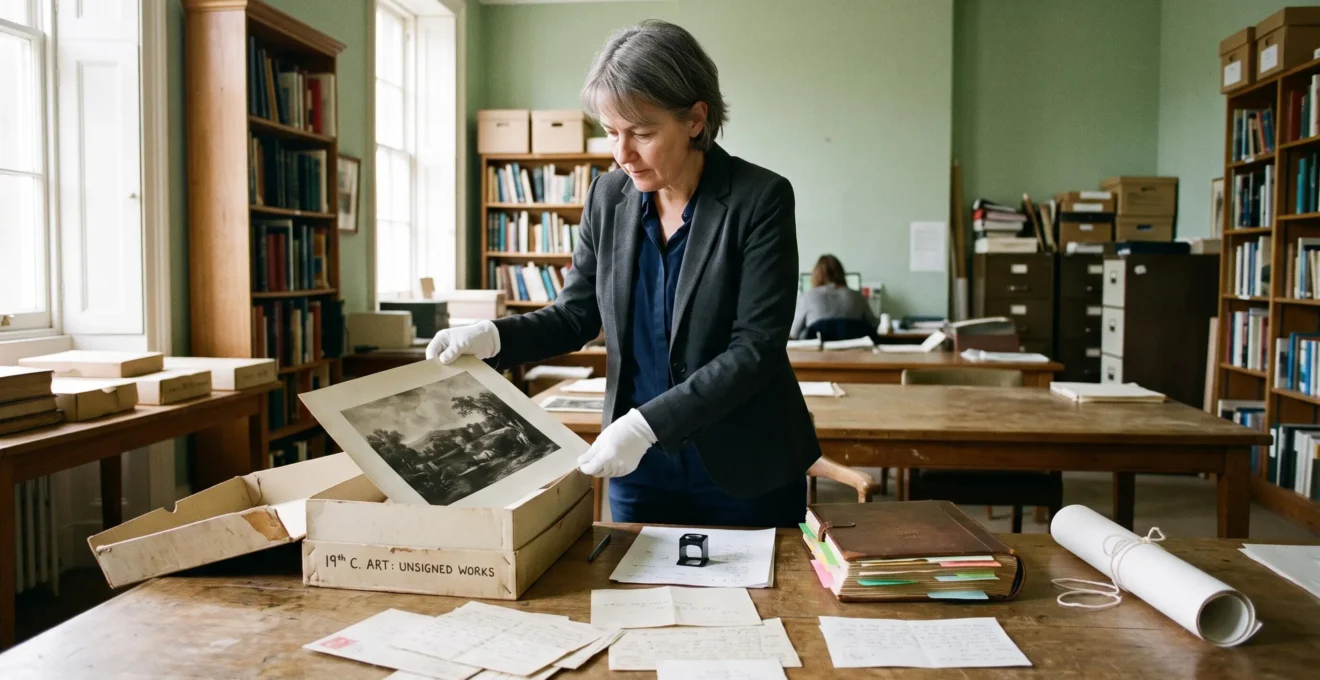
A curator who knows an obscure artistic subfield exceptionally well can become more professionally valuable than a generalist with a much larger public profile. The advantage comes not from obscurity itself, but from developing expertise that museums, researchers, collectors and other specialists cannot easily replace.
In a field such as seventeenth-century Dutch still-life painting, genuine authority means recognising the significance of an unfamiliar inventory, questioning an inherited attribution, connecting objects across dispersed collections and explaining why those findings change an established interpretation. That expertise develops through sustained contact with primary sources, methodological discipline and research that other scholars can evaluate.
For emerging curators and doctoral researchers, the challenge is choosing a sufficiently productive territory, making original contributions visible and knowing when to expand beyond the initial specialisation. A narrow research subject can support a broad professional trajectory, provided its questions remain consequential and its methods transferable.
How specialist curatorial authority develops
- Choose a narrow field with accessible primary evidence, unresolved questions and several possible institutional audiences.
- Build recognition through original, verifiable contributions: publications, object research, catalogues and argument-driven exhibitions.
- Expand into adjacent subjects only when your existing expertise provides a credible foundation for broader responsibilities.
- Why Do Museums Hire Unknown Specialists Over Famous Generalists for Major Exhibitions?
- How Do You Find Art Historical Niches With Enough Depth for a 30-Year Career?
- Single-Artist Expertise vs Movement Surveys: Which Specialisation Strategy Opens More Doors?
- The Dead-End Niche: When Hyper-Specialisation Kills Career Prospects
- The Expansion Moment: When to Leverage Niche Expertise Into Broader Curatorial Roles
- How Do You Identify Art Historical Questions That Haven’t Already Been Answered?
- Why Do Thematic Groupings Feel Shallow Compared to Exhibitions With Clear Arguments?
- What Makes Art Historical Research Publishable in Top-Tier Academic Journals?
Why Do Museums Hire Unknown Specialists Over Famous Generalists for Major Exhibitions?
Museums may favour a relatively unknown specialist when an exhibition demands unusually deep knowledge of objects, archives, provenance and unresolved scholarly disputes. In such projects, demonstrable expertise can matter more than public recognition. This is not a universal hiring rule: the institution’s objectives, available resources, exhibition audience and professional requirements determine which candidate is most suitable.
Consider a proposed exhibition reassessing the attribution of Dutch still-life paintings dispersed across European and North American collections. A well-known generalist might communicate the period’s cultural significance effectively. Yet a researcher who has studied workshop practices, historical inventories and individual paintings for years may be better equipped to evaluate disputed objects and explain the evidence behind an attribution.
The distinction becomes important when scholarly errors could undermine a catalogue, an exhibition argument or relationships with lending institutions. A specialist can identify uncertainties before they become public claims. That capacity is especially useful when rare works require careful documentary examination.
The College Art Association guidance on curatorial careers identifies subject expertise, authenticity research, provenance investigation, scholarly publication and exhibition development as important curatorial responsibilities. It also distinguishes specialist positions in larger institutions from broader collection responsibilities commonly found elsewhere.
Exhibition lenders must assess borrowing institutions and project conditions. A respected specialist may strengthen the scholarly credibility of a proposal, although expertise alone cannot guarantee access to a requested object.
The following decision grid illustrates how different institutional priorities can favour different profiles. It is a practical framework, not a measured ranking of museum recruitment outcomes.
| Project criterion | Niche specialist | Established generalist |
|---|---|---|
| Scholarly reassessment | Strong advantage when detailed corpus knowledge is essential | Useful for connecting findings with wider historical debates |
| Public-facing blockbuster | Provides object-level research and scholarly credibility | May offer wider interpretive and communication experience |
| Academic audience | Can address specialised evidence and contested attributions | Can situate findings within larger art-historical narratives |
| General museum audience | Contributes distinctive discoveries and compelling objects | May have experience explaining broad historical narratives |
| Complex loan negotiations | Offers specialist documentation and object knowledge | May contribute institutional relationships and project leadership |
| Catalogue responsibility | Well positioned for detailed scholarly entries | Well positioned for broader synthesis and contextual essays |
The central career lesson is that professional authority depends on the usefulness and reliability of expertise, rather than reputation alone. An early-career researcher who becomes the person colleagues consult about a difficult group of works has started developing a recognisable scholarly position.
That position becomes sustainable only when the research territory contains enough material and questions to support continuing contributions.
How Do You Find Art Historical Niches With Enough Depth for a 30-Year Career?
A sustainable art-historical niche contains more than an interesting subject. It offers substantial primary material, questions that can be approached through different methods, and connections to collections or debates beyond a single institution. No investigation can guarantee thirty years of professional demand, but examining the available evidence and research infrastructure can reveal whether a niche has room to grow.
Start by distinguishing between fashionable niches and structural niches. The former attract attention because a subject currently features prominently in exhibitions, scholarship or institutional programmes. The latter have continuing research needs connected with collections, documentation, attribution, provenance or conservation.
These categories can overlap. A newly prominent subject may reveal a substantial, previously neglected archival record. Conversely, an established collecting field may offer fewer accessible original questions than its institutional visibility suggests.
The practical test is whether the niche can generate several research programmes rather than a single dissertation.
- Primary material: Are there historical inventories, correspondence, technical records, exhibition catalogues or undocumented works that remain open to investigation?
- Research access: Can evidence be consulted through multiple archives, collections or digitised resources?
- Scholarly disagreement: Are important interpretations, attributions or chronological assumptions still contested?
- Institutional relevance: Do museums, libraries or research programmes have continuing reasons to investigate the material?
- Methodological flexibility: Could new conservation findings, collecting histories or comparative research reopen existing questions?
- Adjacent territory: Can investigations expand into neighbouring artists, production networks, trade or cultural history?
The Getty Museum documentation on provenance research illustrates the continuing evidentiary work involved in tracing objects through sale catalogues, inventories, personal papers and physical marks. Such records can raise successive questions about ownership, identification and historical interpretation, although individual cases may remain unresolved.
A useful example is a hypothetical researcher focusing on a little-studied group of seventeenth-century still-life painters. The initial project might examine authorship. Later projects could investigate workshop exchanges, patronage, export markets, material techniques and the reception of paintings in later collecting traditions. Each question returns to the same core corpus while developing a different contribution.
This is the adjacency principle: the strongest narrow territories provide routes into neighbouring problems without requiring researchers to abandon their distinctive knowledge.
Five steps to assess a potential research niche
- Compile a bibliography of foundational and recent scholarship. Deliverable: an annotated reading map identifying established positions and recurring uncertainties.
- Locate relevant archives, museum collections and historical catalogues. Deliverable: a source inventory recording holdings, access conditions and known gaps.
- Identify unresolved empirical, interpretive and methodological questions. Deliverable: a research matrix connecting each proposed question to available evidence.
- Map potential institutional and methodological connections. Deliverable: a diagram of neighbouring fields, relevant collections and transferable research techniques.
- Design three distinct projects with different scholarly outputs. Deliverable: a provisional research portfolio demonstrating potential continuity beyond the initial thesis.
One important warning concerns dependence. If essential documents belong to one inaccessible estate, or if only one supervisor or institution supports the topic, the researcher has limited control over the project. Diversifying sources and professional relationships reduces that exposure.
Once a territory appears viable, the next decision concerns its intellectual boundaries: whether to organise expertise around an individual artist or a wider artistic formation.
Single-Artist Expertise vs Movement Surveys: Which Specialisation Strategy Opens More Doors?
Single-artist expertise can create opportunities in attribution, catalogue research, provenance and detailed object scholarship. Movement-level expertise is often better suited to comparative exhibitions, teaching and broad interpretive publications. Neither guarantees better career outcomes. The appropriate strategy depends on the available evidence, competition within the field and the kinds of institutions or scholarly projects the researcher hopes to join.
A monographic specialist concentrates on one artist’s production, documentary record, relationships and reception. This depth can make the researcher particularly useful when questions about authorship or the boundaries of a corpus arise.
However, expertise should not be confused with authentication authority. Formal authentication practices, institutional responsibilities and legal consequences vary, and a scholar’s opinion may be only one element of an attribution assessment.
Movement-level specialists investigate broader groups of makers, artistic exchanges and shared historical conditions. Their advantage lies in constructing comparisons that may not be visible through a single artist’s work.
| Career dimension | Single-artist expertise | Movement-level expertise |
|---|---|---|
| Core research | Individual works, chronology, attribution and documentation | Comparative developments, networks and historical interpretation |
| Potential projects | Catalogue raisonné, monograph, collection research | Survey exhibition, edited volume, thematic research programme |
| Professional distinction | Depth of knowledge about a defined corpus | Ability to connect multiple artistic practices |
| Principal vulnerability | Dependence on a limited corpus or competing specialist claims | Difficulty demonstrating expertise that is not readily interchangeable |
| Expansion route | Artist’s circle, workshops, patrons and markets | Focused case studies or cross-period questions |
An additional question is whether the selected territory is intellectually ownable. Ownership here means developing an identifiable contribution, not claiming exclusive rights over an artist or subject.
Examine the existing bibliography. Has one scholar already documented virtually every accessible work? Are several active researchers publishing competing interpretations? Is there a neglected evidentiary category, such as dealers’ records or technical examination, through which a distinctive contribution remains possible?
A promising strategy is to establish a monographic anchor and expand deliberately. A researcher might begin with one Dutch still-life painter, investigate the workshop network surrounding that artist and subsequently examine broader patterns of collecting or artistic exchange.
This approach protects depth while developing relevance beyond a single name. It also helps mitigate the risk that another scholar publishes a major discovery first. A rigorous, diversified portfolio cannot eliminate competition, but it makes professional expertise less dependent on one anticipated publication.
Movement specialists face a different challenge: demonstrating why their particular synthesis matters. An original analytical framework, distinctive source base or technical competency can differentiate them from other scholars working on the same period.
Whichever route is chosen, specialisation becomes hazardous when its intellectual boundaries prevent the development of skills that other institutions need.
The Dead-End Niche: When Hyper-Specialisation Kills Career Prospects
Hyper-specialisation becomes a career liability when research opportunities, access to evidence and institutional demand contract without leaving transferable capabilities. The problem is not necessarily that the subject is small. It is that the researcher can no longer produce consequential work or explain how their expertise solves problems beyond the original corpus.
A narrow field may still support valuable scholarship even when public attention is limited. Conversely, a prominent but heavily studied subject may offer little room for an emerging researcher to contribute something distinctive.
The relevant distinction is between subject scarcity and opportunity scarcity.
Potential warning signs include:
- Fewer conference sessions, research projects or institutional initiatives engaging with the subject over time.
- Limited recent acquisitions or collection activity that would generate new documentation or object research.
- Major attribution, provenance or interpretive questions appearing exhausted or blocked by missing evidence.
- Essential archives being controlled by a single estate or institution with restrictive access conditions.
- Research support depending disproportionately on one collector, foundation or individual patron.
These indicators require interpretation. A small conference presence does not establish that a subject lacks scholarly value. Museum acquisition patterns can reflect budgets or collecting policies rather than the research potential of an entire field. The warning becomes more persuasive when several independent sources of opportunity are contracting together.
Funding dependence deserves particular attention. If a collector supports the only exhibition programme in a niche, would scholarly or institutional work continue if that funding stopped? Are independent collections and archives available? Could the same research methods address questions valued elsewhere?
The last question points towards the most useful corrective strategy.
Imagine, as a hypothetical example, a curator specialising in a restricted group of paintings whose archival documentation is no longer accessible. Rather than simply changing periods, the researcher could apply established expertise in historical inventories and ownership reconstruction to a neighbouring corpus with better documentary access.
Alternatively, research initially focused on the stylistic classification of one workshop could be reframed as an investigation of artistic labour, collaborative production or collecting practices.
These pivots preserve the researcher’s methodological investment. Expertise in provenance, technical art history, collection documentation, exhibition development or archival interpretation is potentially useful across numerous subjects.
The professional risk is highest when a specialist identifies entirely with a topic and neglects the competencies required to investigate it. The niche establishes scholarly distinction; transferable methods make that distinction employable.
When the research foundation remains strong, a different question emerges: whether the specialist has achieved enough recognition to expand deliberately rather than defensively.
The Expansion Moment: When to Leverage Niche Expertise Into Broader Curatorial Roles
The right time to expand is when established specialist work provides a credible foundation for responsibilities beyond the original corpus. Useful signals include substantive publications, recognition from other researchers and invitations to contribute to adjacent projects. These signs do not guarantee advancement, but they suggest that expertise has become sufficiently visible to support a broader professional identity.
Expansion is most convincing when colleagues can understand the connection between earlier contributions and new responsibilities.
A curator recognised for research on seventeenth-century Dutch still-life inventories might develop an exhibition about collecting practices. The next project could investigate changing relationships between painting, commerce and material culture. A subsequent role might involve responsibility for a broader collection of early modern European art.
The progression follows a clear sequence: corpus expertise → thematic interpretation → wider collection responsibility.
By contrast, an early-career researcher who shifts repeatedly between unrelated subjects may struggle to establish a recognisable scholarly contribution. Flexibility matters, but continuous reinvention can prevent the accumulation of evidence that institutions use to evaluate expertise.
Before expanding, consider three indicators:
- Scholarly recognition: Are other researchers engaging with your findings through citations, invitations or substantive responses?
- External demand: Are institutions requesting contributions outside your original research territory?
- Conceptual continuity: Can the new subject be explained as an extension of your existing methods, evidence or historical questions?
Institutional structure also matters. Large museums may distinguish highly specialised curatorial departments from senior collection-wide leadership roles. Smaller museums may require curators to combine research with collections management, exhibitions, public engagement and administrative responsibilities.
University museums and academic departments can involve another set of expectations, particularly where research, teaching and curatorial practice intersect.
The CAA standards for tenure-track curatorial appointments recognise scholarly exhibitions, collection research and museum publications as important contributions within relevant academic appointment structures. This matters because curatorial authority need not be demonstrated solely through conventional journal articles.
These professional standards primarily address particular academic curatorial arrangements. They should not be treated as universal promotion requirements across the United Kingdom, United States, Canada, Australia or other anglophone museum environments.
A specialist seeking advancement should therefore examine the actual research, collections, teaching and leadership expectations of the intended institutions. A move into broader responsibility may require project management, staff supervision or collection stewardship alongside scholarly distinction.
Research breadth becomes credible through substantive questions. Finding those questions, especially when a field appears thoroughly studied, is itself a specialised intellectual skill.
How Do You Identify Art Historical Questions That Haven’t Already Been Answered?
Unanswered art-historical questions can be identified by systematically examining gaps, uncertainties and inherited assumptions in existing scholarship. Catalogue raisonné footnotes, exhibition catalogues, dissertations and historical source references often reveal what researchers could not establish. The essential test is whether new evidence or methods can produce a defensible answer, rather than merely identifying something that remains unknown.
Begin by reading scholarly apparatus as carefully as the main argument. Footnotes frequently record doubtful identifications, conflicting dates, missing documents or disagreements that receive little attention in an author’s central narrative.
Exhibition catalogue essays may identify areas for future research, while dissertation bibliographies and indexes can reveal which objects, archives or debates have received sustained attention.
The Getty Research Portal for historical art publications provides access to digitised art-historical literature, including historical books and exhibition and auction catalogues from participating research libraries. Such resources can help researchers reconstruct earlier interpretations and identify where claims originated.
However, digitised publications do not constitute a complete scholarly record. Originality still requires checking recent literature and, when necessary, unpublished or inaccessible sources.
Research gaps fall into three useful categories, each involving different opportunities and risks.
| Gap type | Research opportunity | Main feasibility risk |
|---|---|---|
| Empirical | Document an unidentified work, reconstruct provenance or investigate a missing archive | Relevant evidence may be unavailable or insufficient |
| Interpretive | Reconsider established readings using existing sources and different questions | The reinterpretation may not substantially change the scholarly debate |
| Methodological | Reassess known works through technical examination, comparative datasets or digital methods | New methods may not yield decisive or historically meaningful findings |
The inherited-consensus test is especially useful. Identify an accepted claim, locate the publication that established it and examine the evidence on which it originally rested. Then investigate whether later scholarship independently verified the conclusion or simply repeated it.
For instance, a hypothetical attribution accepted because an influential early scholar connected an inventory description to an existing painting may warrant reassessment if the documentary identification proves ambiguous. The argument cannot be overturned merely because it is old; the revision must rest on stronger evidence or a demonstrable flaw in the original reasoning.
False gaps are equally important to recognise. An unidentified painting may remain unidentified because no reliable evidence survives. A provenance question may be impossible to resolve without access to private records. A technically testable hypothesis may require equipment or permissions the researcher cannot obtain.
Before investing years, define the question, the evidence required, the access conditions and what outcome would actually count as an answer. A strong question is not simply unanswered; it is potentially answerable and historically consequential.
Once an original question has produced a persuasive interpretation, the next challenge is communicating that interpretation through exhibitions and other forms of public scholarship.
Why Do Thematic Groupings Feel Shallow Compared to Exhibitions With Clear Arguments?
Thematic exhibitions can feel shallow when they place artworks under a shared label without explaining what their relationship demonstrates. An argument-driven exhibition advances a specific, evidence-based proposition that visitors can examine or challenge. Its intellectual strength comes from the interpretation connecting the objects, not simply from the attractiveness, rarity or diversity of the works displayed.
Consider an exhibition titled « Flowers in Dutch Painting. » It might assemble still lifes depicting tulips, roses and other botanical subjects. The selection could be visually compelling and educational, but the theme alone does not explain what visitors should discover about the historical significance of the paintings.
A stronger curatorial proposition might ask whether flower paintings reveal relationships between artistic representation, botanical knowledge and collecting practices. That question requires the curator to identify evidence, distinguish historical contexts and test whether the selected works support the proposed interpretation.
The resulting exhibition is not stronger merely because it uses an argumentative title. Its object selection, catalogue research, labels and overall sequence must actually substantiate the claim.
A theme identifies a subject; an argument explains what the exhibition establishes about it.
The difference can be tested with one question: What would have to be true for this selection of objects to demonstrate something important?
If the proposed answer is simply that the works share an iconographic motif, the grouping may remain descriptive. If their comparison reveals a previously overlooked practice, contradiction or historical relationship, the curator has the basis for a more substantial interpretation.
Hypothetical curatorial exercise: from theme to argument
A curator begins with a proposed exhibition of seventeenth-century Dutch still lifes containing imported objects. The initial organising principle is the presence of foreign commodities.
The curator then examines inventories, object histories and pictorial evidence to investigate how these representations relate to trade, consumption and collecting. The revised proposal advances a qualified historical claim and identifies which works support it, which complicate it and which cannot substantiate it. The scenario illustrates a research method, not the findings of an actual exhibition.
An argument-driven exhibition can also expose the limits of a specialist’s interpretation. Objects that contradict the proposed thesis are potentially useful, because they establish boundaries and prevent a selective presentation of evidence.
This approach can strengthen scholarly recognition. A distinctive, well-supported argument gives other researchers something precise to engage with, whether through catalogue essays, exhibition reviews or subsequent publications. However, attendance, critical reception and citation outcomes cannot be predicted from argumentative structure alone.
The professional significance for a niche curator is substantial. An exhibition becomes an opportunity to demonstrate that detailed knowledge of a limited corpus can illuminate a larger historical question.
Instead of merely displaying rare expertise, the specialist shows why that expertise matters beyond its original boundaries.
Exhibitions make arguments visible to audiences, while sustained publication gives those arguments another means of entering and influencing academic discussion.
Key takeaways before developing a publication strategy
- Identify an established interpretation that your evidence can meaningfully revise, rather than presenting new material without a clear scholarly consequence.
- Choose publication formats according to the contribution: an article, collection entry, exhibition catalogue or substantial research project may serve different intellectual purposes.
- Make the significance of specialist findings understandable to researchers outside the immediate niche without overstating what the evidence proves.
What Makes Art Historical Research Publishable in Top-Tier Academic Journals?
Research becomes a credible candidate for a leading art-history journal when it presents an original, significant and adequately supported contribution to an existing scholarly discussion. New documents or unfamiliar objects are not sufficient by themselves. The author must explain which established interpretation the evidence changes, why that change matters and how the argument remains persuasive beyond a narrow specialist audience.
A niche specialist has an important advantage: sustained familiarity with a corpus makes discrepancies and overlooked connections easier to recognise. The difficulty comes when turning those discoveries into a scholarly argument that readers unfamiliar with the subject can evaluate.
Suppose an archival discovery establishes that a painting once belonged to a previously unidentified collector. The finding may warrant a collection record update. For a substantial journal article, however, the researcher should ask whether the evidence also affects accepted accounts of collecting networks, chronology, patronage or artistic circulation.
That broader significance must be demonstrated, not assumed.
One useful editorial test is to complete the following sentence before drafting:
« This article revises the established interpretation that [claim], because [evidence], with consequences for [larger scholarly question]. »
If the statement cannot be completed convincingly, the project may need further research or a different publication format.
Contribution size also requires calibration. An article that merely accumulates additional examples may not provide a compelling argument. Conversely, an ambitious reinterpretation that the available evidence cannot support may fail because its conclusions exceed its documentary foundation.
A strong submission makes the relevant scholarly disagreement explicit, explains the methods used and distinguishes between established findings, plausible interpretations and unresolved uncertainties.
For researchers accustomed to writing catalogue entries or dissertations, another challenge is audience. A highly specialised account may be valuable without being suitable for every general art-history journal.
Context should therefore establish why the question concerns more than the artist, workshop or collection at its centre. A paper about one Dutch still-life inventory might contribute to debates about collecting behaviour, material culture or artistic labour, provided the evidence genuinely supports those wider connections.
Leading journals have different editorial priorities and review standards. There is no single universal formula for acceptance, and novelty, significance, evidence and clarity are assessed in relation to the journal’s scope.
Nor should peer-reviewed articles be treated as the only legitimate scholarly currency. The CAA standards discussed earlier recognise original exhibitions, catalogues, collection-based publications and other curatorial research contributions within relevant academic contexts. Their professional standing nevertheless depends on the expectations of individual institutions and the quality of the work.
The most durable strategy is to build a coherent, citable research portfolio. Journal articles can establish or challenge interpretations; catalogues document objects; exhibitions develop public arguments; and sustained collection research can preserve evidence for future scholarship.
Across these formats, authority develops through contributions that other specialists can examine, cite, question and build upon. Publication is therefore not simply a means of visibility. It creates an accessible record of what the researcher has demonstrated.
For the next project, select one unresolved claim, identify the evidence needed to test it and choose the scholarly format best suited to the result. Developing recognised authority begins with producing one contribution worth using, then building a research programme that makes subsequent contributions possible.
Do you need a PhD to become a recognised specialist curator?
A doctorate is strongly preferred for many specialist and broad-collection curatorial positions described in CAA professional guidance, but qualifications and hiring requirements vary across institutions and countries. Object-based research experience, publications, collections knowledge, exhibitions and professional relationships also contribute to career development. Independent specialist authority is not identical to eligibility for a particular museum appointment.
Can an independent researcher develop curatorial authority without holding a museum position?
Yes. An independent researcher can contribute original archival findings, publications, catalogue research and exhibition scholarship. The main practical challenges may include access to objects, institutional research facilities, financial support and collaborative opportunities. Clear documentation and engagement with established scholarly standards remain essential regardless of employment status.
How can a doctoral researcher demonstrate expertise before publishing a major monograph?
Useful early contributions may include rigorously researched collection entries, conference papers, journal articles, archival discoveries and collaborative exhibition research. The priority is to document a specific contribution, explain its relationship to existing scholarship and make it accessible to relevant researchers. Several well-connected contributions can establish a clearer professional identity than a collection of unrelated activities.
Does specialist authority require access to original artworks?
Direct examination is particularly important for questions involving physical condition, materials, inscriptions, technique and attribution. Other research questions may be addressed through archival documents, published records and digitised resources. Researchers should distinguish conclusions established through physical examination from interpretations based on reproductions or documentary evidence, and acknowledge any access limitations.
Can a specialist change fields without losing professional recognition?
Changing fields is more convincing when the researcher can demonstrate continuity in evidence, methods or historical questions. A specialist in provenance research, for example, may apply archival reconstruction techniques to neighbouring collections or periods. Established recognition does not automatically transfer, however; substantive contributions in the new field are still necessary.