
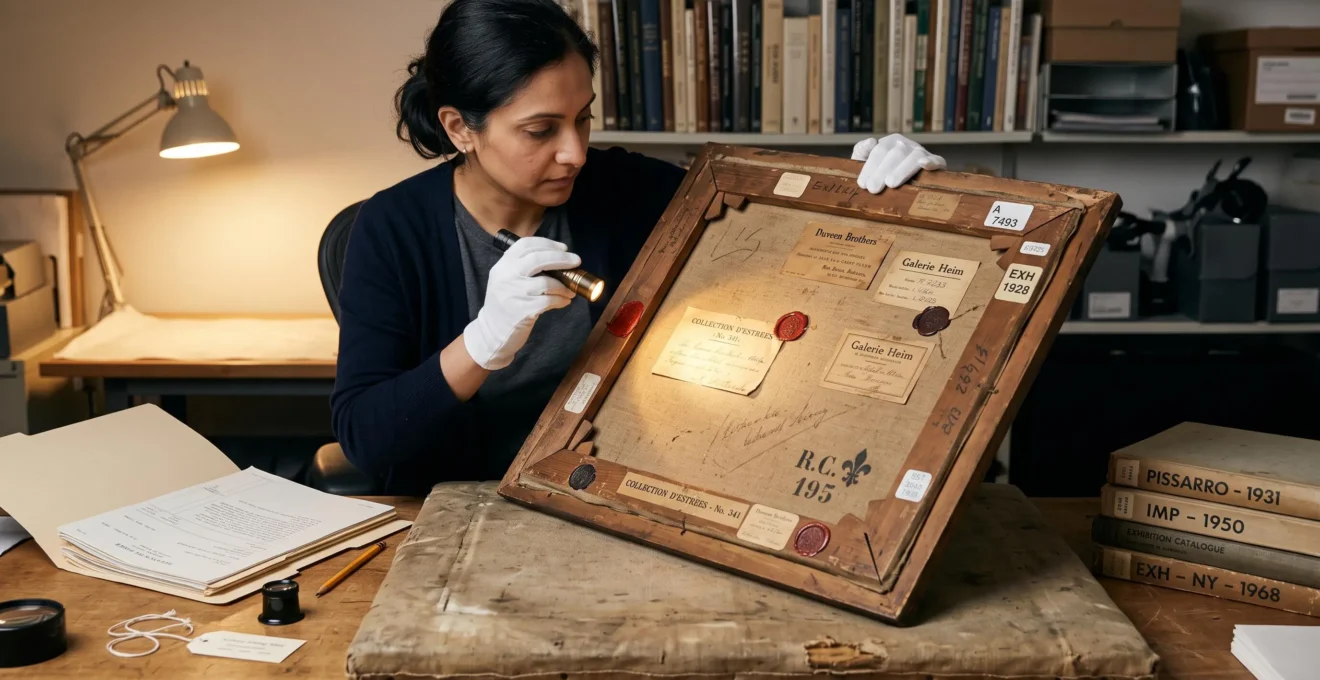
A painting may be attributed to a celebrated artist, exhibit convincing materials and possess exceptional visual quality, yet remain difficult to sell because nobody can establish where it was during a critical period. Conversely, a comparable work supported by original invoices, dated photographs, exhibition records and a defensible ownership chronology may attract greater confidence from auction specialists and bidders.
Documented provenance can increase an artwork’s marketability and potentially its price, but a 300% auction premium is not an established universal benchmark. Such a difference would require evidence from comparable transactions, controlling for attribution, condition, rarity, quality and market conditions. Provenance frequently operates by reducing uncertainty rather than adding a predictable percentage to an estimate.
For auction specialists, private dealers and authentication researchers, the decisive question is not whether a provenance narrative sounds credible. It is whether independent evidence can establish the object’s identity, trace its movements, explain changes of ownership and identify unresolved legal or ethical concerns. The strongest files make those distinctions explicit, especially where wartime displacement, missing archives or later restorations complicate the historical record.
What documented artwork provenance actually establishes
- Contemporaneous, independently verifiable records can strengthen attribution, market confidence and auction eligibility, but cannot guarantee a particular price premium.
- Ownership gaps involving Nazi-era Europe require particular scrutiny; missing documentation is a research problem, not automatic proof of looting.
- Successful provenance assessment combines archival research, physical examination and legal review, with uncertainties disclosed rather than concealed.
- Why Do Missing Provenance Records From the 1940s Stop Major Auction Sales?
- How Do You Trace a Painting’s Location When Ownership Records Have Disappeared?
- Family Stories vs Documentary Proof: Which Provenance Evidence Do Auction Houses Accept?
- The Forged Catalogue Entry That Unravelled a Dealer’s Entire Inventory
- The Research Threshold: When to Delay Auction Until Provenance Questions Are Answered
- How Do Art Forensics Labs Date a Painting to Within 20 Years Using Microscopic Evidence?
- How Do Museums Return Artworks When Legal Title Conflicts With Ethical Responsibility?
- What Defines Genuine Classical Art Versus 19th-Century Neoclassical Reproductions?
Why Do Missing Provenance Records From the 1940s Stop Major Auction Sales?
Missing provenance records from the 1940s can prevent a major auction sale when the undocumented period creates a credible risk of Nazi-era confiscation, forced sale or unresolved ownership claims. Auction houses must assess that risk before offering the artwork. However, a documentary gap alone does not establish unlawful appropriation or automatically prohibit a sale.
The historical danger extends beyond the frequently cited 1946–1948 interval. Nazi persecution and systematic cultural-property appropriation occurred principally between 1933 and 1945. The immediate postwar years added further uncertainty as displaced artworks moved through collecting points, restitution processes, military administrations, dealers and private estates. Documentation was sometimes destroyed, scattered or separated from the objects it described.
The American Alliance of Museums guidelines on Nazi-era provenance identify this historical period as requiring careful investigation. The guidance recognises that missing records must be evaluated in context rather than treated automatically as evidence of theft. These are professional museum guidelines, not binding international auction regulations.
For a seller, the distinction between price uncertainty and sale eligibility is critical. A specialist might propose a conservative estimate when documentation is incomplete but the identifiable risks remain manageable. Where credible adverse evidence or an unresolved claim exists, the same department may request further investigation, postpone consignment or decline the object entirely. Contractual warranties, indemnities and insurance arrangements can form part of risk discussions, but none offers a universal solution.
A reconstructable gap is not the same as an irreconcilable ownership conflict. A prewar collector’s inventory and an independently dated postwar exhibition label may provide useful boundaries for investigation. Neither necessarily explains what occurred between those dates. Researchers must still establish the identity of the object and investigate potentially involuntary transfers.
Publication introduces another complication. An inaccurate ownership statement in an old auction catalogue can circulate into subsequent catalogues, dealer descriptions and digital databases. Repetition may make an unsupported assertion appear authoritative, while later correction requires addressing an established documentary trail.
That distinction determines the next research question: which independent records can establish the painting’s location when its ownership documents have disappeared?
How Do You Trace a Painting’s Location When Ownership Records Have Disappeared?
A painting’s location can be reconstructed without continuous ownership records by comparing independent archival references with physical evidence attached to the object. Researchers work backwards from its earliest secure modern appearance and forwards from its last verified historical location, testing whether catalogues, photographs, shipping records and distinctive object markings refer to the same painting.
The investigation begins with identification. Measurements, medium, support, composition, signatures, restoration history and historical titles must be recorded before matching an archival description to the present object. Similar subjects and repeated titles can otherwise produce false identifications.
The Smithsonian Archives of American Art provenance research guide identifies dealer correspondence, stock inventories, sales ledgers, photographs, estate records and exhibition documentation as useful sources. Their combined value lies in the ability to compare separately created records.
A practical reconstruction moves through several evidentiary categories:
- Contemporaneous transaction records: Locate dealer stock books, invoices and sales correspondence showing who handled the object, when and under what description.
- Location records: Examine museum loan registers, exhibition catalogues, dated installation photographs and correspondence identifying a collection or address.
- Movement records: Search shipping manifests, customs files, insurance schedules and estate inventories for plausible connections between known locations.
- Physical evidence: Compare labels, inscriptions, stretcher marks, inventory numbers and seals against surviving archive material.
- Loss and claims records: Investigate the Art Loss Register and relevant Nazi-era restitution, national claims and historical sales databases, recording the scope and date of each search.
Database searches are screening tools, not certificates of lawful ownership. An absent listing does not exclude an unregistered loss, an incorrectly identified object or a claim documented outside the database searched.
Physical markings deserve particular attention because they can survive the loss of paper archives. A credible exhibition label may link an object to a specific display; a stamped dealer number may connect it with a surviving stock ledger. Yet a label can be transferred, a stretcher replaced and a seal misidentified. Specialists therefore examine adhesives, ageing, placement and consistency with the object’s conservation history before using such details as historical anchors.
Professional investigations may require months of archive requests, cross-border correspondence and examination, especially where wartime records are dispersed. There is no reliable standard price or duration. Research can also end with partial confirmation rather than a complete ownership chain.
The useful outcome is a documented evidentiary map: established locations, plausible movements, rejected identifications and unresolved intervals, each accompanied by a source reference and confidence assessment.
Even a carefully reconstructed chronology may depend partly on inherited recollections. The next question is how an auction specialist should weigh those accounts against contemporaneous documents.
Family Stories vs Documentary Proof: Which Provenance Evidence Do Auction Houses Accept?
Auction specialists generally give greater evidentiary weight to contemporaneous, independently verifiable documentation than to family recollections created decades after the relevant events. An original invoice, dated correspondence or identifiable historical photograph can establish facts a personal account cannot prove alone. Family stories remain valuable when they supply specific details that researchers can investigate and corroborate.
Consider an heir who recalls that a grandfather acquired a painting from a Paris dealer after the war. That account provides a research lead, not a verified transaction. Naming the dealer, approximate year, gallery address and other objects acquired at the same time makes the recollection more testable.
There is no universal documentary ranking applicable to every auction house. Evidentiary strength depends on authenticity, relevance, contemporaneity and independence.
| Evidence | Potential value | Important limitation |
|---|---|---|
| Original dealer invoice or ledger | May establish a dated transaction and named parties | Must be linked securely to the particular object |
| Dated photograph in a collection | May establish location and possession at a specific time | Possession does not necessarily establish legal title |
| Exhibition catalogue or loan record | May identify historical display and an associated lender | Published attribution or ownership statements may be mistaken |
| Historical correspondence | Can explain negotiations, transfers and collection circumstances | Statements may be incomplete, interested or uncorroborated |
| Later affidavit or family statement | Can preserve recollections and identify research leads | Memory and retrospective reconstruction limit independent proof |
Sworn affidavits and heir declarations require particularly careful presentation. They may corroborate a chronology, but the act of making a sworn statement does not transform remembered events into contemporaneous transactional evidence. Treating such documents as if they were original bills of sale can undermine a file’s credibility.
Build an auction-ready provenance evidence file
- Photograph the artwork’s front, reverse, labels, inscriptions and identifying details; produce a dated object-identification record.
- Arrange every original document chronologically, noting its author, date, present location and relationship to the artwork; produce an indexed evidence register.
- Cross-reference each claimed transfer with independent material wherever possible; produce a transaction-by-transaction corroboration table.
- Identify missing years, conflicting names and unverifiable citations without silently resolving them; produce a marked chronology of uncertainties.
- Prepare an evidence summary distinguishing established facts, plausible interpretations and unresolved questions; produce a review dossier for the auction specialist.
A transparent file helps specialists identify what additional research would materially change their assessment. Its usefulness comes from traceability, not from appearing complete.
That standard becomes especially important when a seemingly authoritative historical reference turns out to be fabricated rather than merely mistaken.
The Forged Catalogue Entry That Unravelled a Dealer’s Entire Inventory
A forged catalogue citation can undermine numerous artworks when the same dealer repeatedly uses it to support ownership histories or prestigious exhibition claims. Once a citation is shown to be fabricated, researchers must reconsider other claims dependent on the same source. The resulting scrutiny may extend across an inventory, although the discovery does not automatically prove that every associated artwork is inauthentic.
The following is a hypothetical investigative scenario, not an account of a documented dealer scandal. The supplied evidence does not identify a verified case in which one forged catalogue entry caused an entire dealer’s inventory to collapse in value.
Hypothetical case: an exhibition citation that cannot be verified
A private dealer offers several paintings with provenance descriptions citing a supposedly authoritative historical exhibition catalogue. One painting is said to appear under a specific catalogue number, accompanied by a named former collector.
A researcher consults an independently held copy of the cited volume and discovers that the entry does not appear where claimed. A different edition also fails to support the reference. Archive enquiries reveal no corroborating exhibition record. The citation is therefore unverified and potentially fabricated, but the underlying explanation still requires investigation.
When several additional paintings supplied by the same dealer rely on similarly unsupported references, the auction specialist has reason to re-examine those files independently. The commercial outcome remains uncertain until the underlying facts are established.
The mechanism is straightforward: an invented bibliographic reference can create an apparently credible historical anchor. Subsequent descriptions may reproduce it without examining the underlying publication, gradually converting one unsupported assertion into multiple mutually dependent references.
Authenticating a catalogue citation requires more than finding matching words in an online database:
- Record the complete citation, including author, exhibition title, publisher, date, edition, page and catalogue number where supplied.
- Locate an independently held physical or trustworthy digitised copy through an institutional library or archive.
- Examine the entry, illustration, dimensions, ownership attribution and any relevant errata or supplements.
- Compare different editions where necessary and distinguish a later catalogue revision from a contemporaneous record.
- Document the result with verifiable bibliographic references and copies permitted by the holding institution.
Missing a citation in one copy is not, by itself, proof of forgery. Incorrect pagination, variant editions, transcription mistakes and confused exhibition histories must also be considered. Intentional fabrication requires evidence beyond a failed first search.
Once a document’s reliability is seriously questioned, every ownership claim that depends exclusively on it becomes vulnerable. Other works handled by the dealer may remain well documented through genuinely independent sources.
A suspect document creates a practical decision problem: whether to continue towards auction or pause the consignment while the evidence is independently reviewed.
The Research Threshold: When to Delay Auction Until Provenance Questions Are Answered
An auction should generally be delayed when unresolved provenance questions could materially affect lawful ownership, attribution, catalogue accuracy or the seller’s ability to meet contractual obligations. A credible restitution claim, contradictory documentation or unexplained Nazi-era transfer may justify further investigation before publication. Minor documentary omissions may be manageable when the remaining evidence establishes a defensible history.
Deciding whether to proceed requires comparing the proposed sale with the realistic benefits and costs of additional research. A delay has practical consequences: specialist fees, storage, insurance, a missed auction season and possible exposure to a changing market. Proceeding prematurely may create more serious consequences if a disputed ownership statement appears in a public catalogue.
The central variables can be evaluated without inventing a universal discount or research budget:
| Decision factor | Stronger reason to delay | Potential reason to proceed after review |
|---|---|---|
| Wartime history | Unexplained transfer involving a persecuted owner or relevant European market | Incomplete chronology with independently corroborated surrounding circumstances |
| Legal status | Credible unresolved claim or conflicting ownership documents | No identified adverse claim after proportionate investigation, subject to remaining uncertainties |
| Historical citations | Material inconsistency or document suspected of fabrication | Minor bibliographic error corrected against original records |
| Physical examination | Material or construction conflicts with claimed date or identity | Findings consistent with the proposed history, with limitations disclosed |
| Research prospects | Identified archive or document could resolve a consequential question | Further investigation is unlikely to change the material assessment |
One commonly overlooked risk is that a successful auction does not necessarily extinguish a historical ownership dispute. Applicable law may permit subsequent claims, depending on jurisdiction, limitation rules, good-faith acquisition doctrines and the facts of the transfer. Seller warranties and disclosure obligations also vary by contract and legal system.
Transparency is a risk-control measure, not merely an ethical preference. Disclosing an uncertainty allows the specialist department and legal advisers to evaluate its significance before any public representation is made.
A productive consignment discussion begins with the evidence dossier, not a desired estimate. The seller can ask which unresolved questions are material, what research would assist the decision, and whether the likely timetable fits the auction’s catalogue deadline.
Where a credible ownership dispute exists, qualified legal advice should inform the decision before publication or transfer. Provenance researchers establish historical evidence; they do not independently settle every legal question created by that evidence.
If documents leave a material contradiction unresolved, scientific examination may provide another independent means of testing the proposed history.
How Do Art Forensics Labs Date a Painting to Within 20 Years Using Microscopic Evidence?
Art forensics laboratories can constrain a painting’s possible date by examining pigments, binding media, support materials and manufacturing characteristics. Microscopy is one tool within a broader scientific investigation. Dating a painting to within 20 years is not reliably achievable in every case: accuracy depends on the material examined, available comparative evidence and the difference between material manufacture and artistic execution.
The scientific question must be defined before samples are collected. Testing whether a pigment was available before a purported sale is fundamentally different from determining the precise year a painting was completed.
The Getty Conservation Institute research on analytical methods for modern paints illustrates why different paint constituents require different analytical approaches. Pigments, binding media and additives cannot all be assessed reliably through one universal procedure.
Relevant methods include optical microscopy for examining paint layers and particles; instrumental pigment and binder analysis for identifying chemical constituents; dendrochronology for suitable wooden panels; radiocarbon analysis for certain organic materials; and examination of canvas fibres, weave characteristics and construction. These techniques answer different questions and have different limitations.
A hypothetical discrepancy illustrates the value of material testing. Suppose an artwork is represented as having been completed and sold before a particular synthetic pigment became commercially available. If that pigment is securely identified in an original paint layer, the claimed chronology requires reconsideration. The laboratory must first exclude later restoration, retouching, contamination and sampling from a replacement component.
Dendrochronology may establish information about when suitable panel timber grew or was felled, but it does not independently date the act of painting. Radiocarbon dating yields a scientifically interpreted age range for sampled carbon-bearing material, subject to calibration and contextual limitations. Canvas-weave analysis may assist comparative identification or support dating but does not ordinarily provide a precise standalone creation date.
Before commissioning testing, the owner should ask which historical proposition the proposed method can evaluate, whether sampling is necessary, which materials will be examined and how uncertainty will appear in the written report. Costs and turnaround depend on the laboratory, technique, sampling requirements and analytical scope.
An inconclusive result can still help delimit the investigation. It may rule out a proposed identification, identify restoration material or clarify which questions scientific analysis cannot answer.
Even where physical and archival evidence support a coherent attribution, legal ownership and ethical responsibility may remain separate questions, particularly for objects affected by persecution and dispossession.
How Do Museums Return Artworks When Legal Title Conflicts With Ethical Responsibility?
Museums can resolve disputed ownership histories through restitution, negotiated settlements, financial redress or other agreed arrangements even when the institution has a defensible legal title. Ethical review may recognise persecution, coercion and historical injustice beyond what a court can remedy. The available solution depends on the evidence, applicable law, institutional authority and the circumstances of the claim.
Legal ownership and ethical legitimacy are not interchangeable. A court examines legally enforceable rights under the relevant jurisdiction. A restitution advisory body may also consider historical circumstances, the fairness of transactions, persecution and the strength of a moral claim, according to its governing framework.
A documented example concerns four drawings held by the British Museum and claimed by the heirs of Dr Arthur Feldmann.
The Feldmann drawings: legal title and moral responsibility
In 2006, the United Kingdom’s Spoliation Advisory Panel considered a claim involving four drawings in the British Museum’s collection. Its review distinguished the legal position of the claimants from the moral consequences of the historical circumstances.
According to the UK Spoliation Advisory Panel report on the British Museum drawings, the claimants had no legal claim to the drawings, but the panel recognised a compelling moral claim. It recommended an ex-gratia government payment of £175,000. This was case-specific financial redress, not an auction valuation or a general compensation formula.
The case illustrates why a legal-title conclusion alone may not resolve an institution’s ethical responsibilities. It also demonstrates that a remedy need not involve physical restitution of the artwork. Negotiated outcomes may differ substantially according to the governing legal framework and the interests of the parties.
Claims review ordinarily requires identifying the relevant artwork, reconstructing its historical ownership, documenting the circumstances of loss and examining the current holder’s acquisition. Claimants may provide estate records, correspondence and historical inventories; institutions may contribute acquisition files, archival evidence and research into the circumstances of transfer.
Advisory panels do not necessarily operate under the same standards, procedures or legal powers as courts. Their conclusions should therefore be read within their specific remit rather than treated as universally binding precedents.
For private sellers, museum resolutions provide useful interpretive examples, not automatic legal rules or pricing benchmarks. An object associated with a plausible unresolved restitution claim may face more consequential obstacles than an object with ordinary documentary gaps.
A negotiated settlement reached before auction may clarify rights and reduce uncertainty, but it does not guarantee marketability or a higher hammer price. The resolution must also be appropriately documented and legally effective for the transaction concerned.
Once title, historical movements and material evidence have been assessed, the final valuation question is whether the artwork itself has been correctly identified as an original of its claimed period.
Key findings before evaluating authenticity and value
- A documented ownership history strengthens confidence only when the records refer securely to the artwork being offered.
- Scientific evidence can challenge a historical attribution without resolving legal ownership, while restitution review can question legitimacy without changing the object’s physical identity.
- Before considering an exceptional auction premium, separate three variables: the object’s genuine date and attribution, the reliability of its ownership history and the status of any unresolved claims.
What Defines Genuine Classical Art Versus 19th-Century Neoclassical Reproductions?
Genuine classical art belongs to the historical period and artistic tradition to which it is attributed, whereas nineteenth-century neoclassical works deliberately revive earlier visual forms. A neoclassical reproduction is not necessarily a forgery: it may be an authentic nineteenth-century object. The decisive distinction comes from material evidence, production context, historical documentation and the accuracy of the attribution offered to buyers.
The terminology itself requires precision. Classical antiquity, later classical traditions and nineteenth-century neoclassicism describe different historical contexts. An ancient Roman marble, a later Renaissance interpretation of antique sculpture and a nineteenth-century academic copy may resemble one another visually while possessing fundamentally different origins.
Researchers evaluate those distinctions through several intersecting forms of evidence:
| Assessment | Classical attribution | Later neoclassical attribution |
|---|---|---|
| Materials and techniques | Must be compatible with the proposed historical period and production context | May exhibit later materials, manufacturing methods or workshop conventions |
| Style and iconography | Assessed against securely dated works and relevant historical traditions | May deliberately imitate earlier compositions, subjects and proportions |
| Historical documentation | Earlier descriptions, collection records or archaeological context may support identification | Commission records, nineteenth-century catalogues or later workshop evidence may establish origin |
| Physical interventions | Later repairs and additions must be distinguished from original components | Artificial ageing or historical restoration can complicate the examination |
Documentation and physical examination must agree at the level of the particular object, not merely its subject. A historical inventory describing a marble figure of Apollo is insufficient to authenticate the present sculpture without reliable identifying characteristics and an established connection between the recorded object and the surviving work.
Attribution can also change over time. A work once catalogued as antique might later be identified as a nineteenth-century copy. The earlier entry remains an authentic historical document, but its attribution may have been incorrect. Provenance establishes what was recorded and when; it does not make every historical description true.
This distinction is essential to the article’s 300% question. A genuine classical object and a nineteenth-century reproduction cannot be treated as otherwise identical comparables merely because they share a composition. Differences in period, authenticity, authorship, rarity, condition and collector demand may dominate any contribution from provenance.
No reliable percentage premium can be isolated without appropriate comparable sales. An apparent fourfold difference in prices does not demonstrate that documentary provenance caused a 300% increase if the artworks differ materially in attribution or historical significance.
For a more defensible valuation, specialists should compare objects of similar attribution, quality, condition and market context, then examine whether independently documented ownership histories correspond with observable price differences. Even then, sample limitations and other market variables must be acknowledged.
Before commissioning an auction estimate, assemble the identified object’s historical documents, physical examination findings and unresolved ownership questions into one reviewed dossier. Ask the specialist to explain which aspects of provenance affect eligibility, attribution confidence and valuation separately. That approach produces a defensible decision even when no measurable provenance premium can be established.
Can documented provenance guarantee a 300% increase in auction value?
No. A 300% premium would mean an increase from a baseline price to four times that price, but the supplied evidence does not establish such a general market effect. Any proposed premium must be tested against genuinely comparable sales while considering attribution, condition, rarity and bidding conditions.
Does a complete ownership chain prove that an artwork is authentic?
No. A complete ownership chain can establish a documented history while preserving a mistaken historical attribution. Authentication also requires examination of the object, its materials, stylistic characteristics and consistency with independent scholarly evidence.
Can an artwork with unknown previous owners still be sold at auction?
Potentially. Auction eligibility depends on the circumstances of the gap, the object’s identity, applicable legal requirements and the auction house’s assessment. Missing names do not automatically establish unlawful ownership, but credible claims or contradictory evidence can justify further research or refusal.
Who should examine provenance records before a high-value consignment?
A qualified provenance researcher can assess archival evidence and object identification, while an appropriate technical specialist can examine material inconsistencies. Where a disputed transfer or restitution issue arises, legal counsel familiar with the relevant jurisdiction should review the matter alongside the auction specialist.
Should a seller disclose an unresolved historical ownership question?
Yes. Disclosing material uncertainties allows the auction house and relevant advisers to assess potential legal, contractual and reputational consequences. The precise disclosure duties depend on the contract and jurisdiction, but concealing a known material concern can expose a transaction to avoidable disputes.