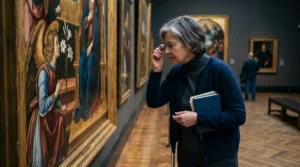
A white lily standing beside a young woman, a pair of keys held by an elderly apostle, or a skull positioned beneath the Crucifixion may look like incidental details to a modern museum visitor. For viewers familiar with Christian scripture, liturgy and devotional traditions, however, such objects can transform the meaning of an entire painting.
Religious art communicates through a **visual language of attributes, symbols, gestures and compositional relationships**. These elements can identify holy figures, recall biblical episodes, express theological beliefs and guide devotional attention. Yet their meanings are neither arbitrary nor universally fixed.
A lily does not always identify the Virgin Mary. A gold background does not automatically make a painting Orthodox. Even a familiar saintly attribute may require confirmation from an artwork’s original setting.
Understanding religious imagery therefore involves more than memorising a dictionary of symbols. It requires interpreting individual clues within an interconnected system of narratives, artistic conventions and historical circumstances. The result is a richer way of looking: a painting becomes not merely a representation of a sacred story, but an argument about its significance.
Religious iconography: the essential principles
- Symbols communicate through context. Objects such as lilies, keys and ointment jars acquire meaning from the figures, narratives and traditions surrounding them.
- Identification and interpretation are different tasks. Recognising Saint Peter by his keys does not explain why he occupies a particular position within an altarpiece.
- Historical setting matters. Religious commissions, liturgical functions and institutional restrictions shaped what artists depicted and what their original audiences understood.
- Why Does a White Lily Always Signal the Virgin Mary in Renaissance Religious Paintings?
- How Do You Identify Which Saint Is Depicted When Names Are Not Written?
- Catholic vs Orthodox Icons: Why Do Crucifixions Look Different Between Traditions?
- The Critical Misreading: When Museum Labels Ignore the Theological Meaning of Visual Elements
- The Five Visual Clues That Require Scriptural Cross-Referencing for Accurate Interpretation
- How Do You Communicate a Character’s Past Through Three Strategic Background Objects?
- How Did Caravaggio Criticise the Church in Altarpieces Without Being Excommunicated?
- How Did Political Censorship Determine What Renaissance Artists Could Publicly Display?
Why Does a White Lily Always Signal the Virgin Mary in Renaissance Religious Paintings?
A white lily frequently evokes the Virgin Mary’s purity, particularly in Renaissance paintings of the Annunciation, but it does not always identify her. The same flower appears with other saints and in secular or mythological settings. Its meaning depends on the subject, surrounding figures and established iconographic conventions rather than on its appearance alone.
In an Annunciation, the lily helps communicate the theological significance of the encounter between Gabriel and Mary. The flower’s association with purity draws attention to Mary’s virginity and her role in the Incarnation. It may appear in Gabriel’s hand, in a vase between the figures or elsewhere in the painted setting.
According to the National Gallery‘s glossary entry on lilies, the flower also appears as an attribute of Catherine of Siena and Anthony of Padua. Its use is consequently broader than a single Marian identification.
The distinction between an **attribute** and a **symbol** is especially useful here. An attribute helps identify a particular figure within a recognised visual tradition. A symbol communicates a concept that may apply to different figures or narratives. The lily can perform both functions, but neither function operates independently of context.
Renaissance paintings also use enclosed gardens, pomegranates and other meaningful objects. The *hortus conclusus*, or enclosed garden, has Marian associations rooted in interpretations of the Song of Songs. Pomegranates can evoke multiple Christian themes, including resurrection and eternal life, depending on their setting.
These conventions developed through artistic practice, patronage and textual traditions; they were not imposed by one universal handbook. Cesare Ripa‘s *Iconologia*, for example, belongs to the later history of codified allegorical imagery and should not be treated as the original authority for every Renaissance symbol.
To test a proposed interpretation, first identify the narrative. A lily appearing beside Gabriel and Mary in an Annunciation has different evidential weight from one carried by an otherwise unidentified saint.
The distinction also reveals what an educated historical viewer could bring to an image. Familiarity with scripture, sermons, liturgy and local devotional conventions enriched interpretation, although such familiarity was not exclusive to people who could read.
A recurring symbol becomes persuasive evidence only when its proposed meaning fits the painting as a whole. That principle is equally important when the subject is an unidentified saint.
How Do You Identify Which Saint Is Depicted When Names Are Not Written?
An unnamed saint can often be identified through a combination of attributes, clothing, narrative setting and the artwork’s original commission. Keys suggest Peter, arrows suggest Sebastian, and a wheel may identify Catherine of Alexandria. None should be treated as conclusive without checking accompanying figures, regional traditions and the broader composition.
The most reliable approach begins with the entire image rather than a single object.
- Identify the narrative setting. Determine whether the scene represents a biblical event, martyrdom, devotional assembly or episode from a saint’s life.
- Examine distinctive attributes. Look for keys, wheels, arrows, books, ointment jars or other objects with established associations.
- Read clothing and ecclesiastical rank. A bishop’s mitre, papal tiara or monastic habit can narrow the possibilities, although these garments rarely identify an individual by themselves.
- Examine the original artistic programme. The altar dedication, patron saint, associated panels and commissioning community may clarify the figure’s identity.
A particularly useful documented example appears in the Metropolitan Museum‘s Saint Peter collection record. The museum describes a fourteenth-century Sienese painting in which Peter carries keys and Mary Magdalene carries an ointment jar.
Those objects accomplish two things simultaneously. They distinguish the figures visually and evoke episodes associated with their religious significance.
Ambiguity remains common. The palm of martyrdom belongs to numerous saints, while bishops may share croziers and similar vestments. An attribute’s significance can also shift according to place and period.
When several candidates remain plausible, secondary clues become important: a particular religious habit, a companion saint, an associated narrative episode or the dedication of the original church. Provenance and surviving donor records may provide confirmation unavailable from the painted surface.
Documented example: attributes within a dispersed altarpiece
The Metropolitan Museum identifies Peter through his keys and Mary Magdalene through her ointment jar in panels attributed to a follower of Lippo Memmi.
The panels once belonged to a larger altarpiece, with other surviving components preserved in Siena. Their original ensemble supplies information that isolated figures cannot communicate independently.
Recognising the saint is only the first stage. A figure’s position beside Mary, scale relative to a donor, or gaze towards Christ may establish a theological relationship that the attribute alone cannot explain.
Once individual figures are identified, the next interpretive challenge is understanding why different Christian traditions represent the same sacred events in noticeably different ways.
Catholic vs Orthodox Icons: Why Do Crucifixions Look Different Between Traditions?
Catholic and Orthodox Crucifixion images can differ because their artistic traditions have developed distinct ways of communicating Christ’s suffering, divinity and redemptive death. Western Renaissance painting frequently explores bodily emotion and naturalistic space, while Byzantine-derived iconography often employs stylised forms and symbolic spatial conventions. These are tendencies, however, not fixed rules separating two incompatible understandings of Christ.
A Western Crucifixion may emphasise anatomical weight, bleeding wounds and the emotional reactions of witnesses. The viewer encounters the event through bodily suffering and human grief.
A Byzantine-derived image may organise the scene around a more formal, hieratic presentation. Stylisation, deliberate proportions and a less illusionistic setting can direct attention beyond the historical episode towards its theological meaning.
Orthodox theology of icons developed through debates over the legitimacy of sacred images, including Byzantine Iconoclasm. Icons are understood within a devotional tradition that distinguishes veneration of the image from worship due to God.
Western religious imagery likewise operated within theological constraints, but painters developed varied approaches to illusionism, narrative drama and devotional emotion. The Council of Trent later addressed the proper religious use of images; it did not originate Western artistic naturalism.
The relationship between these traditions is especially evident in the National Gallery of Art‘s analysis of Paolo Veneziano’s Crucifixion.
The museum identifies Byzantine-derived details, including angels collecting Christ’s blood and Adam’s skull beneath Golgotha, alongside Western-associated elements such as the swooning Virgin and kneeling Mary Magdalene.
This mixed vocabulary challenges any rigid Catholic-versus-Orthodox classification.
| Visual clue | Possible interpretive significance | Important limitation |
|---|---|---|
| Christ’s body | Anatomical naturalism or stylisation may shape the experience of suffering and sacred presence. | Both traditions contain considerable variation. |
| Blood and wounds | May emphasise sacrifice, redemption and the bodily reality of the Passion. | Neither blood nor wounds belong exclusively to Western imagery. |
| Virgin and Saint John | Witnesses can direct attention towards grief and scriptural relationships. | Their presence alone cannot identify a denomination. |
| Gold background and space | May prioritise sacred presence over naturalistic setting. | Gold grounds also occur extensively in Western medieval painting. |
| Nails and loincloth | May reflect particular artistic models, dates or regional conventions. | Neither is a reliable standalone test of confessional identity. |
The documented Crucifixion by Paolo Veneziano also illustrates how an artwork’s original function affects its interpretation. Its panel probably occupied the upper centre of a triptych, where surrounding images and candlelight would have influenced the experience of worship.
The question is therefore not which tradition depicted the event correctly. It is how different visual choices shaped religious attention.
This sensitivity to original viewing conditions becomes especially important when sacred paintings are removed from churches and displayed as independent museum objects.
The Critical Misreading: When Museum Labels Ignore the Theological Meaning of Visual Elements
A museum label may identify an artist, date, medium and provenance without fully explaining the theological function of a religious image. Such information is essential for art history, but it may leave visitors unable to understand why particular figures, objects or gestures appear. Reading the painting as a devotional object alongside its museum description restores an important interpretive dimension.
Consider an altarpiece originally positioned above a church altar. Its placement linked the represented sacred figures to prayers, ritual actions and the devotional expectations of a particular community.
When the same panel enters a gallery, it may be viewed under neutral lighting, separated from companion paintings and discussed primarily as an example of artistic development.
The painting has not necessarily changed physically. Its **relationship with the viewer**, however, has changed substantially.
The National Gallery of Art’s account of Paolo Veneziano’s Crucifixion provides a concrete example: a panel probably associated with a triptych is now encountered individually, without the original surrounding panels or candlelit setting.
That context matters because an altarpiece’s theological meaning can depend on the dialogue between its components. A saint positioned below a Crucifixion, for example, may participate in a larger programme of intercession or devotion.
Museum labels vary greatly in depth, and many institutions do provide substantial religious interpretation. The problem is not that museum scholarship necessarily neglects theology; rather, concise exhibition texts cannot always reconstruct every level of meaning.
A useful reading exercise separates four questions:
- Identification: Who made the painting, and what does it represent?
- Provenance: Where was it originally installed, and for whom?
- Devotional function: What religious practices or expectations shaped its use?
- Theological communication: Which visual elements express beliefs beyond the represented narrative?
A scholarly collection record, reconstruction of an altarpiece or specialist iconographic catalogue may answer questions left unresolved by the gallery label.
The most productive habit is to treat the label as an informed starting point, not as an exhaustive account of the image’s meaning.
Recovering that information often depends on a more demanding practice: matching what appears in the painting to the texts and traditions that explain it.
The Five Visual Clues That Require Scriptural Cross-Referencing for Accurate Interpretation
Five categories of visual evidence are especially useful when interpreting Christian religious art: gestures, objects, clothing, setting and compositional placement. Their meanings often become clearer through comparison with biblical passages, liturgy or hagiographic traditions. Scripture is an essential starting point, but not every iconographic detail comes directly from the canonical Bible.
Each category asks a different interpretive question.
- Narrative gestures: Does a raised hand indicate blessing, instruction, recognition or grief? Compare the action with the represented episode before assigning a meaning.
- Attributes and objects: Is a jar, key, book, palm or flower identifying a figure, recalling an event or communicating an abstract virtue?
- Clothing and colour: Do vestments establish ecclesiastical office, religious affiliation or a theological distinction? Avoid assuming that colours have identical meanings in every region and century.
- Architecture and landscape: Does an enclosed garden, city gate, mountain or rocky landscape locate the narrative, evoke a scriptural passage or provide a typological reference?
- Compositional placement: Do scale, proximity, direction of gaze and the relationship between panels establish hierarchy or devotional emphasis?
Consider the skull traditionally represented beneath the Cross at Golgotha, a feature identified in Paolo Veneziano’s Crucifixion by the National Gallery of Art.
The Gospels associate the Crucifixion with a place called Golgotha, meaning the Place of a Skull. Later Christian traditions connect the location with Adam, giving the skull an additional theological resonance: Christ’s redemptive death is understood in relation to humanity’s fall.
The proper reading therefore develops through several stages. The biblical place name establishes one layer, while later tradition helps explain why an artist might depict an actual skull beneath Christ.
This also demonstrates the limits of biblical cross-referencing. A viewer may correctly locate a Gospel narrative yet miss an interpretation that emerged through theological commentary, devotional practice or noncanonical literature.
The same caution applies to elaborate symbolic readings of ordinary household objects. Without evidence that an artist or community associated an object with a particular text, an attractive interpretation remains a hypothesis.
A five-step workflow for verifying a religious symbol
- Identify the likely sacred episode and record one proposed scene title.
- List three distinctive visual clues and note their exact positions within the painting.
- Find the relevant biblical passages using a concordance and record chapter-and-verse references.
- Compare unresolved motifs with a specialist iconographic reference, distinguishing canonical, apocryphal and later devotional explanations.
- Check the museum catalogue, original commission or documented artistic programme, then write a short interpretation separating confirmed evidence from uncertainty.
This procedure is a practical interpretive method, not a claim that every artist followed a single historical system of symbolic rules.
Once individual clues have been checked, several can be combined to reveal something more complex: the history of a figure represented in a single moment.
How Do You Communicate a Character’s Past Through Three Strategic Background Objects?
A religious painting can evoke a figure’s past through a small selection of recognisable objects, each recalling an important episode, identity or transformation. An ointment jar can evoke Mary Magdalene’s association with anointing traditions, keys identify Peter’s apostolic authority, and a lion recalls Jerome’s legendary biography. Three objects can create a compact visual narrative, although their number is a useful analytical device rather than a historical artistic rule.
The underlying principle is **narrative compression**: a painted attribute allows the viewer to recall a story without seeing every event represented.
Mary Magdalene’s ointment jar is particularly instructive. The Metropolitan Museum’s Saint Peter collection record connects the jar with the preparation of Christ’s body for burial. A viewer familiar with the figure’s devotional traditions could use the object to recall a broader religious narrative.
Peter’s keys serve a somewhat different function. Their association with Matthew 16:19 evokes the authority bestowed upon Peter, so the object communicates ecclesiastical significance as well as identity.
Jerome’s lion belongs to hagiographic tradition rather than a Gospel episode. In later legendary accounts, the saint helps a lion by removing a thorn from its paw. The animal consequently became an identifiable feature of Jerome’s iconography. His cardinal-like red garments, when depicted, refer to a later convention of representing his ecclesiastical status rather than an accurate portrait of ancient clerical dress.
The three examples show that biographical shorthand can operate at different levels:
- Identity: An object helps name the figure.
- Memory: It recalls a defining event or tradition.
- Interpretation: It encourages the viewer to understand the figure through a particular virtue, office or spiritual transformation.
When examining a painted saint, rank objects according to their narrative specificity. An ointment jar associated with a recognised sacred figure may be more useful than an ordinary book. A lion beside Jerome is more discriminating than generic clerical clothing.
But the surrounding objects may not all belong to the saint’s history.
A donor’s coat of arms, prayer book or family emblem may instead communicate patronage, wealth or affiliation. Such features describe the commissioning individual rather than the sacred protagonist.
Distinguishing biography from patronage is particularly important in altarpieces where donors kneel near saints or appear within the same sacred space.
The same visual economy could become contentious when an artist’s treatment of sacred figures conflicted with the expectations of the institution commissioning the work.
How Did Caravaggio Criticise the Church in Altarpieces Without Being Excommunicated?
Caravaggio’s controversial religious paintings do not establish that he deliberately criticised Church doctrine. His conflicts with ecclesiastical patrons concerned the acceptable representation of sacred subjects, particularly decorum and realism. Rejection of a painting was not equivalent to a formal judgment of heresy, and the documented disputes should not be interpreted as evidence that he faced excommunication for his artistic choices.
The distinction matters because modern viewers may interpret unsettling naturalism as an intentional attack on religious authority.
Caravaggio brought strong contrasts of light, recognisably human bodies and intense psychological immediacy into sacred painting. Such choices could heighten devotion while also challenging patrons’ expectations about the dignity of holy figures.
His *Death of the Virgin* illustrates the resulting tension.
The painting was commissioned for Santa Maria della Scala in Rome but rejected by the Carmelite order because its depiction of the Virgin was considered inappropriate.
The surviving institutional record does not demonstrate that Caravaggio intended to deny a doctrine or publish an anti-Church argument through the image.
A rejected image and an initially rejected replacement
Caravaggio received the commission in 1601. After his painting was rejected, Carlo Saraceni produced a replacement around 1608 for the same church.
The Metropolitan Museum documents that Saraceni’s first version was also refused: the Virgin’s slumped head and closed eyes caused objections. Saraceni ultimately supplied another composition in which angels welcome Mary into heaven.
The case is revealing because even the replacement artist encountered resistance.
The difficulty was not necessarily personal hostility towards Caravaggio. It concerned how the Virgin’s death should appear within a specific devotional environment.
The controversy also clarifies the relationship between artistic commissions and ecclesiastical oversight. Patrons could refuse, replace or relocate works whose presentation failed to meet their expectations. These were meaningful artistic and commercial consequences, but they were not automatically doctrinal prosecutions.
Similarly, discussions of Caravaggio’s choice of models require caution. Claims that particular paintings employed courtesans as models should not be treated as established explanations without evidence specific to the artwork.
A credible interpretation of artistic criticism must distinguish three possibilities: deliberate protest, stylistic innovation perceived as offensive, and later audiences projecting political meanings onto an earlier controversy.
Such conflicts form part of a wider question about religious art: who possessed the authority to decide which images could appear publicly?
What to remember before examining artistic censorship
- A painting’s present appearance may differ from what its maker originally conceived, making later alterations part of the historical evidence.
- Patron objections, ecclesiastical rules and civic authority should be distinguished rather than treated as one censorship system.
- When an image was rejected, altered or relocated, that history can change how its surviving symbols should be interpreted.
How Did Political Censorship Determine What Renaissance Artists Could Publicly Display?
Religious and political authorities influenced Renaissance artistic display through patronage, requirements of decorum, restrictions on sacred imagery and alterations to existing works. Ecclesiastical officials, civic rulers and commissioning institutions could exercise different forms of control. Their influence shaped not only which paintings were publicly displayed but also how particular theological subjects were represented and subsequently interpreted.
The mechanisms of control were not uniform.
A religious patron might refuse to install an altarpiece. A civic authority could influence the subject and placement of an important commission. Ecclesiastical authorities could object to imagery regarded as inappropriate for a sacred setting.
The Council of Trent addressed religious images in its decrees, including the importance of avoiding representations considered doctrinally misleading or indecorous. Applying such principles, however, depended on institutions and historical circumstances.
One of the clearest distinctions is between **removing an image** and **modifying an image that remains publicly visible**.
Daniele da Volterra’s additions of drapery to nude figures in Michelangelo’s *Last Judgment* provide a well-known example of the latter. Such interventions demonstrate that institutional control could change the appearance of an already completed religious work.
For the viewer, this raises a crucial question: does the surviving painted surface represent the artist’s initial design, or has it been altered by later expectations?
Censorship also interacted with artistic strategy. Artists working for different patrons could adjust subject matter, degrees of nudity, allegorical references and styles of representation according to the intended setting.
Mythological subjects and allegories offered representational possibilities distinct from those permitted in sacred commissions. Yet it would be inaccurate to assume that every classical myth or indirect biblical allusion concealed a censored message.
The evidence must come from the history of the specific work.
Caravaggio’s rejected *Death of the Virgin* provides an example of ecclesiastical patronage affecting display, whereas modifications to the *Last Judgment* illustrate intervention in an existing composition. These are related but distinct processes.
Neither episode alone establishes a universal censorship policy governing every Renaissance workshop.
For educated viewers, the interpretive consequence is substantial. A publicly displayed religious image does not necessarily communicate only its original maker’s intentions. Its appearance may reflect compromises involving patrons, theologians, later restorers or officials.
The artwork becomes a layered historical object: original design, religious function, institutional reception and subsequent intervention can all affect meaning.
A practical examination should begin by establishing the object’s date, original location and documented changes. Where reliable evidence exists, compare its surviving appearance with preparatory material, earlier descriptions or conservation findings. Where such evidence is absent, uncertainty should remain explicit.
On a museum visit, choose one religious painting and record its identifiable figures, three meaningful visual details, original setting and any documented alterations. Compare those observations with the collection catalogue before drawing a theological conclusion. The aim is not to find hidden messages everywhere, but to distinguish interpretations supported by evidence from those suggested only by visual resemblance.
Can Christian symbols have different meanings in different centuries?
Yes. Religious imagery developed through changing artistic traditions, local devotions and institutional practices. An object’s meaning should be established through the painting’s subject, date and original context. A familiar symbol can preserve an established association while acquiring additional significance in another period or setting.
What is the difference between iconography and iconology?
Iconography concerns the identification and interpretation of subjects, figures and conventional motifs. Iconology generally seeks a broader understanding of how images express cultural, intellectual or religious assumptions. The terms overlap in scholarly usage, but distinguishing recognition from deeper historical interpretation is useful when studying sacred art.
Are all details in Renaissance religious paintings intentionally symbolic?
No. Objects can serve narrative, decorative, compositional or observational purposes without carrying a specific theological message. A symbolic interpretation becomes stronger when supported by a recognised iconographic convention, relevant textual tradition or documentation associated with the commission.
Do visitors need theological training to understand religious paintings?
Formal theological training is not essential. Learning a few recurring attributes, identifying the biblical narrative and consulting reliable museum catalogues can substantially improve interpretation. More specialised knowledge becomes valuable when imagery refers to apocryphal traditions, liturgy or complex doctrinal debates.
How can a museum visitor verify an uncertain religious symbol?
Begin with the museum’s scholarly collection record. Identify the figure, narrative and original setting, then compare the proposed symbolism with relevant scripture and specialist iconographic references. If several interpretations remain possible, retain the uncertainty rather than presenting one association as established fact.