
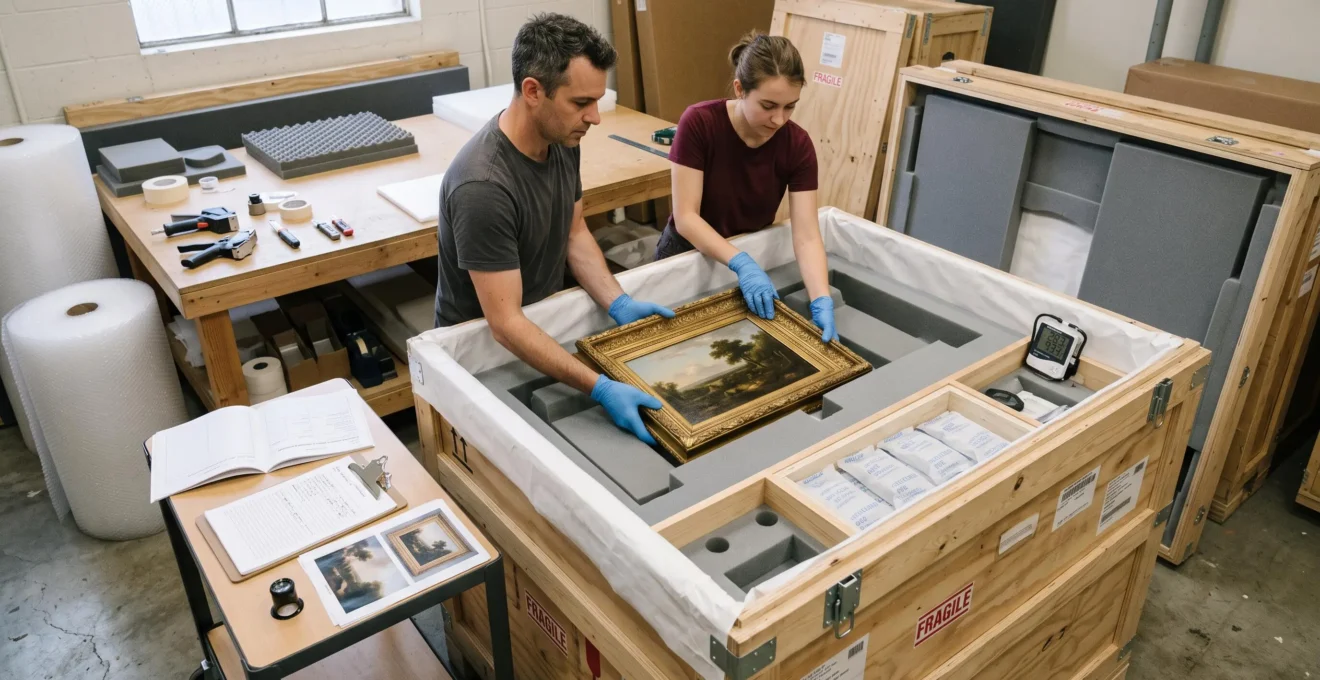
A £100 million painting may weigh only a few kilograms, yet moving it between continents requires an engineered protection system, a carefully controlled chain of custody and a transport plan that anticipates failure at every handover. The shipping challenge is not primarily the distance. It is preventing mechanical damage, environmental instability, theft, loss and inappropriate handling throughout the journey.
Museum registrars and shipping coordinators begin with the artwork’s condition and vulnerabilities, then work backwards through its required packaging, courier arrangements, transport route, customs procedures, insurance or indemnity provisions, and receiving venue. A secure crate cannot compensate for an unsafe loading operation, and a climate-controlled vehicle cannot protect a painting during an uncontrolled airport transfer.
The practical objective is therefore to establish measurable transport conditions, assign responsibility for each movement and ensure that the receiving institution can safely accept the object. For irreplaceable artworks, successful logistics means preserving both the physical object and the institutional trust that makes future loans possible.
International museum art shipping: essential decisions
- Shipping budgets pay principally for specialised protection, supervision and risk management, not the painting’s weight.
- Climate-buffering crates delay environmental changes; their performance depends on construction, conditioning, transit duration and controlled unpacking.
- Transport mode, courier oversight and loan approval must be evaluated together, with particular attention to every transfer and handling event.
- Why Do Museums Spend £30,000 Shipping a Painting That Weighs 15kg?
- How Do You Design Transport Crates That Maintain 50% Hygrometric Stability Across 8,000km Journeys?
- Air Cargo vs Road Transport: Which Shipping Method Minimises Risk for Old Master Paintings?
- The Shattered Marble: When Standard Shipping Destroyed an Irreplaceable Classical Bust
- The Loan Refusal Point: When Does Transport Risk Outweigh Exhibition Value?
- Why Does Touching a Gilded Frame’s Edge Cause £40,000 in Conservation Damage?
- How Do Conservation Labs Create Oxygen-Free Environments for Corroding Metal Artefacts?
- Which Handling Protocols Prevent the £200,000 Accidents That Destroy Museum Objects?
Why Do Museums Spend £30,000 Shipping a Painting That Weighs 15kg?
A museum might budget £30,000 to move a 15kg painting because transport charges reflect the consequences of damage rather than the object’s mass. A high-value loan requires individually engineered packaging, specialist handling, insurance or indemnity arrangements, condition documentation, environmental protection and coordinated supervision. The stated figure is an illustrative budget, not an established standard market price.
The major cost components arise before the painting enters a vehicle. Conservators assess structural vulnerabilities, registrars document existing conditions, and packing specialists fabricate a crate designed for the object’s dimensions, fragility and journey. A courier may accompany the shipment, while customs brokers arrange the documentation needed for temporary international movement. Specialist storage, security and controlled transfers can add further expenditure.
Financial exposure also differs fundamentally from the economics of ordinary freight. Commercial distribution typically accounts for weight, volume and service level. Fine-art logistics must additionally price the engineering, supervision and contingency arrangements required when even a minor accident could permanently alter the object.
The distinction between declared value and cultural irreplaceability is crucial. A financial settlement may compensate a lender under an applicable policy, but it cannot reconstruct original brushwork or restore a lost historic surface. The UK Government guidance on the Government Indemnity Scheme describes an alternative to commercial insurance for eligible cultural loans, potentially covering transit, storage, installation and display. Eligibility and specific indemnity conditions must nevertheless be established for each arrangement.
Loan budgets therefore protect more than monetary value. An accident can undermine confidence between institutions, jeopardise future collaborations and create conservation obligations extending beyond the immediate claim.
The appropriate comparison is total controlled-shipment cost against the consequences of an avoidable failure, not a specialist quotation against the cheapest available freight rate.
Once these costs are understood, the next decision is how to make the crate perform as an environmental buffer rather than merely a physical container.
How Do You Design Transport Crates That Maintain 50% Hygrometric Stability Across 8,000km Journeys?
A museum transport crate does not normally maintain exactly 50% relative humidity through active regulation. Instead, a carefully sealed and conditioned enclosure slows humidity exchange between its interior and changing external conditions. Its suitability depends on the artwork’s environmental requirements, the buffering materials, leakage rate and duration of exposure throughout the 8,000km journey.
Passive climate protection combines structural construction with environmental buffering. Multi-layer plywood, appropriate barrier films, carefully sealed joints and conditioned humidity-buffering materials can reduce the speed of change. Tyvek may provide a protective contact or lining layer, but it should not be treated as a complete water-vapour barrier on its own.
The crate interior must also protect against shock and vibration. Cushioning, immobilising supports and adequate clearance around fragile surfaces are selected according to the object, its mounting system and the anticipated mechanical hazards. A heavy wooden box without correctly engineered internal support may still transfer damaging forces to the artwork.
The Canadian Conservation Institute technical bulletin on artwork packaging and transport provides engineering guidance on these interacting hazards. Its illustrative humidity-buffering models show why leakage, buffer content and crate construction matter more than a nominal 50% target alone.
Approximately 7 days
In one modelled plywood-crate configuration initially equilibrated at 50% relative humidity, with 16.8 air changes per day and 25% buffer content, the predicted change was 2.5 percentage points after approximately seven days. This is a configuration-specific model, not a universal crate guarantee.
Canadian Conservation Institute, Technical Bulletin 34.
Pre-shipment preparation should establish the acceptable temperature and relative-humidity ranges for the specific painting, condition the packaging under suitable conditions and verify the crate’s performance before loading. A datalogger inside the enclosure records whether the expected environment is achieved during shipment; exterior measurements alone cannot confirm the microclimate surrounding the object.
The receiving environment is part of the same calculation. Rapidly opening a cold crate in a warm room can create condensation risks even when the artwork experienced acceptable conditions in transit. The Canadian Conservation Institute recommends a 24-hour indoor acclimatisation period for certain cold-exposed, wrapped paintings, rather than prescribing that duration for every shipment.
For route planning, the correct question is how long the crate must remain protective between the last controlled packing environment and safe unpacking. Airport dwell times, customs inspections and potential delays must be included in that interval.
With packaging performance defined, transport mode can be selected according to the threats encountered during the complete journey, not simply the fastest itinerary.
Air Cargo vs Road Transport: Which Shipping Method Minimises Risk for Old Master Paintings?
Neither air cargo nor road transport is inherently safest for every Old Master painting. Air transport can substantially shorten long-distance journeys but introduces airport transfers, cargo handling and potentially extreme environmental exposure. Specialist road transport provides closer control over the vehicle and handling arrangements, although longer journeys may increase exposure to disruption. The safer choice is the route with the most manageable combined risks.
For registrars, the comparison should include mechanical exposure, climate management, access to the shipment, security, delays and the number of times responsibility passes between operators. A short flight requiring several uncontrolled warehouse movements may carry risks that are not visible in the published transit time.
The comparison becomes clearer when each mode is assessed as an operational chain.
| Risk factor | Specialist air cargo | Dedicated road transport |
|---|---|---|
| Transit duration | Generally shorter across continents | Practical over connected land routes, but often longer |
| Climate exposure | Potential exposure during airport handling, tarmac dwell and flight | Continuous vehicle control possible, with exposure during stops and transfers |
| Handling | Airport, cargo-terminal and ground-transport handovers | Can be direct door-to-door with fewer transfers |
| Courier oversight | Access and supervision depend on carrier arrangements and security restrictions | Dedicated specialist vehicles may permit closer supervision |
| Disruptions | Flight changes, cargo capacity, airport delays | Road conditions, border delays, vehicle disruption |
Air transport introduces challenges that cannot be assessed solely by looking at aircraft flight conditions. The Canadian Conservation Institute identifies possible low-humidity environments in air transport, while uncontrolled ground handling can expose shipments to substantial temperature variation. Crate qualification must reflect the actual network rather than an assumption that all flight stages are environmentally uniform.
Many intercontinental loans consequently use a multimodal protection strategy: a specialist climate-controlled truck collects the artwork, a carefully arranged flight completes the long-distance leg, and another specialist vehicle delivers the crate to the receiving institution. Dedicated charters may improve control over routing and handling, but they do not automatically eliminate airport or transfer hazards.
A museum courier, sometimes described as a treasure escort, can inspect relevant handling stages, verify seals and monitor compliance with the agreed arrangements. Physical access must be confirmed in advance: a courier travelling on a passenger flight may have no access to the cargo hold or restricted cargo areas.
Thus, the operative unit of risk is often the individual transfer event. Every handover needs documented responsibility, an appropriate handling method and a contingency if scheduled movement cannot occur safely.
Choosing an itinerary reduces exposure, but the next challenge is recognising how quickly that protection can fail when ordinary freight assumptions enter a specialist artwork shipment.
The Shattered Marble: When Standard Shipping Destroyed an Irreplaceable Classical Bust
A classical marble bust can fracture in transport when its weight is supported incorrectly, its vulnerable projections are inadequately restrained or its packaging fails to protect against foreseeable impacts. The supplied conservation sources do not document a specific historical incident matching this title. The following reconstruction is therefore hypothetical and illustrates a failure mechanism rather than reporting a verified museum loss.
Hypothetical case: a marble bust transported through a general freight network
A borrowing institution accepts a shipment plan based principally on the bust’s dimensions and gross weight. The object is secured inside a crate, but no conservator-approved support design addresses the narrow neck, projecting features or distribution of internal forces. A general carrier takes custody, and the crate passes through several handling points without continuous specialist supervision.
During a transfer, a substantial impact or inappropriate orientation loads a fragile section beyond its tolerance. The bust arrives fractured. Because handover documentation and event records are incomplete, investigators cannot reliably establish when the damaging event occurred. This chain is an educational scenario, not an attributed accident.
The important weakness is not necessarily an obviously defective crate. It may be the assumption that packaging designed for routine goods will protect an object whose form, materials and historical repairs make its failure modes unusual.
Marble is mechanically strong under some loading conditions but vulnerable to fracture where stress concentrates. Historic joins, weathered surfaces and projecting elements can demand tailored restraints, localised clearance and specialist packing methods. An intact exterior crate is not proof that its contents experienced safe forces.
The Canadian Conservation Institute’s comparative shipping guidance distinguishes supervised art-handler networks from general commercial distribution systems. That distinction concerns anticipated handling hazards and suitable packaging; it does not demonstrate that every commercial shipment will fail.
A robust handover should specify condition documentation, orientation requirements, protective mounting, identifiable custody and appropriate mechanical monitoring. Shock indicators and event recorders can help identify exceptional events, although their readings require interpretation and cannot by themselves diagnose damage.
Following a verified incident, a museum would need to investigate the object’s condition, the actual transport history, contractual responsibilities and future conservation implications. Lessons could lead to revised packaging approval, route restrictions or a decision that the object should not travel again.
For particularly fragile works, the strongest protection may ultimately be a refusal to lend rather than another layer of packing material.
The Loan Refusal Point: When Does Transport Risk Outweigh Exhibition Value?
Transport risk outweighs exhibition value when a lending institution cannot demonstrate that the proposed journey, handling arrangements and receiving conditions will keep an artwork within acceptable preservation and security limits. Financial indemnity and public benefit do not automatically justify a loan. Approval depends on the object’s actual condition, the feasibility of protective measures and the lender’s willingness to accept residual risk.
The registrar brings together several distinct assessments. Conservators determine whether existing cracks, unstable paint, weakened supports or sensitive previous restorations restrict movement. Logistics specialists examine routing and packaging options. Security staff consider custody and access, while the borrowing venue supplies evidence of suitable environmental controls and handling capabilities.
Trustees, directors or delegated loan committees then assess the exhibition’s significance against foreseeable consequences. Authority differs between institutions; there is no single international approval procedure applying to every museum.
A conditional loan can reconcile legitimate exhibition objectives with conservation requirements. Conditions might include a particular transport method, an approved route, named courier oversight, environmental limits, restrictions on unpacking or maximum display-light exposure. Such requirements must be object-specific and supported by the lender’s assessment; they should not be applied as arbitrary universal rules.
Route instability adds complexity. Extreme heat can affect storage and transport resilience, while conflict, security disruption, airport closures or border restrictions can invalidate assumptions made months before departure. Loan approval should therefore establish when a changed itinerary requires renewed authorisation.
International loans also have diplomatic and scholarly value. Declining a request can affect exhibition programming and institutional relationships, which explains the effort invested in finding acceptable alternatives rather than treating the first identified hazard as an automatic refusal.
Where the object is uniquely important or exceptionally vulnerable, substitution with a different object, a reproduction or a digital presentation may offer a viable alternative. These options change the exhibition experience, but they can avoid irreversible physical consequences.
Even an approved route cannot protect a painting if the next person handling it misunderstands the structure and fragility of its historic frame.
Why Does Touching a Gilded Frame’s Edge Cause £40,000 in Conservation Damage?
Touching a historic gilded frame can cause disproportionate conservation damage because its decorative surface may consist of fragile gold leaf over sensitive preparatory layers and carved wood. Local pressure, abrasion or contact with unstable ornament can detach original material. The £40,000 figure illustrates a potentially serious claim, but the supplied sources do not establish it as a typical or documented repair cost.
A gilded frame is not simply a decorative accessory. Historic examples may contain original carved elements, gilding, applied ornament, surface coatings and evidence of earlier conservation. Layers of gesso and gilding can be exceptionally thin, while their underlying wooden structures respond to changes in temperature and relative humidity.
Skin oils and direct contact may introduce contamination, but the immediate danger from handling is frequently mechanical: an operator grips a weak ornament, compresses a brittle edge or disturbs an existing lifting area. Damage to original gilding may be irreversible even when a conservator can stabilise the substrate or visually integrate a loss.
The cost of intervention cannot reliably be predicted from the physical size of a damaged area. Assessment, consolidation, specialist surface treatment, examination and documentation may all be necessary. Conservation aims to preserve original material, rather than simply making the frame look newly gilded.
The handling response is therefore structural. Conservators identify authorised support points before movement. Appropriate clean gloves may be selected according to the object and task; nitrile or cotton gloves are not universally interchangeable. Where the frame cannot safely support its own weight, handlers use an approved auxiliary support or handling system rather than gripping decorative elements.
For a large or vulnerable painting, a coordinated multi-person lift can reduce uncontrolled movement, provided the number of handlers and their positions are determined through a specific risk assessment. A blanket two-person rule is not a substitute for understanding load paths.
Condition reports should document frame and painting separately, including pre-existing cracks, gilding losses, loose ornament and structural concerns. Loan documentation must clarify how both components are covered and assessed after arrival.
This material sensitivity is part of a wider conservation principle: controlling environmental exposure before deterioration occurs is more effective than relying on treatment after damage.
How Do Conservation Labs Create Oxygen-Free Environments for Corroding Metal Artefacts?
Conservation laboratories create low-oxygen or anoxic environments by enclosing objects in appropriately sealed barrier systems and removing or displacing atmospheric oxygen, often using an inert gas such as nitrogen or argon. Sensors or indicators verify the achieved oxygen concentration. Such systems can limit oxygen-dependent reactions and support specific treatments, but they do not automatically stop every form of metal corrosion.
The enclosure may be a sealed flexible barrier-film package or a purpose-built chamber. Its design depends on the object’s materials, the environmental objective, the treatment period and whether the system must remain closed or be actively regulated. Gas flushing, oxygen scavenging and leak monitoring are different techniques that require compatible materials and suitable safety procedures.
For metals, corrosion behaviour depends on more than oxygen alone. Moisture, soluble salts, surface chemistry and existing corrosion products can influence whether deterioration continues. Anoxia may also be used in conservation for pest treatment, although effective pest eradication requires validated environmental conditions and exposure durations. The supplied shipping sources do not establish a universal anoxic protocol for corroding metal artefacts.
Measurement is essential. An oxygen indicator or sensor gives evidence about the enclosure’s actual atmosphere, subject to the instrument’s operating range and calibration. Merely sealing an artefact inside a plastic bag does not establish that oxygen has been removed or that the barrier will perform over time.
The connection with international artwork transport is methodological rather than a claim that paintings routinely require oxygen-free crates. Both conservation treatments and climate-buffered shipping depend on identifying damaging environmental variables, engineering a suitable enclosure and verifying its performance.
No controlled atmosphere reverses structural loss or reconstructs material already destroyed by corrosion. Stabilisation, suitable storage and preventive measures remain necessary after treatment, and intervention plans must account for the object’s particular composition and condition.
Environmental engineering reduces one category of risk. The final safeguard is the handling system used whenever an artefact or its crate changes location or custody.
Key takeaways before approving a physical move
- Translate conservation restrictions into object-specific handling instructions that every participating operator can follow.
- Identify uncontrolled handovers and establish responsibility, access and stopping conditions before movement begins.
- Make condition records and environmental evidence part of the acceptance process, not paperwork completed after the move.
Which Handling Protocols Prevent the £200,000 Accidents That Destroy Museum Objects?
Museums prevent potentially catastrophic handling accidents through object-specific movement plans, trained personnel, suitable lifting equipment, documented condition checks and clearly assigned responsibility. Every stage, from removing a painting from its wall to opening its crate overseas, requires an agreed procedure. The £200,000 figure is illustrative rather than a verified average loss; prevention depends on controlling individual handling hazards, not meeting a generic financial threshold.
The greatest operational challenge is maintaining consistent protection across activities that may appear routine. Moving a framed painting from a gallery to a packing room can involve fewer kilometres than an international shipment but still exposes the object to collision, vibration, loss of support and accidental contact with fragile surfaces.
Before any move, the registrar and handling team should examine the object’s dimensions, weight, construction, condition and structural vulnerabilities. A route survey identifies narrow doorways, changes in floor level, obstacles, unsuitable lifts and areas where the object cannot safely turn. The resulting movement plan establishes the handling method, personnel, equipment and decision points.
The Canadian Conservation Institute’s Five Steps to Safe Shipment explains the importance of understanding an object’s fragility and anticipating the hazards of the transport network. Its comparative guidance identifies lower relative handling hazards in specialist door-to-door arrangements than in less controlled commercial distribution networks. These classifications are comparative assessments, not measured accident probabilities.
The handling team should use written instructions that distinguish permitted structural contact points from vulnerable ornament, unstable joints and sensitive surfaces. For heavier or awkwardly shaped objects, staffing and equipment must match the actual handling assessment. A designated supervisor coordinates movement, but each participating handler should be empowered under the institution’s operating procedures to call for a stop when an unsafe condition appears.
Human factors deserve particular attention. Familiarity with a route or an object can encourage operators to overlook checks that would be mandatory during an unusual movement. Rehearsals, pre-move briefings and independent checks are practical safeguards for complex moves. Their frequency should reflect institutional procedures and the assessed risks, rather than an unsupported universal requirement.
The historical insurance-loss study discussed in Canadian Conservation Institute Technical Bulletin 34 attributed share of reported transit losses attributed to improper handling 50 % in its dataset to improper handling. That figure comes from an older study involving 126 art museums and must not be interpreted as the current global proportion of museum transport accidents. It nevertheless demonstrates why handling risk deserves explicit attention alongside packing and climate control.
Documentation makes those controls operational. Condition photographs, agreed object descriptions, crate identification, transport records and handover acknowledgements help identify the artwork’s state and custody at successive points. Condition examinations should occur at appropriate defined stages, particularly before departure and after arrival, without unnecessarily exposing a vulnerable object to repeated unpacking.
Five verifiable actions before authorising an international artwork move
- Approve the object’s transport condition. Obtain a dated, conservator-reviewed condition report identifying structural vulnerabilities, fragile surfaces and any restrictions on movement. Deliverable: signed condition report with reference photographs.
- Validate the physical handling route. Survey the departure and arrival routes, identify access restrictions and confirm lifting equipment and authorised contact points. Deliverable: annotated route survey and object-specific movement instructions.
- Confirm packaging and environmental protection. Check the approved crate design, internal restraint arrangements, conditioning requirements, monitoring equipment and planned transit duration. Deliverable: packing specification and pre-dispatch environmental verification record.
- Assign responsibility at each handover. Identify carriers, handlers, couriers, customs agents and receiving personnel, including who can authorise changes or halt movement. Deliverable: approved custody and handover matrix with escalation contacts.
- Verify the receiving arrangements. Confirm secure unloading, suitable temporary storage, any required acclimatisation, authorised unpacking personnel and post-arrival condition examination. Deliverable: receiving-site acceptance checklist and agreed inspection procedure.
A successful shipment is not defined simply by a crate arriving on time with its seals intact. The receiving institution must also establish that agreed conditions were maintained, that any recorded abnormal events have been assessed and that the artwork is fit for its next stage of handling, installation or display.
For a £100 million painting, protection is therefore a continuous process connecting conservation, logistics, security and institutional accountability. Every physical intervention should have an identified purpose, an approved method and a documented responsible party.
Before authorising the next international loan, convene the registrar, conservator, specialist shipper and receiving institution to approve one coordinated transport dossier: object condition, crate performance, route, custody responsibilities, insurance or indemnity arrangements and arrival acceptance criteria. That dossier, rather than the painting’s declared value alone, provides the operational basis for a defensible go-or-no-go decision.
What documents should accompany a high-value painting on an international loan?
The shipment documentation normally includes the loan agreement, detailed condition report, object identification and photographic records, packing and handling instructions, transport itinerary, custody arrangements and applicable insurance or indemnity confirmation. Customs paperwork and any required export, import or cultural-property permissions depend on the countries involved, the artwork’s classification and the transaction. Registrars should verify jurisdiction-specific requirements before dispatch rather than assume that a temporary exhibition loan is automatically exempt.
Does a £100 million painting always need a museum courier?
No universal rule requires a courier solely because a painting has a particular declared value. The lender may require one based on condition, significance, security, transport complexity or contractual requirements. Courier duties and permitted access should be specified before shipment, particularly for airport cargo transfers and restricted handling areas.
Can a sealed transport crate guarantee stable humidity during a long customs delay?
No. Passive humidity buffering delays environmental change but has finite capacity, and leakage, external conditions and construction affect performance. The crate must be evaluated against the anticipated journey and plausible delays. Where the expected protective duration may be exceeded, the transport plan needs an approved contingency involving suitable environmental storage and instructions from the lender.
When can a museum safely open a painting crate after international transport?
Unpacking should follow the lender’s approved procedure and account for the temperature difference between the artwork, its packaging and the receiving environment. For cold-exposed, crated and wrapped paintings, Canadian Conservation Institute guidance recommends allowing 24 hours of indoor acclimatisation before opening and unwrapping to reduce condensation risk. That recommendation is situation-specific, not a fixed waiting period for every loan.
Who is responsible if an artwork is found damaged at the receiving museum?
Responsibility depends on the loan agreement, transport contracts, insurance or indemnity terms, applicable law and evidence establishing when and how damage occurred. The receiving team should document the observed condition, preserve relevant packaging and monitoring records, and notify the lender and designated responsible parties under the agreed incident procedure. A condition discrepancy on arrival does not, by itself, establish which carrier or institution caused it.