
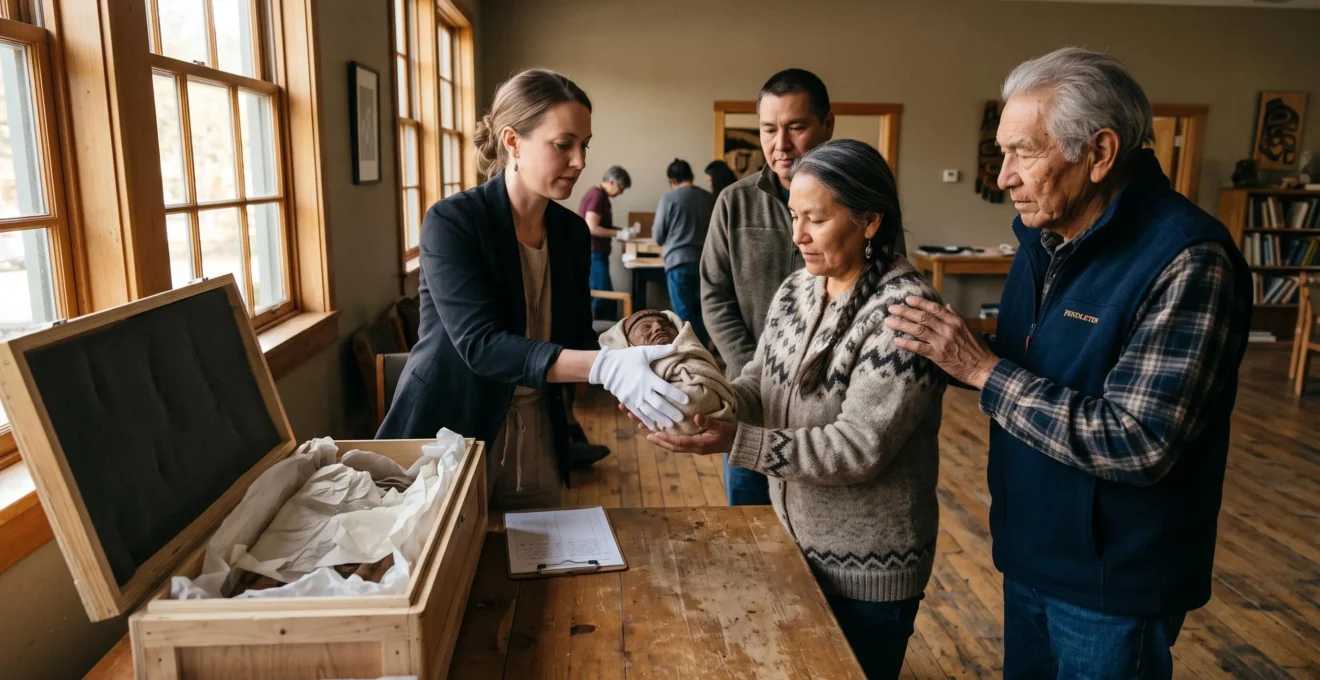
When Indigenous communities reclaim cultural objects from museums, the significance extends far beyond the physical transfer of an artwork. Repatriation can restore relationships between ancestors, living custodians, ceremonial traditions, and future generations. An object previously classified as a museum collection item may regain its place within a system of cultural responsibilities, knowledge transmission, and collective identity.
This distinction matters because cultural continuity cannot be measured solely by an object’s physical survival. Ceremonial access, community authority, traditional knowledge, and decisions about who may see or handle an item can be equally important. For some communities, appropriate care means preserving an object indefinitely; for others, it involves active ceremonial use or accepting material change as part of its cultural life.
The United Nations legal commentary on the Declaration on the Rights of Indigenous Peoples explains the international framework connecting cultural heritage, spiritual practices, collective rights, and the transmission of knowledge between generations. Articles 11, 12, 13, and 31 provide particularly relevant principles, although the Declaration does not automatically create an enforceable right to recover every museum object.
Effective repatriation therefore requires more than resolving ownership. It requires museums and Indigenous communities to determine how cultural authority can be restored, how objects should be cared for, and how the next generation will participate in their continuing significance.
How repatriation supports Indigenous cultural continuity
- Repatriation can restore Indigenous authority over sacred objects, ceremonial access, cultural interpretation, and custodial responsibilities.
- Legal ownership and ethical responsibility are distinct. Museums may need to pursue negotiated returns even where historical acquisition documents establish legal title.
- Full repatriation, shared custody, and controlled access offer different benefits, but arrangements should reflect the originating community’s priorities and informed choices.
- Why Do Indigenous Groups Reject the Argument That Museums « Preserve » Their Sacred Objects?
- How Do Museums Return Artworks When Legal Title Conflicts With Ethical Responsibility?
- Full Return vs Shared Custody: Which Model Better Serves Indigenous Cultural Continuity?
- The Sacred Object Scandal: When Public Display Violates Living Religious Practice
- The Ethical Threshold: When Museum Holdings Must Be Returned Regardless of Legal Ownership
- Why Do Missing Provenance Records From the 1940s Stop Major Auction Sales?
- How Do Western and Chinese Viewers Interpret the Same Painting Completely Differently?
- How Does Documented Provenance Increase an Artwork’s Value by 300% at Auction?
Why Do Indigenous Groups Reject the Argument That Museums « Preserve » Their Sacred Objects?
Indigenous communities may reject museum preservation arguments because protecting an object’s material condition is not equivalent to sustaining its cultural purpose. Sacred belongings can require ceremonies, restricted handling, seasonal use, or responsibilities assigned to particular custodians. When museums preserve their physical form but prevent those relationships from continuing, conservation may protect the object while interrupting the living tradition it supports.
Conventional conservation frequently prioritizes environmental stability, minimal intervention, and the prevention of physical deterioration. Those goals can be appropriate for many collections, but they do not necessarily represent every community’s understanding of responsible care.
A ceremonial belonging may derive meaning from its participation in specific practices. Its significance can depend on who handles it, when it is used, how knowledge about it is transmitted, and which community authorities determine its treatment. A glass case may preserve its appearance without preserving those relationships.
The difference is particularly important when museums describe restricted access as protection. A prohibition on handling may prevent damage, but it may also prevent designated custodians from fulfilling obligations that give the object its continuing significance.
Community-directed conservation offers another approach. Depending on the traditions concerned, authorized custodians may regulate viewing, determine who can handle an item, supervise its ceremonial use, or establish culturally appropriate storage arrangements. Practices such as renewing painted surfaces or permitting material transformation may also have ceremonial significance in particular traditions. These practices should never be presumed universal or undertaken without community authorization.
The assumption that originating communities cannot care for their own heritage is especially problematic. A museum may possess specialized conservation equipment, but this expertise does not automatically confer authority over sacred knowledge or custodial relationships. Where additional physical resources are needed, collaborative conservation training and funding can support community-defined care without displacing Indigenous decision-making.
Historically, claims about the superior preservation capacity of collecting institutions were used to justify retaining cultural material acquired under unequal colonial conditions. Such arguments could present the displacement of cultural belongings as a protective act while overlooking the political circumstances of acquisition and the authority of originating communities.
The distinction today is not between preservation and neglect. It is between preservation defined exclusively by the holding institution and care determined through legitimate cultural authority.
When Indigenous custodians regain control over how cultural belongings are used and protected, preservation can become a means of cultural renewal rather than a justification for continued separation.
How Do Museums Return Artworks When Legal Title Conflicts With Ethical Responsibility?
Museums can return Indigenous artworks despite conflicting legal and ethical considerations by identifying their authority to transfer collections, examining acquisition circumstances, and negotiating an institutionally lawful repatriation process. Depending on the jurisdiction and governing documents, this may require board approval, legal review, legislative authorization, or a transitional custody arrangement. Ethical responsibility should inform the decision even where historic legal title appears valid.
The central difficulty is that a museum’s possession of legal title does not establish that an acquisition was culturally legitimate. Objects may have entered collections through transactions or transfers shaped by colonial authority, unequal bargaining power, or the exclusion of traditional custodians.
Conversely, an ethically persuasive claim does not necessarily give museum directors unilateral authority to transfer property. Public collections, charitable institutions, and museums governed by special statutes may face different restrictions on removing collection items.
The ICOM analysis of legal and ethical approaches to cultural property restitution, published in December 2025, emphasizes cooperation with originating communities, provenance transparency, and voluntary restitution. Its discussion also recognizes legal limits: professional ethical guidance does not authorize institutions to disregard applicable laws.
A responsible return process therefore separates the ethical determination that repatriation is warranted from the procedural question of how it can legally be accomplished.
- Establish the object’s status. Identify the current legal owner, acquisition history, donor restrictions, collection classification, and any applicable repatriation legislation.
- Identify authorized community representatives. Determine how the originating community wishes to conduct consultation and who can communicate decisions about custodial responsibilities.
- Review institutional authority. Examine governing statutes, charitable obligations, collection policies, and board approval requirements before proposing a transfer.
- Agree on an appropriate return mechanism. Consider lawful title transfer, an authorized statutory process, or a temporary custody arrangement where permanent transfer cannot yet be completed.
- Document the transfer and future responsibilities. Record agreed handling protocols, access restrictions, transport arrangements, documentation permissions, and any continuing institutional obligations.
These are planning considerations, not a universal statutory procedure. Actual requirements vary by country, institution, object category, and applicable legal regime.
Long-term loans or temporary deposits can provide transitional access while legal obstacles are addressed. However, they should not be presented as repatriation when the museum continues to retain decisive authority and the community seeks permanent return.
Similarly, conditioning return on an institution’s assessment of community storage capacity risks reproducing the assumption that museums alone can determine appropriate care. Conservation support can be negotiated collaboratively, but any infrastructure conditions require a defensible legal or practical basis rather than a presumption of Indigenous incapacity.
Five practical steps for preparing an Indigenous repatriation decision
- Compile the object’s acquisition, ownership, and custody records into a documented provenance dossier identifying known gaps.
- Consult the originating community about representation, cultural status, and appropriate engagement, producing an agreed consultation record.
- Ask institutional legal counsel to identify transfer powers and restrictions, resulting in a written legal-options memorandum.
- Develop a community-reviewed proposal covering title, custody, ceremonial access, conservation, and documentation, producing a draft return agreement.
- Record the authorized decision, outstanding obligations, and handover arrangements in an approved implementation plan.
Once institutions recognize that legal ownership and ethical authority are separate questions, negotiations can move beyond defending historical transactions toward designing arrangements that support cultural continuity.
Full Return vs Shared Custody: Which Model Better Serves Indigenous Cultural Continuity?
Full repatriation generally provides the strongest basis for Indigenous control when cultural continuity depends on unrestricted community authority over a physical object. Shared custody may be appropriate when the originating community chooses continued institutional cooperation and retains meaningful decision-making powers. Digital or rotational access can support education and geographically dispersed members, but neither necessarily replaces ceremonial possession.
The appropriate model depends on the object’s cultural role, the wishes of authorized custodians, and the practical arrangements required to sustain its use. Treating every Indigenous collection item as requiring the same outcome disregards differences between sacred belongings, community patrimony, and other heritage materials.
For example, a ceremonial object required at recurring community events may need permanent physical availability. A collection used primarily for historical research or language education may support different forms of access, depending on community preferences.
The following decision grid compares potential benefits and limitations. These are practical considerations, not experimentally established rankings of cultural outcomes.
| Decision criterion | Full repatriation | Shared custody | Digital or rotational access |
|---|---|---|---|
| Ceremonial access | Allows community-directed use, subject to its own protocols. | Depends on agreed handling rights and availability. | May not support frequent or object-specific ceremonies. |
| Authority over decisions | Can place ownership and custodial control with the community. | Depends on the distribution of contractual powers. | Often leaves control of the physical object with the institution. |
| Access for dispersed members | May require community-managed outreach and travel. | Can support multiple access locations. | Can support remote learning where culturally permitted. |
| Fragile physical condition | Requires an agreed, culturally appropriate care plan. | May enable shared conservation resources. | Can reduce repeated physical handling but cannot replace every use. |
| Intergenerational transmission | Supports direct learning with authorized custodians. | Can support collaborative programmes under community authority. | May support documentation, language learning, and replicas where appropriate. |
| Long-term flexibility | Decisions rest with the receiving community, subject to applicable law. | Requires review, amendment, and exit provisions. | Depends on access rights, permissions, and technological continuity. |
Physical return and ownership transfer should not be conflated. An object may be physically located in a community facility while title remains with a museum. Conversely, a community might hold legal ownership while choosing to deposit the object at an institution for conservation or public interpretation.
Full repatriation can also involve trade-offs. Removing an object from an internationally visited museum may reduce its visibility to certain audiences or limit opportunities for academic research. Some communities may value that international presence for cultural diplomacy; others may regard visibility as secondary to sacred obligations. The museum’s preference for public display must not be treated as a substitute for the community’s assessment.
Shared custody becomes problematic when an institution retains veto powers over ceremonies, photography, access, or eventual return. A genuinely equitable agreement should specify whose authority determines cultural protocols, how institutional resources are allocated, and how the arrangement can be reconsidered.
Funding for community facilities, conservation assistance, and authorized digital documentation can strengthen any chosen model. These forms of cooperation should support community decisions rather than provide grounds for indefinite institutional retention.
The preferred arrangement is therefore not necessarily the one that maximizes exhibition opportunities. It is the one that enables the originating community to sustain the object’s cultural role on terms it has meaningfully chosen.
The Sacred Object Scandal: When Public Display Violates Living Religious Practice
Displaying Indigenous sacred objects can violate living religious practice when museums expose restricted belongings to unauthorized viewers, disregard ceremonial obligations, or publish images that communities consider sensitive. Such display may be harmful even when the physical object remains undamaged and the museum possesses legal title. Appropriate institutional responses include consultation, restricted access, removal from exhibition, and community-controlled decisions about documentation.
Public access is often presented as a fundamental museum benefit. Yet unrestricted viewing can conflict with the cultural rules governing particular sacred materials. In some traditions, certain belongings or knowledge may be accessible only to initiated members, designated custodians, or people fulfilling specific responsibilities.
Restrictions can concern gender, ceremonial status, kinship, or other community-defined conditions. These obligations are culturally specific and cannot be generalized across Indigenous peoples.
The problem becomes more serious when institutions treat sacred belongings as decorative objects detached from living relationships. Items understood by a community as ancestral presences, active ceremonial agents, or objects associated with mourning may be displayed through labels emphasizing aesthetic qualities, stylistic classification, or market history.
For younger community members, this can create a conflict between inherited cultural teaching and the authoritative interpretations presented by museums. A display that omits ceremonial significance may fail to transmit the knowledge through which the object remains meaningful.
Photography and digitization introduce additional risks. Once images are uploaded, they may circulate through educational databases, social platforms, commercial applications, or archives outside the community’s control. Removing the original museum webpage does not guarantee that all copies disappear.
Consent should therefore address not only the physical exhibition but also photography, research access, reproduction, metadata, and subsequent publication. Where sensitive images already exist, museums can consult custodians about restricting institutional access and requesting removal of unauthorized reproductions where feasible.
United States repatriation regulations provide an important example of a legally specified consent requirement. The National Park Service announcement of the revised NAGPRA regulations explains changes announced on 6 December 2023, including requirements for free, prior, and informed consent before exhibition, access, or research involving covered human remains and cultural items.
That requirement concerns objects and institutions within the law’s scope. It should not be described as a universal rule governing every Indigenous artwork in every country, and the 2023 announcement alone does not establish all subsequent legal developments.
Beyond statutory requirements, museums can undertake cultural sensitivity reviews, suspend exhibition while concerns are assessed, create restricted viewing arrangements, and establish community-approved image permissions. Removing an item from public display may be a necessary interim measure while a broader repatriation request is considered.
Respectful exhibition policy protects living religious practice by allowing originating communities to define which forms of visibility, interpretation, and documentation are appropriate for their own heritage.
The Ethical Threshold: When Museum Holdings Must Be Returned Regardless of Legal Ownership
An ethical case for returning Indigenous cultural belongings can become compelling when acquisition involved coercion or unequal power, the object remains significant to a living community, and authorized custodians seek its return. Legal title alone may not resolve these concerns. However, an ethical obligation to pursue repatriation must be distinguished from a legally enforceable duty, which depends on the relevant jurisdiction and collection category.
Historic acquisition records can document a sale, donation, exchange, or transfer without establishing that a community meaningfully consented to losing control of a sacred belonging.
Colonial administrations frequently operated through legal and political systems that constrained Indigenous decision-making. An individual transaction conducted within such a system may therefore require examination beyond whether the collecting institution possesses paperwork supporting ownership.
A consent-based ethical assessment asks who had the authority to transfer the item, what circumstances shaped the transaction, and whether relevant custodial obligations were understood or respected.
Three considerations are particularly important:
- Acquisition circumstances: evidence of coercion, dispossession, institutional pressure, or unequal authority that may undermine the legitimacy of an apparent transfer.
- Continuing cultural significance: the object’s ceremonial role, relationship to collective identity, or importance to the transmission of knowledge.
- Community wishes and authority: the expressed position of appropriate representatives and the custodial arrangements they seek.
These considerations provide an ethical assessment framework rather than a universally binding legal test. Their application requires attention to the particular object’s history and the community’s own account.
In the United States, statutory repatriation regimes establish specific requirements for qualifying categories and institutions. The Native American Graves Protection and Repatriation Act applies to covered federal agencies and museums within its statutory scope, while the Smithsonian’s National Museum of the American Indian operates under a distinct legislative framework.
The Smithsonian National Museum of the American Indian repatriation programme describes the institution’s responsibilities under the National Museum of the American Indian Act, including its approach to sacred objects and objects of cultural patrimony. The museum also identifies repatriation as a human rights issue for Indigenous peoples.
These frameworks should not be treated as interchangeable. Neither establishes that every object classified as Indigenous art must legally be returned upon request.
Outside binding statutory obligations, institutions may still have compelling reasons to negotiate voluntary return. Professional ethics, evidence of problematic acquisition, cultural responsibilities, and community wishes can justify institutional action without implying that legal restrictions may simply be ignored.
Ethical repatriation also requires listening to what communities actually request. Some may prioritize immediate physical return, while others may seek recognition of ownership, restrictions on use, or a staged arrangement developed under their direction.
Where ethical grounds strongly favor return but current law restricts transfer, the appropriate response is to identify lawful remedies and pursue them transparently rather than treating historical title as the end of the discussion.
Why Do Missing Provenance Records From the 1940s Stop Major Auction Sales?
Missing provenance records from the 1940s can disrupt major auction sales because that period overlaps with extensive Nazi-era persecution, dispossession, and art looting in Europe. Unexplained ownership gaps may raise questions about lawful title, restitution claims, and potential litigation. Auction houses and buyers may consequently require further research, delay a transaction, or withdraw a work when material uncertainties remain unresolved.
Provenance records establish an object’s documented chain of ownership and custody. They may include invoices, estate inventories, exhibition catalogues, shipping records, correspondence, and institutional accession files.
A gap does not prove that an artwork was stolen. It indicates that an important part of its history remains unverified. The significance of that gap depends on the object’s location, previous owners, wartime movements, and the availability of other evidence.
For European artworks circulating during the Nazi era, these uncertainties can be especially consequential. Buyers and auction houses may need to assess potential restitution claims before proceeding with a sale.
Possible consequences include additional due diligence, contractual warranties, insurer concerns, buyer hesitation, and withdrawal or postponement. These outcomes are case-dependent rather than automatic consequences of any missing 1940s record.
The connection with Indigenous repatriation lies in the importance of acquisition evidence, although the historical and legal circumstances are distinct.
Indigenous cultural objects acquired during colonial administrations may also have incomplete documentation. Records might describe the collecting institution’s actions while saying little about the originating community’s authority, consent, or continuing cultural responsibilities.
This presents an important evidentiary imbalance. Museums may hold the surviving acquisition documents, while communities were excluded from the archival systems through which transactions were recorded. An absence of written documentation should not automatically invalidate Indigenous knowledge about provenance or custodianship.
For covered NAGPRA processes, the 2023 regulatory revision discussed earlier expressly strengthened recognition of Indigenous Knowledge. That approach illustrates why provenance assessment should not be limited to documents produced by collecting institutions.
Institutions can improve research by making records accessible, identifying uncertainties explicitly, and consulting communities about oral histories and traditional knowledge. Such consultation does not mean that every undocumented acquisition is necessarily wrongful; it means incomplete archives should be examined rather than presumed conclusive.
For repatriation officers, the practical implication is clear: provenance research should investigate how ownership was established, whose evidence has been preserved, and whose knowledge has historically been excluded.
How Do Western and Chinese Viewers Interpret the Same Painting Completely Differently?
Western and Chinese viewers may interpret the same painting differently because artistic meaning depends partly on learned conventions, cultural knowledge, and historical context. Some Western art-historical approaches emphasize authorship, composition, and stylistic innovation, while Chinese painting traditions may place particular weight on inscriptions, seals, calligraphic relationships, and histories of ownership. These are interpretive tendencies, not fixed characteristics of every viewer.
A painting is not simply a collection of visible shapes and colors. Its significance also depends on the practices through which viewers understand its subject, material, authorship, and social relationships.
In certain Western art-historical settings, an interpretation might begin with the artist’s identity, treatment of perspective, composition, or relationship to a stylistic movement.
In the study of a traditional Chinese handscroll, however, inscriptions, seals, and successive acts of appreciation can form integral parts of the object’s history. Viewing a scroll progressively may also create a different experience from observing a painting displayed continuously on a wall.
Neither example defines all Western or Chinese viewers. Both traditions contain diverse approaches, and individuals may combine multiple interpretive frameworks.
The contrast helps illuminate a central question in Indigenous cultural repatriation: who has the authority to explain what an object means?
A museum might classify a ceremonial belonging according to its materials, period, maker, or visual characteristics. Those categories may provide valuable information, but they can omit relationships that originating custodians regard as essential.
For example, a museum label could describe an item as a carved ceremonial object while offering little information about the responsibilities associated with its use. Alternatively, displaying detailed ceremonial information without permission could violate restrictions on who may receive that knowledge.
Community participation is therefore not merely a way to improve a label’s cultural sensitivity. It can change which questions the museum asks, what information it is authorized to publish, and whether public exhibition is appropriate at all.
Intergenerational knowledge transmission often relies on relationships among people, objects, languages, and practices. Documentation alone may not reproduce the learning that occurs when authorized custodians teach younger members through direct participation.
At the same time, Indigenous communities should not be treated as internally uniform. Different generations, families, and recognized authorities may hold distinct responsibilities or perspectives. Museums need to follow culturally appropriate consultation processes rather than selecting a single convenient interpretation.
Repatriation can restore more than an object’s physical location: it can help return interpretive authority to the people whose traditions determine its continuing significance.
Key considerations before the final provenance assessment
- Assess provenance as a record of how an object moved, not automatic proof that every transfer was legitimate or consensual.
- Separate commercial value from cultural rights: a saleable artwork may still be subject to a well-founded restitution or repatriation claim.
- Ensure ownership research incorporates relevant Indigenous Knowledge and identifies unresolved acquisition questions before any proposed transaction.
How Does Documented Provenance Increase an Artwork’s Value by 300% at Auction?
Documented provenance can increase an artwork’s auction value by improving confidence in authenticity, ownership history, and legal transferability. However, a 300% increase is not a universal or established market effect. The premium varies by object, attribution, ownership history, and buyer demand. For Indigenous cultural material, stronger provenance can also reveal grounds for repatriation rather than simply increasing saleability.
At auction, buyers evaluate more than visual appeal. They may consider attribution, condition, rarity, exhibition history, documented ownership, and potential legal or ethical claims.
A well-supported provenance can reduce uncertainty when it demonstrates a coherent and credible ownership history. Conversely, documentation exposing coercion, contested ownership, or restrictions on transfer may reduce buyer confidence or prevent a transaction from proceeding.
The headline figure of 300% should therefore be understood only as an illustrative comparison, not an average, forecast, or documented market statistic. The supplied sources do not establish a general uplift of that magnitude for artworks or Indigenous collections.
Hypothetical comparison: identical artistic quality, different provenance risks
Consider two otherwise comparable artworks offered to collectors. One has a coherent ownership record, relevant export documentation, and no identified competing claim. The other has an unexplained acquisition period and unresolved questions about whether the original holder consented to its transfer.
Buyers might assign a premium to the first or decline to bid on the second. The extent of any difference cannot be calculated without actual comparable sales and the facts of the individual objects. This hypothetical scenario illustrates a risk mechanism, not a verified auction result.
For Indigenous heritage, provenance research has a further consequence: the evidence that clarifies a collection item’s history may also establish a stronger basis for its return.
Acquisition records can identify collecting expeditions, previous custodians, colonial officials, intermediaries, or circumstances indicating that a transfer was not freely authorized. Such discoveries may strengthen a community’s claim even if they make the object less attractive to prospective purchasers.
Documentation is therefore potentially double-edged. It can support commercial confidence where an object is legitimately transferable, while exposing ethical or legal obstacles where its acquisition history is contested.
The relevant distinction is not simply between documented and undocumented objects. It is between credible evidence of legitimate transfer and documentation that leaves essential questions unanswered or reveals circumstances requiring restitution review.
Ethical acquisition policies can also affect market participation. Museums, foundations, and private collectors may apply their own restrictions to objects with unresolved cultural-property concerns. The precise market impact depends on the policies of the potential purchasers and the facts of the proposed sale.
For repatriation officers and heritage advocates, this commercial dimension underscores the importance of retaining accurate records while keeping the cultural purpose of provenance research in view. The objective of investigating a sacred belonging should not automatically be to improve its exchange value.
Instead, research should help identify rightful authority, determine whether past transfers were legitimate, and support decisions about future custody, access, and cultural responsibilities.
Before approving an acquisition, sale, loan, or return agreement, review the provenance dossier with relevant community representatives and institutional advisers, document unresolved issues, and agree on the next legitimate decision-making step. The value of that work lies not only in reducing transaction risk but in ensuring that cultural heritage remains connected to those responsible for its future.
Can Indigenous communities request the return of objects that were legally purchased?
Yes. A community can raise an ethical repatriation request even when a museum holds documentation of a lawful purchase. The institution should examine who authorized the transaction, the circumstances of acquisition, and any continuing cultural responsibilities. Whether return is legally required depends on the applicable legislation and facts; voluntary restitution may remain possible where no statutory duty applies.
Does repatriation always require a museum to surrender legal ownership?
No. Physical custody, legal ownership, and authority over use can be addressed separately. Some arrangements involve full ownership transfer, while others establish deposits, loans, or shared stewardship. Nevertheless, an arrangement that leaves ownership and decisive authority with the museum should not be described as equivalent to full repatriation when the originating community seeks permanent return.
How can museums support Indigenous knowledge transmission after repatriation?
Museums can provide conservation assistance, accessible historical records, archival copies, transport support, and funding for community-defined heritage activities. They can also collaborate on educational resources where authorized. The originating community should determine which knowledge may be shared, who may access it, and whether materials can be photographed or reproduced.
Are digital replicas an acceptable substitute for sacred objects?
Digital replicas may support learning, research, and access for geographically dispersed community members, but they do not necessarily reproduce an object’s ceremonial significance. Some communities may welcome documentation; others may restrict images or regard physical presence as essential. Decisions about digitization should therefore follow community-defined permissions rather than assumptions about universal access.
Who should decide whether a repatriated object is displayed, stored, or used ceremonially?
Appropriate decisions should be guided by the originating community’s recognized custodial authorities and relevant cultural protocols, subject to applicable legal obligations. Museums can provide technical advice concerning conservation and handling, but technical expertise does not automatically establish authority over ceremonial practice. Agreements should specify decision-making rights and procedures for resolving disagreements.