
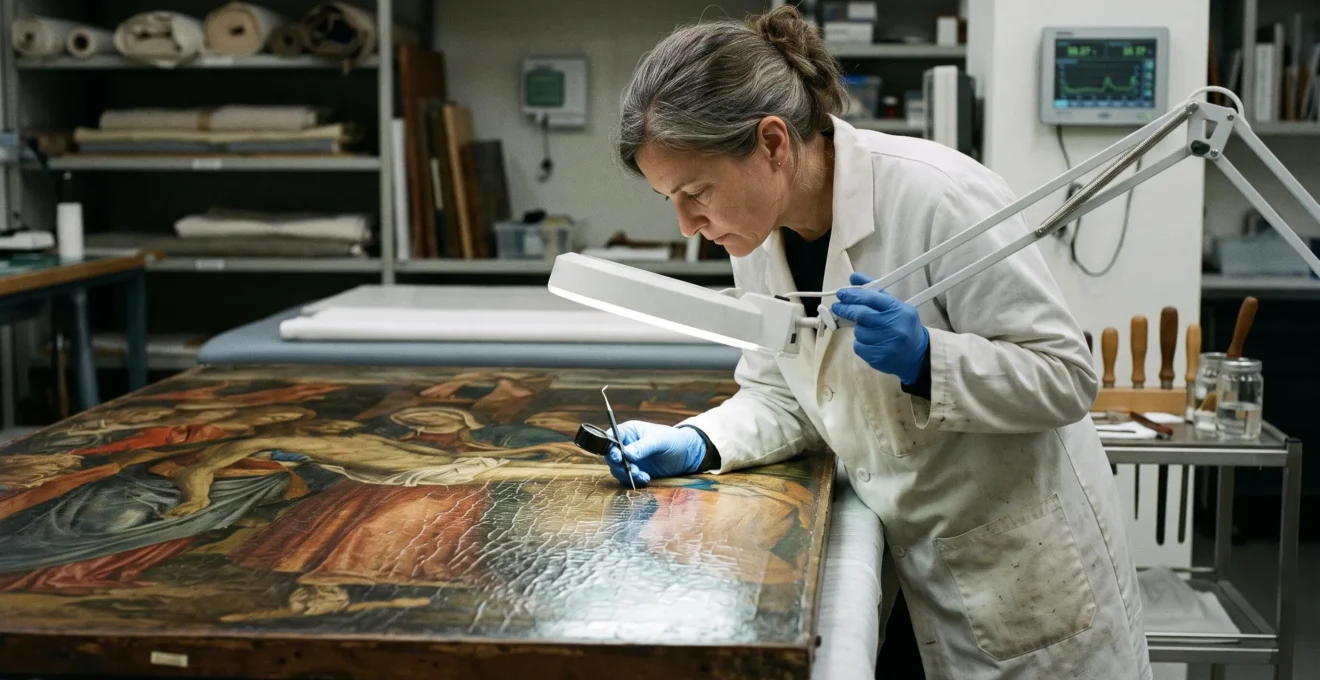
A painting can develop cracks inside a climate-controlled gallery. A centuries-old textile can weaken while resting undisturbed in storage. Even a carefully restored masterpiece may continue deteriorating because its materials remain chemically and physically active.
The claim that 70% of museum collections deteriorate despite modern conservation is not established by the technical sources considered here. No universal deterioration percentage can reliably describe collections containing paintings, textiles, sculpture, photographs and objects manufactured from incompatible materials. Yet the underlying concern is legitimate: modern conservation reduces risks without eliminating the processes responsible for ageing.
Effective preservation requires more than sophisticated air-conditioning or occasional restoration. It depends on understanding individual materials, monitoring environmental conditions, documenting change, preventing avoidable handling damage and intervening when deterioration becomes active.
For curators and heritage professionals, the essential distinction is between an object that bears evidence of historical ageing and one undergoing damage that can still be prevented.
Museum collection preservation: the essential findings
- Climate control reduces risk but cannot guarantee stability. Different materials respond to humidity, temperature and light at different rates, creating mechanical and chemical stresses.
- Preventive conservation provides the foundation for long-term protection. Environmental management, scientific examination, appropriate storage and condition documentation help institutions intervene before damage escalates.
- Handling protocols and early detection remain critical. Coordinated movements, protective packaging and prompt responses to new deterioration can prevent avoidable losses.
- Why Do Climate-Controlled Museums Still Lose 15% of Paintings to Cracking Over 50 Years?
- How Do World-Class Museums Protect Artworks Through Five Critical Preservation Stages?
- Preventive Care vs Active Restoration: Which Approach Saves More Artworks Over 100 Years?
- The Handling Error That Destroyed £2 Million Worth of Renaissance Panels in 2019
- The Three Warning Signs That Demand Immediate Conservation Action Within 48 Hours
- Why Do Ancient Textiles Disintegrate When Museum Humidity Varies by Just 5%?
- Why Do Paintings From 1950 Show More Colour Loss Than Works From 1550?
- Which Handling Protocols Prevent the £200,000 Accidents That Destroy Museum Objects?
Why Do Climate-Controlled Museums Still Lose 15% of Paintings to Cracking Over 50 Years?
Climate-controlled museums can still experience paint cracking because controlling gallery air does not eliminate internal stresses within an artwork. Wooden panels, canvas, preparation layers and paint films absorb moisture and respond at different rates. Repeated environmental changes can therefore produce deformation, cracking or cleavage. However, no reliable universal evidence establishes a 15% cracking rate over 50 years.
Consider a Renaissance panel painting consisting of a wooden support, preparation layers, pigment-bound paint and protective coatings. Each component possesses different mechanical properties and responds differently to environmental change.
Wood exchanges moisture with surrounding air. As its moisture content changes, it expands or contracts, often unevenly across the grain. The relatively less flexible paint and preparation layers may resist this movement, creating stress at their interfaces.
Regulating room humidity does not mean every layer of an artwork has reached moisture equilibrium. A rapid change in gallery conditions may affect an exposed surface before the interior of a thick wooden panel responds.
The Canadian Conservation Institute‘s environmental guidelines for paintings identify stable relative humidity between 40% and 60% as generally appropriate for paintings on canvas or wood. They also recognise that a conventional central setting of 50% relative humidity is not universally required.
40–60% RH
The general stable relative-humidity range identified by the Canadian Conservation Institute for paintings on canvas or wood. It is guidance for these materials, not a universal prescription for every collection or proof against cracking.
Canadian Conservation Institute, Environmental Guidelines for Paintings, CCI Notes 10/4.
Environmental management should therefore consider the object’s construction, previous exposure and present condition. An artwork that has accommodated particular historical fluctuations may behave differently from one already weakened by structural treatment or existing cleavage.
The rate of environmental change also matters. Abrupt fluctuations may establish moisture gradients and transient stress before an object has time to equilibrate. Nevertheless, the magnitude and duration of change, material response and previous environmental history are all important. Fluctuation speed cannot be treated as the dominant risk in every circumstance.
A conservator investigating new cracks should compare the painting’s condition history with temperature and humidity records, examine the support and identify whether damage is active. Maintaining a nominal set point alone does not establish the cause.
Climate control is most effective when combined with object-specific risk assessment, regular condition monitoring and a broader institutional preservation system.
How Do World-Class Museums Protect Artworks Through Five Critical Preservation Stages?
Museums protect artworks through a continuous cycle comprising acquisition assessment, initial examination, preventive conservation, safe storage and transport, and periodic reassessment. Each stage generates information needed for the next conservation decision. The process is not a universal five-step standard but a practical framework for coordinating scientific investigation, environmental management, object handling and long-term stewardship.
The first stage begins before an object enters the collection. Acquisition assessments consider its condition, materials, previous treatments, provenance documentation and the institution’s capacity to care for it.
Accepting a particularly fragile work without suitable storage, monitoring or specialist expertise may create a preservation obligation that the museum cannot adequately fulfil.
The second stage establishes the object’s condition through examination and documentation. Conservators may employ visible-light photography, raking light, radiography, infrared reflectography and material analysis when these methods are appropriate to the object’s construction and the questions being investigated.
Infrared reflectography can reveal certain underdrawings and alterations beneath paint layers. Radiography can provide information about internal construction and some hidden structural features. Pigment analysis can help identify materials whose stability or treatment responses require further investigation.
The third stage involves preventive conservation: controlling avoidable environmental stresses, managing light exposure, monitoring pests, inspecting storage systems and reducing unnecessary handling.
The fourth concerns storage, packing and transport. Supports, enclosures and movement procedures must be adapted to the object. A stable gallery environment cannot compensate for inadequate packing during a journey or unsupported storage over many years.
Finally, periodic reassessment compares current observations with baseline records. A condition report becomes especially valuable when an artwork is considered for exhibition, loan or treatment.
The condition record is a decision-making instrument, not simply an administrative archive. It should distinguish established historical damage from new changes and identify any restrictions on movement or display.
These stages form a cycle. A new condition finding may trigger environmental investigation, modification of a mount, reconsideration of a loan or specialist treatment.
The stronger the continuity between examination, documentation and preventive care, the less likely a developing problem is to remain unnoticed until substantial intervention becomes necessary.
Preventive Care vs Active Restoration: Which Approach Saves More Artworks Over 100 Years?
Preventive conservation generally offers the broader long-term benefit because it reduces deterioration risks across entire collections without requiring repeated physical intervention on individual objects. Active restoration remains essential when structural instability or ongoing material loss threatens an artwork. Over a century, the strongest preservation strategy combines sustained prevention with carefully justified, minimally invasive treatment when necessary.
The distinction is important because prevention and restoration address different problems.
Preventive conservation modifies the conditions surrounding an object. It may involve improved storage, environmental management, pest control, exhibition planning, appropriate mounts and better handling practices.
Active conservation-restoration involves intervention on the object itself. Depending on the circumstances, treatment might include stabilising detached paint, addressing structural damage or reducing harmful deposits.
For collection managers allocating limited resources, the comparison is best understood in terms of scope, risk and ongoing responsibilities.
| Decision criterion | Preventive conservation | Active restoration |
|---|---|---|
| Primary objective | Reduce the likelihood or rate of deterioration | Address an identified condition or stability problem |
| Typical application | Continuous collection-wide management | Object-specific treatment when justified |
| Direct physical intervention | Usually limited or avoided | Often necessary and carefully controlled |
| Principal risks | Inadequate environmental specifications, monitoring or maintenance | Unintended material changes, treatment incompatibility and loss of original material |
| Long-term planning | Requires recurring institutional investment | Requires specialist assessment, treatment resources and subsequent monitoring |
| Best application | Routine protection of stable collections | Active deterioration that cannot be adequately managed through prevention alone |
The economic advantage of prevention arises from its scale. An improved storage environment can benefit many objects simultaneously, whereas a complex restoration may demand substantial specialist time for a single work.
Nevertheless, no universal financial ratio demonstrates how much every pound invested in preventive care will save in restoration expenditure. Costs depend on the collection, building, staffing arrangements and condition of the objects involved.
Minimum intervention and compatibility with original materials remain central conservation considerations. Reversibility, or the possibility of retreatment, is an important ethical aspiration, but not every treatment can be completely reversed.
Cleaning illustrates the problem. Removing a discoloured surface coating may improve appearance, yet an inappropriate solvent or cleaning method can alter original paint and produce losses that cannot subsequently be recovered.
Conversely, postponing every intervention can be equally harmful. Actively lifting paint, unstable joins or progressing structural failure may require prompt treatment to prevent further loss.
The conservation decision must therefore address two questions: what harm may follow if intervention is deferred, and what irreversible consequences might the proposed treatment introduce?
Because analytical techniques and conservation materials continue to develop, retaining sound original material and avoiding unnecessary structural alterations can preserve opportunities for future examination and treatment.
Preservation over 100 years is not achieved through a single successful restoration. It depends on successive generations maintaining an informed, adaptable conservation programme.
The Handling Error That Destroyed £2 Million Worth of Renaissance Panels in 2019
The alleged 2019 incident involving £2 million worth of Renaissance panels cannot be verified from the supplied conservation sources. It should not be presented as an established historical loss. The underlying preservation risk is nevertheless real: handling can subject fragile wooden paintings to impact, bending and vibration, with damage extending beyond the initial accident.
A Renaissance panel painting is a composite object. Wood, ground layers, paint and previous restoration materials may possess different stiffness, ageing characteristics and responses to sudden forces.
Imagine a hypothetical museum transfer in which a large painted panel is lifted without adequate structural support. If one handler changes position while another continues moving, the panel may experience an unintended twisting or bending force.
Such movement can affect vulnerable joins, existing cracks and paint layers. A visible fracture is not necessarily the only consequence: structural separation or weakened adhesion may require subsequent examination to determine the full extent of damage.
Correct handling therefore depends on the object’s construction, not simply its apparent weight. A comparatively light artwork may still need substantial support if its frame, panel or previous repairs are unstable.
The institutional implications of a serious accident also extend beyond the object itself:
- Specialist examination and treatment may require substantial resources.
- Restricted display or loan availability can disrupt exhibition planning.
- Insurance and indemnity considerations may require further documentation.
- Incident investigation can reveal deficiencies in handling procedures.
- Loan relationships may be affected if lenders lose confidence in collection management.
These consequences should not be converted into a specific monetary loss without verified documentation.
An incident investigation should also distinguish the immediate handling action from the conditions that made failure possible.
Insufficient staffing, rushed schedules, inadequate equipment, unclear instructions and weak escalation procedures can all contribute to unsafe movements. Their involvement must be established for each incident rather than assumed.
There is likewise no evidence in the supplied material that most museum deterioration occurs during handling rather than exhibition or storage. Those different risks require separate assessment.
The most useful response to an accident is a documented examination followed by proportionate changes to equipment, training and movement procedures, rather than assigning responsibility without examining the wider system.
The Three Warning Signs That Demand Immediate Conservation Action Within 48 Hours
Three warning signs warrant urgent conservation assessment: newly developing structural damage, evidence of active biological infestation and abnormal environmental conditions threatening vulnerable objects. An initial response within 48 hours is a useful institutional escalation target, not a universal scientific deadline. Active water ingress, rapidly spreading damage or an immediate safety hazard may require action much sooner.
First, new or progressing cracks, lifting paint and delamination can indicate that an object is experiencing mechanical instability.
The distinction between old and active damage is essential. Stable historical craquelure does not automatically justify treatment. Newly raised paint, extending fractures or fresh material losses are more concerning when confirmed against earlier condition records.
Initial examination should establish the location, extent and apparent progression of the problem while avoiding unnecessary movement.
Second, evidence of active infestation or fungal growth requires prompt assessment and appropriate containment.
Examples include newly observed insect activity, fresh frass where relevant to the pest involved, or visible mould growth. Insect remains or historical exit holes alone do not necessarily demonstrate current infestation.
Any suspected biological problem should be evaluated in relation to the affected materials, environmental conditions and potential consequences for neighbouring objects.
Third, an abnormal microclimate may expose collections to rapid deterioration.
Examples include a sustained humidity excursion, local condensation, equipment malfunction or water-related incident. Conservators should consider the accuracy and placement of monitoring instruments before interpreting a single reading as proof of object damage.
Different conditions require different responses. Structural instability may call for movement restrictions and specialist examination. Suspected pests may require isolation and identification. Environmental faults require investigation and stabilisation of conditions.
Five immediate actions for suspected collection deterioration
- Record the observation: photograph the affected area without disturbing it and create a dated incident entry containing the object’s identifier and location.
- Compare earlier evidence: retrieve previous condition images and notes, producing a short comparison identifying confirmed changes and unresolved uncertainties.
- Check relevant conditions: review available environmental readings, nearby incidents and object vulnerabilities, attaching the relevant records to the incident entry.
- Restrict exposure and handling: document an appropriate temporary safeguard, such as suspension of movement or controlled isolation, after considering the risks of the safeguard itself.
- Escalate for specialist assessment: notify the responsible conservator or designated collection-care professional and record the referral, immediate decisions and next review point.
Staff should not attempt improvised consolidation, solvent cleaning, pesticide application or other potentially harmful treatment without suitable professional assessment.
Containment must also respect object-specific risks. For example, moving an unstable painting solely to achieve quarantine may cause more immediate damage than maintaining a controlled exclusion area around it.
Urgency should be governed by the severity and progression of the observed threat, supported by evidence, rather than treating 48 hours as a safe period during which no action is necessary.
Why Do Ancient Textiles Disintegrate When Museum Humidity Varies by Just 5%?
Ancient textiles do not universally disintegrate when relative humidity changes by five percentage points. Historical fibres absorb and release moisture, but their vulnerability depends on fibre composition, previous degradation, physical restraints and environmental extremes. Moderate humidity changes may be tolerated, while fragile or constrained textiles can experience damage when moisture-related movement interacts with existing weakness.
Wool, linen and silk differ in structure and response to moisture. Their preservation also depends on factors such as earlier light exposure, oxidation, pollutants, manufacture and previous storage conditions.
As hygroscopic materials, textile fibres exchange water vapour with their surroundings. Changes in moisture content can alter dimensions and mechanical properties, but the consequences are not identical across textile types.
For example, a loosely supported textile may accommodate moderate dimensional movement more readily than fabric constrained within an inflexible frame or attached to a rigid structure.
The Canadian Conservation Institute’s textile and costume conservation guidelines explain that many textiles tolerate a relatively wide range of humidity conditions. Extreme humidity, rather than an arbitrary five-percentage-point fluctuation, is a central concern.
“Textiles can tolerate a wide range of RH levels. It is only the extremes that threaten textile collections.”
Low humidity can make certain textiles more brittle and vulnerable during handling. High humidity may increase biological risks and influence chemical deterioration, particularly when accompanied by elevated temperature.
The same institutional guidance explains that mould development is highly dependent on moisture conditions. Around 70% relative humidity, development may take months, while at 90% it may occur within days. These are conditional examples, not guaranteed incubation periods.
Light introduces another irreversible deterioration pathway. Photochemical reactions can weaken fibres and alter dyes, even where humidity remains comparatively stable.
Silk is particularly susceptible to some forms of light-induced deterioration. A fragile silk garment may therefore require carefully restricted illumination and exhibition duration, regardless of whether its storage humidity is well managed.
Practical measures include:
- Using appropriate padded supports to distribute the weight of garments and reduce local mechanical stress.
- Providing suitable flat storage for textiles unable to support their own weight safely.
- Considering passive microclimate enclosures where a particular object requires additional environmental buffering.
- Restricting light exposure according to material sensitivity and cumulative exhibition history.
- Implementing environmental monitoring, integrated pest management and appropriate examination procedures.
Conditioned silica gel may be useful in a properly designed enclosure, but its suitability, quantity, maintenance and buffering performance require assessment. It is not automatically beneficial in every display case.
The preservation objective is to limit damaging extremes and mechanical stresses while addressing cumulative light exposure, pollutants and biological threats.
Why Do Paintings From 1950 Show More Colour Loss Than Works From 1550?
Paintings produced in 1950 do not necessarily lose more colour than paintings produced in 1550. Some modern synthetic pigments and binders present complex ageing and treatment challenges, but historical paintings can also contain unstable colourants. Differences in fading depend on specific materials, exposure, previous treatments and condition, not simply on the century in which an artwork was created.
The apparent paradox partly reflects the diversity of materials used by artists.
Historical painters frequently employed mineral pigments such as earth colours and certain inorganic blues, alongside other pigments and organic colorants with very different stability characteristics.
Some mineral pigments have demonstrated substantial durability. However, that observation does not establish the permanence of every pigment used in Renaissance painting.
Likewise, twentieth-century manufacturing introduced a wide variety of synthetic pigments, binding media, additives and paint formulations.
These developments expanded artistic possibilities while creating new questions about long-term chemical behaviour, surface properties and appropriate conservation treatments.
The Getty Conservation Institute‘s Modern Paints research project investigates the cleaning, chemical analysis and physical characterisation of paintings made with synthetic paint media.
The programme, which began in 2002, addresses conservation challenges associated with the varied formulations of modern painting materials.
Its existence demonstrates the need for material-specific research, not that all modern paintings deteriorate faster than Old Master works.
Modern paint systems may raise treatment questions involving additives, surface sensitivity, changing solubility, migration of constituents and interactions between cleaning systems and original materials.
These behaviours vary by formulation. Acrylic, alkyd and other synthetic systems should not be treated as interchangeable, nor should every modern paint layer be assumed to yellow, become insoluble or resist cleaning.
Ageing also changes historical materials. Old varnishes may yellow, previous restorations may become visible, and certain historical pigments or dyes may undergo irreversible alteration.
There is an additional limitation to direct comparison: surviving paintings from 1550 represent objects with particular histories of preservation, damage, alteration and selection. Their present appearance is not a controlled measure of their original colour stability.
For museums, the strategic implication is clear. Material identification and treatment testing should inform conservation decisions rather than assumptions about historical period.
A modern artwork may require detailed investigation before surface cleaning, especially where a cleaning method could extract paint components or permanently alter gloss and texture.
Similarly, an early painting with sensitive glazes or historic retouching may demand precautions that differ substantially from those suitable for a stable mineral paint layer.
As conservation research develops, institutions can strengthen treatment decisions by preserving analytical records, monitoring changes and documenting methods that future specialists may need to reassess.
Key takeaways before handling and movement
- Material identification should guide handling. A structurally unstable panel, a fragile textile and a sensitive modern painting require different supports and precautions.
- Condition documentation should determine movement readiness. An object already showing active damage needs specialist review before routine relocation.
- Institutional procedures must be practical and enforceable. Safe handling depends on trained personnel, suitable equipment and the authority to stop unsafe work.
Which Handling Protocols Prevent the £200,000 Accidents That Destroy Museum Objects?
Effective museum handling protocols combine object-specific risk assessment, documented movement plans, suitable staffing, structural support, protected transport routes and coordinated communication. They reduce the likelihood and severity of accidental damage but cannot guarantee prevention. The £200,000 figure is not a verified standard accident cost; institutional procedures should be justified by collection vulnerability rather than assumed financial thresholds.
Handling is a conservation activity, not merely a logistical task. Every movement introduces possible mechanical and environmental risks, including impact, vibration, compression, abrasion and changes in temperature or humidity.
The Canadian Conservation Institute’s technical publication, Five Steps to Safe Shipment, identifies these hazards and emphasises adapting packing and transport arrangements to the object’s characteristics and anticipated journey.
The document’s five shipment steps specifically concern packing fragile objects for transport. They should not be confused with a complete five-stage conservation-management framework.
A written movement plan provides the operational foundation. It should identify the object, its condition, the proposed route, necessary equipment, responsible personnel and any restrictions arising from its construction.
Staffing must be proportionate to the object’s size, weight, fragility and movement complexity. A two-person team may be suitable for certain objects, but it is not a universal safety requirement or sufficient arrangement for every movement.
Large or unstable artworks may require additional trained handlers and mechanical assistance. Conversely, some small objects may be safely moved by a single appropriately trained professional using a suitable container.
The critical consideration is control over the object throughout the entire transfer.
Handling points must be selected according to the object’s construction and current stability. For framed paintings, a structurally sound frame may sometimes contribute to safe handling, but decorative frames, weak joints and unstable attachments must not be assumed capable of carrying the object’s weight.
Direct pressure against canvas or vulnerable painted surfaces should be avoided. Suitable protective backing, rigid supports, trays or purpose-designed handling devices may be necessary.
Glove selection should also be material-specific. Clean hands may provide better control for certain tasks, whereas appropriately selected gloves are important for objects sensitive to skin oils or contamination. Cotton gloves are not universally the safest option.
Where multiple handlers are involved, one designated coordinator can direct the movement, confirm readiness and establish agreed stopping procedures.
A practical communication system should ensure that every participant understands when movement begins, how changes in direction are communicated and that anyone can call for an immediate stop when a risk arises.
Before an object leaves its existing position, the team should verify the route. Doorways, turning space, floor conditions, lifts, temporary obstructions and the destination support all require consideration.
For external shipment, protective packaging must address foreseeable transport hazards. Depending on the object, appropriate measures may include structural restraint, shock-absorbing materials, suitable cushioning, environmental protection and carefully designed crates.
Packaging should not itself introduce excessive pressure, harmful emissions or incompatible contact materials.
The final defence is an effective institutional safety culture. Practical training, supervised movements, equipment inspection and structured incident reviews help staff identify hazards before damage occurs.
Near-miss reporting is particularly useful because it reveals weaknesses without requiring an object to be damaged first. A non-punitive reporting approach can encourage staff to disclose problems, provided responsibilities and corrective actions remain clear.
No accident-reduction percentage can be assigned to these measures without relevant institutional data. Nevertheless, they establish a defensible system of prevention, documentation and accountability.
Before authorising the next collection movement, review the object’s latest condition report, confirm the handling plan with the responsible conservator and ensure the designated team can stop the operation if conditions become unsafe. This is a practical step towards protecting both the artwork and the institution’s long-term custodial responsibilities.
Can museums guarantee that a collection will remain unchanged for centuries?
No. Many collection materials continue to undergo chemical and physical change even under carefully managed conditions. Conservation can reduce avoidable deterioration and preserve cultural significance, but it cannot universally stop ageing. Long-term protection relies on monitoring, suitable environments, documentation and timely interventions informed by each object’s condition.
Is 50% relative humidity the ideal setting for every museum object?
No. The Canadian Conservation Institute identifies a stable range of 40–60% relative humidity as generally appropriate for paintings on canvas or wood, while recognising that different materials and previous exposure histories affect environmental requirements. Textiles, composite objects and other vulnerable collections require material-specific assessment rather than automatic adoption of one universal setting.
How can a museum distinguish harmless ageing from active deterioration?
The distinction depends on documented change. Conservators compare current observations with earlier photographs, examination reports and environmental records. Stable historical cracking, fading or wear may need monitoring rather than treatment. New fractures, lifting materials, progressive deformation or active biological damage require further investigation and, where appropriate, prompt stabilisation.
Should every fragile artwork be restored before exhibition?
Not necessarily. Exhibition readiness depends on the object’s condition, proposed mounting, light exposure, environmental conditions and handling risks. Some artworks can be safely displayed with preventive safeguards, while others need stabilisation or should remain in controlled storage. Restoration is justified by a specific conservation need, not simply by the intention to exhibit an object.
What documentation should accompany an artwork proposed for an international loan?
A loan assessment should be supported by current condition documentation, relevant images, material and structural information, identified vulnerabilities, proposed packing and movement arrangements, and appropriate environmental and display requirements. The exact documents depend on the borrowing and lending institutions, the object’s characteristics and applicable loan agreements. Conservation specialists should review unresolved risks before movement is authorised.