
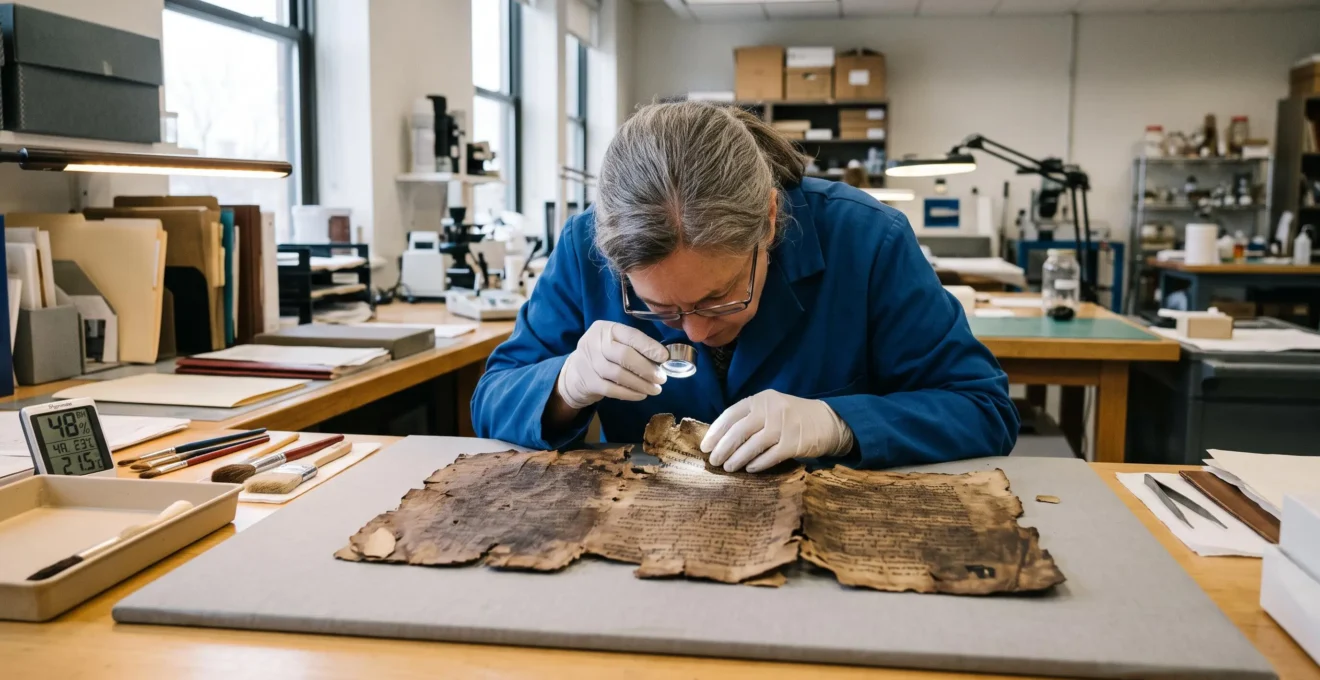
A manuscript that has survived two millennia can begin losing fragments during a single handling session. Its apparent solidity may conceal weakened cellulose, degraded collagen, fractured ink layers or damage accumulated through centuries of environmental change. Preventing further loss requires understanding which deterioration processes remain active and which interventions would introduce additional risk.
Conservators begin with material identification, condition assessment and environmental investigation. They then select measures ranging from protective supports and controlled storage to local consolidation, moisture management and non-invasive documentation. The objective is rarely to restore an object to its original appearance. It is to preserve surviving material and the historical information that material contains.
The same scientific principles apply beyond manuscripts. Ancient textiles respond to humidity, archaeological metals corrode after excavation, ceramic repairs can obscure evidence, and paintings retain mechanical damage from environments they experienced centuries earlier. Effective conservation therefore combines chemistry, materials science, documentation and carefully justified decisions about when not to intervene.
How conservators prevent irreversible material loss
- Control the deterioration mechanism: identify moisture sensitivity, corrosion, mechanical fatigue or chemical instability before choosing environmental targets.
- Minimise intervention: stabilise vulnerable material, document its condition and avoid treatments that compromise original evidence.
- Plan beyond treatment: safe handling, monitoring, storage resources and future retreatability determine whether conservation remains effective.
- Why Do Ancient Textiles Disintegrate When Museum Humidity Fluctuates by Just a Few Percent?
- How Do Conservation Labs Create Oxygen-Free Environments for Corroding Metal Artefacts?
- 3D Scanning vs Physical Repair: Which Preserves More Information From Broken Pottery?
- The Victorian Glue Now Causing Multi-Million-Pound Re-Conservation Costs Across UK Museums
- When to Stop Digging: The Critical Point Where Unearthed Objects Need Immediate Treatment
- Why Do Even Climate-Controlled Museums Still Lose Paintings to Cracking Over Decades?
- How Do Infrared and UV Scans Uncover Hidden Sketches Beneath Finished Paintings?
- Why Do Certain Renaissance Paintings Look Pristine While Others From the Same Era Have Crumbled?
Why Do Ancient Textiles Disintegrate When Museum Humidity Fluctuates by Just a Few Percent?
Ancient textiles can deteriorate during humidity fluctuations because their fibres repeatedly absorb and release water, producing dimensional changes and mechanical stress. Severely weakened fibres may fracture where movement is restrained. However, fluctuations of a few percentage points do not automatically destroy textiles: the risk depends on fibre chemistry, existing damage, previous environmental exposure and the magnitude and frequency of change.
Wool and silk are protein-based fibres, whereas linen consists predominantly of cellulose. Their moisture sorption behaviour differs, but all can respond dimensionally to changing relative humidity (RH). In a damaged textile, these movements may concentrate stress around broken yarns, embroidery, previous repairs or areas constrained by mounting systems.
Repeated deformation can contribute to mechanical fatigue. This must be distinguished from chemical deterioration: hydrolysis and oxidation weaken polymers through chemical reactions, while mechanical fatigue concerns damage associated with repeated stress. Both processes can coexist, but humidity cycling does not necessarily cause direct molecular chain scission.
The Canadian Conservation Institute‘s analysis of incorrect relative humidity distinguishes excessively damp conditions, material-specific critical humidity thresholds and fluctuations. Its environmental-control framework includes a stringent class with short-term RH variations of approximately ±5 percentage points, without establishing that such variations inevitably damage textiles.
±5% RH
Approximate short-term relative-humidity fluctuation specified for Class AA environmental control. This is a control specification, not a universal textile-damage threshold.
Canadian Conservation Institute, Agent of Deterioration: Incorrect Relative Humidity.
Stability matters, but it cannot replace appropriate absolute conditions. A stable atmosphere that encourages mould remains unsuitable, regardless of how small its daily fluctuations are. Conversely, an institution maintaining a slightly different RH setpoint with limited variation may provide acceptable protection for particular textiles. Environmental histories and collection-specific vulnerabilities should guide the decision.
Assessment begins with magnification, mapping of losses, identification of fibre types and examination of existing supports. Tensile or fold-endurance testing may inform research on representative material, but destructive testing of an exceptionally fragile historic textile can be unjustifiable. Non-contact observation is often the appropriate alternative.
Some textiles cannot safely tolerate even small movements. When detached fibres, powdering or unstable embroidery are present, a fully supported mounting arrangement and restricted handling may be more important than further tightening the gallery’s climate-control specification.
Conservation decisions also reflect practical constraints. Lighting for exhibitions, visitor access, building performance and energy budgets must be evaluated alongside environmental risk. The scientifically defensible objective is an appropriate and maintainable preservation environment, not an isolated numerical target.
This material-specific approach becomes even more important for archaeological metals, where changing moisture and oxygen availability can reactivate deterioration through entirely different chemical mechanisms.
How Do Conservation Labs Create Oxygen-Free Environments for Corroding Metal Artefacts?
Conservation laboratories establish low-oxygen environments by sealing artefacts inside oxygen-barrier enclosures and removing or displacing the enclosed air using inert gases or oxygen scavengers. These systems can markedly reduce oxygen-dependent corrosion, provided humidity, pollutants and enclosure integrity are also controlled. Anoxia slows deterioration; it does not reconstruct metal already destroyed or eliminate every corrosion pathway.
Three practical approaches are available. A controlled chamber can be flushed with nitrogen or argon. A sealed enclosure can contain an oxygen scavenger that chemically consumes residual oxygen. Alternatively, a combination of inert-gas flushing, barrier materials and scavengers can establish and maintain a protective microenvironment.
Selection depends on artefact size, material composition, enclosure volume, treatment objectives and access requirements. An enclosure intended for short-term insect eradication has different operational requirements from one designed for long-term corrosion control.
The Canadian Conservation Institute’s guidance on caring for metal objects describes protective materials including Marvelseal and Escal barrier films, as well as oxygen-scavenging products and indicator systems.
For chloride-contaminated archaeological iron, very dry conditions are particularly important. The Institute identifies approximately 0–10% RH as a preventive-storage range for vulnerable chloride-bearing iron. Such conditions cannot automatically be applied to composite artefacts containing wood, textiles or other moisture-sensitive materials.
Where soluble chloride contamination contributes to corrosion, desalination may form part of a separate conservation strategy. Its suitability depends on the object’s construction, condition and treatment history. Anoxic storage is not a substitute for assessing contamination, nor is prior desalination universally required.
Successful enclosure preparation requires more than achieving a low initial oxygen reading. Seals can leak, oxygen scavengers have finite capacities, and opening a package destroys its controlled internal atmosphere.
Oxygen sensors or suitable indicator systems therefore provide essential verification. Monitoring should establish that the intended conditions have been reached and remain within the limits selected for the object. Indicators require appropriate interpretation, and their service life must be considered.
A poorly designed enclosure can accelerate deterioration if it traps moisture or harmful volatile compounds. Some vulnerable metals react to organic acids released by unsuitable storage materials. An impermeable package containing an unstable internal atmosphere may consequently become more damaging than a properly ventilated alternative.
These principles illustrate a central distinction in conservation science: creating a protective environment preserves existing evidence, whereas recovering lost material is generally impossible. Broken pottery presents a related choice between maintaining evidence and reconstructing appearance.
3D Scanning vs Physical Repair: Which Preserves More Information From Broken Pottery?
Neither 3D scanning nor physical repair preserves every category of information. Scanning records accessible geometry, surface features and spatial relationships without permanently joining fragments. Physical repair can restore structural coherence and improve interpretation, but adhesives and fills may alter original surfaces. The appropriate choice depends on research needs, fragment condition, handling requirements and the information at risk.
A high-resolution digital model can preserve geometric evidence before intervention. Fracture boundaries, manufacturing irregularities, decorative relief and relative sherd positions may be documented in a form that researchers can examine without repeatedly handling the object.
Digital reconstruction also allows alternative arrangements to be tested without committing the ceramic to a particular physical configuration. This is valuable when fragments are missing or joins remain uncertain.
Physical assembly provides different benefits. A securely reconstructed vessel may communicate original form more readily in an exhibition and allow structural relationships to be examined directly. Yet reconstruction can also conceal fracture surfaces, ancient residues or evidence of earlier use and repair.
Modern conservation practice therefore emphasises minimal intervention, detailed documentation and retreatability. An adhesive should be chosen for compatibility and ageing behaviour, with future removal considered where feasible. No treatment material can be assumed perfectly reversible under all conditions.
The decision can be organised around the object’s physical condition and intended use.
| Conservation question | 3D documentation | Physical intervention |
|---|---|---|
| Are fractures recent and clean? | Records edges before intervention. | May permit straightforward, well-aligned joins. |
| Are edges degraded or incomplete? | Preserves accessible geometry without contact between edges. | May require supports or fills that could obscure evidence. |
| Are fragments missing? | Supports virtual reconstruction and comparison of alternatives. | Requires a decision about whether losses should remain visible. |
| Is the priority research? | Enables repeatable geometric examination. | May improve physical access to vessel form while covering some surfaces. |
| Is the priority display? | Supports digital interpretation without joining originals. | Can present the surviving object as a coherent physical form. |
Scanning also has important limitations. Standard geometric capture does not automatically establish pigment composition, absorbed residues, microscopic manufacturing traces or the chemical character of deposits. Material investigation may still require microscopy, spectroscopy or other analytical methods selected for the object.
Digital records themselves demand preservation. File formats, descriptive metadata, calibration information and storage infrastructure require maintenance. A three-dimensional model without reliable scale or provenance may be considerably less useful than the original survey intended.
For many ceramics, the strongest outcome combines careful pre-treatment scanning with limited, justified physical stabilisation.
The lasting consequences of adhesives are particularly clear in historic collections, where repairs once considered successful may create complex conservation problems for later generations.
The Victorian Glue Now Causing Multi-Million-Pound Re-Conservation Costs Across UK Museums
Historic adhesives can create expensive re-conservation problems when ageing changes their colour, flexibility, adhesion or solubility. Animal glues, resinous adhesives and other traditional repair materials may become difficult to remove without disturbing original surfaces. However, no verified evidence in the supplied conservation references establishes a specific multi-million-pound cost attributable to one Victorian glue across UK museums.
Victorian restorers often prioritised visual completeness and structural strength. Repaired ceramics, furniture, manuscripts and decorative objects were expected to appear intact, with fills and joins sometimes concealed beneath retouching or coatings.
Materials were selected according to contemporary knowledge and availability. Animal glues, including collagen-based formulations, were used in many historical contexts, although the specific adhesive present in an individual repair requires identification rather than assumption.
Ageing may produce embrittlement, discoloration, contraction or changes in solubility. A shrinking adhesive can introduce local stress into fragile substrates. A discoloured adhesive can also affect interpretation, particularly where historic additions are difficult to distinguish from the original object.
Removal is not necessarily safer than retention. Mechanical scraping may remove original material; solvents may mobilise stains, coatings or residues; moisture-based treatments can threaten sensitive organic substrates. Testing and examination must precede any intervention.
The ethical question is therefore not simply whether a historic repair looks inappropriate. Conservators must establish whether it is actively damaging the object, whether it provides essential support and whether removal can be accomplished without disproportionate loss.
A visibly altered adhesive may remain in place when it is chemically stable and removal would compromise original surfaces. Conversely, evidence of continuing deformation or harmful interaction may justify carefully controlled intervention.
Today’s conservation adhesives and consolidants create their own long-term uncertainties. Even materials with promising ageing characteristics must be documented, because their behaviour can depend on application methods, environmental exposure and interactions with historic substrates.
Conservation records should identify the material used, its concentration where relevant, the treated locations, application method, testing observations and any known limitations. Such documentation preserves the possibility of informed future retreatment.
Preventing another generation of difficult interventions begins before an artefact reaches the laboratory. Excavation itself can expose previously stable materials to conditions they can no longer withstand.
When to Stop Digging: The Critical Point Where Unearthed Objects Need Immediate Treatment
Excavation should stop or change method when continued exposure, drying, handling or mechanical separation is likely to destroy information that cannot be recovered. Waterlogged wood, severely weakened organic remains and unstable archaeological metals require particular attention. The critical point is determined by observed condition and environmental change, not by a universal number of minutes or hours after discovery.
Buried materials may have remained in relatively stable chemical and physical conditions for extended periods. Excavation changes oxygen availability, temperature, moisture and mechanical support, sometimes simultaneously.
Waterlogged wood is particularly vulnerable because deterioration may have removed structural components while water continues to occupy spaces within the remaining cellular framework. Uncontrolled drying can produce severe dimensional change and collapse of weakened structures.
Archaeological metals present different hazards. Chloride-bearing iron can deteriorate after exposure to oxygen and moisture, while some copper alloys develop active corrosion under unsuitable storage conditions. The correct emergency response depends on composition and contamination; keeping all metal finds wet is not an appropriate general rule.
Historic England‘s Waterlogged Wood conservation guidance, updated in December 2025, addresses excavation, recording, sampling, conservation, storage and long-term management. It explicitly recognises the need for specialist advice when investigating sites containing waterlogged wood.
Field conservation is consequently a triage process. The team must determine whether an object can be recorded and lifted safely, whether temporary environmental protection is needed, and whether its condition demands immediate specialist involvement.
When the object cannot be separated from the soil without risking fragmentation, lifting it together with a supported block of surrounding material may permit more controlled investigation later. The method requires suitable structural support and specialist planning rather than improvisation around a fragile find.
Five documented actions before lifting a fragile archaeological find
- Record the discovery context. Produce an in-situ photographic record with location, orientation and visible condition.
- Identify immediate hazards. Complete a short condition note covering moisture state, cracking, corrosion, fragmentation and exposed surfaces.
- Specify temporary protection. Record the selected support, shielding and moisture-management arrangements, with their material-specific justification.
- Confirm the lifting strategy. Obtain a documented decision on direct lifting, supported block lifting or referral for specialist assessment.
- Secure post-excavation care. Prepare a transfer record identifying packaging conditions, responsible personnel and the destination for assessment or controlled storage.
These actions form a general decision framework, not a universal treatment protocol. Waterlogged organic material may require protection against drying, whereas other finds may demand carefully controlled low-humidity conditions.
The availability of laboratory facilities and conservation funding also affects excavation planning. Recovering an object without arranging suitable storage, examination and treatment can expose it to avoidable risk after removal from the ground.
Even after an artefact enters a professionally managed collection, environmental control cannot erase damage inherited from its earlier history. Paintings provide a clear example of that limitation.
Why Do Even Climate-Controlled Museums Still Lose Paintings to Cracking Over Decades?
Climate-controlled museums cannot eliminate all paint cracking because paintings consist of interacting materials with different mechanical responses and extensive environmental histories. Existing fractures may have developed before acquisition, while internal ageing and occasional environmental disturbances can continue to affect vulnerable works. Stable conditions reduce important risks, but they cannot reverse accumulated damage or guarantee crack-free surfaces.
A traditional painting may contain a wooden panel or textile support, preparatory ground, one or more paint layers and a varnish. These materials vary in stiffness, moisture sensitivity, thermal expansion and ageing behaviour.
Canvas responds to humidity and tension differently from oil paint. Wooden panels can undergo dimensional changes across the grain, while aged paint and ground layers may have become increasingly brittle. Stress develops where incompatible movements are constrained.
Craquelure therefore has multiple possible origins. Some patterns reflect original painting techniques or drying processes. Others result from support movement, previous environmental fluctuations, mechanical handling or historic treatment.
The distinction between existing and newly developing cracks is essential. A painting acquired with established craquelure should not be counted as a new conservation failure simply because those cracks remain visible decades later.
Likewise, the presence of cracking does not prove that a contemporary museum’s climate-control system caused it. Earlier storage conditions may have produced the underlying damage long before environmental monitoring began.
Preventive conservation reduces future exposure to damaging fluctuations through controlled galleries, storage areas and protective frames. Nevertheless, localised conditions can differ from building-wide averages. Lighting, ventilation patterns, exterior walls and short-term equipment failures may create environmental variations.
Transportation and international loans introduce additional considerations. Packing systems, transit temperatures, acclimatisation and handling procedures must be assessed for works known to be mechanically sensitive.
Condition monitoring provides the evidence needed to distinguish stable historic damage from active deterioration. Close visual inspection, consistent photography, environmental records and documented comparison over time can reveal changes requiring further examination.
The practical objective is not the elimination of every visible fracture. It is the prevention of consequential new damage, including lifting paint, worsening cleavage or progressive losses from already fractured areas.
Where surface examination cannot explain a painting’s construction or condition, technical imaging can reveal evidence hidden beneath its visible appearance.
How Do Infrared and UV Scans Uncover Hidden Sketches Beneath Finished Paintings?
Infrared reflectography can reveal certain underdrawings because infrared radiation passes through some paint layers and is absorbed differently by underlying drawing materials, particularly carbon-based marks. Ultraviolet examination usually serves another purpose: identifying surface fluorescence associated with varnishes, retouching and restoration. These techniques provide complementary evidence, but neither can reliably reveal every hidden feature.
Infrared reflectography uses radiation beyond the visible red region of the spectrum. Its effectiveness depends on the optical properties of the intervening paint, the drawing medium, imaging wavelength and detector sensitivity.
When an upper paint layer is sufficiently transparent to the selected infrared wavelengths, an underlying carbon-rich drawing may produce contrast against a lighter preparatory surface. The resulting image can disclose preliminary outlines, adjustments or abandoned compositional elements.
These changes, known as pentimenti, can inform research into artistic working methods. A composition revised during painting may offer evidence about planning, workshop practices or the development of a particular work.
Ultraviolet-induced visible fluorescence operates differently. Excitation by ultraviolet radiation can cause certain materials to emit visible light. Differences in fluorescence may help distinguish varnishes, coatings and areas of later intervention.
Such observations require care. Fluorescence varies with material composition, ageing and examination conditions. A dark or bright area cannot be assigned automatically to a particular restoration campaign without supporting evidence.
The National Gallery of Art describes the use of infrared photography or reflectography, ultraviolet examination, stereomicroscopy and X-radiography within its published technical examination procedures. Its research documentation demonstrates why different methods are combined rather than treated as interchangeable sources of information.
X-radiography can contribute evidence about construction, structural changes and the distribution of X-ray-absorbing materials. Microscopy provides closer examination of surface characteristics, while analytical techniques may help establish the identity of particular pigments or binding materials.
Interpretation requires comparison. An infrared feature resembling a hidden drawing could relate to the original design, an intermediate alteration or another layer of the painting. Likewise, UV fluorescence alone cannot reliably establish an artwork’s date or authorship.
Technical examination also has a conservation function. Before any cleaning, consolidation or removal of old restorations, imaging can document existing conditions and identify areas requiring special protection.
Where examination reveals stable materials and no evidence of active deterioration, the appropriate outcome may be continued monitoring rather than treatment. Diagnosis is valuable precisely because it can prevent unnecessary intervention.
These findings also explain why two paintings created in the same historical period can present radically different conservation conditions today.
Key takeaways before comparing historical survival
- Investigate the full material history: comparable age does not imply comparable supports, pigments, treatments or environmental exposure.
- Separate appearance from authenticity: a visually complete surface may contain substantial restoration, while visible cracking can coexist with stable original material.
- Base intervention on evidence: technical examination and condition history provide a stronger foundation than aesthetic appearance alone.
Why Do Certain Renaissance Paintings Look Pristine While Others From the Same Era Have Crumbled?
Renaissance paintings survive in different conditions because their materials, environmental histories and previous restorations interact over centuries. Two works of similar age can experience very different moisture exposure, mechanical stress, pollution and treatment. Apparent perfection may also result from later cleaning, retouching or structural repairs rather than exceptional preservation of an untouched original surface.
Material construction is the first major variable. A painting executed on a well-prepared wooden panel may respond differently to its environment from one painted on textile. The species and preparation of wood, canvas construction, ground composition and properties of the paint layers all influence mechanical behaviour.
Pigments also vary in chemical stability. Some undergo alterations associated with light, moisture, pollutants or reactions with neighbouring materials. Binding media and protective coatings introduce additional variables, particularly as their mechanical and optical properties change with age.
Environmental history creates another substantial difference. A painting remaining in relatively consistent conditions may undergo less severe moisture-related deformation than a similar work subjected to repeated relocation, damp storage or abrupt temperature changes.
Exposure to soot, atmospheric pollutants, accidental wetting and inappropriate cleaning can affect condition independently of a work’s original craftsmanship.
Historical restoration adds a third layer of complexity. Previous consolidation, lining, overpainting, varnishing and cleaning may have stabilised vulnerable areas or introduced new problems. A treatment intended to improve appearance may obscure surviving evidence or create later conservation difficulties.
The difference between two works can be illustrated through a hypothetical comparison.
Hypothetical comparison: two Renaissance panel paintings
Painting A remains for centuries in a comparatively stable interior, receives limited intervention and retains a mechanically sound support. Painting B experiences intermittent damp conditions, relocation, structural repair and repeated surface treatment.
Even if both paintings were produced in the same decade with broadly similar materials, their present conditions could differ significantly. The example illustrates interacting conservation risks; it does not represent a documented historical comparison or establish the relative importance of each factor.
Visual impressions must therefore be treated cautiously. A smooth, evenly coloured surface may reflect later retouching or varnish application. Conversely, visible craquelure and colour changes may be historically significant features rather than evidence of continuing deterioration.
Conservation scientists investigate this distinction through technical imaging, material analysis, documentation of previous treatments and comparison with dated condition records. The purpose is to establish which changes are historic, which remain active and which threaten further loss.
The same reasoning applies to a two-thousand-year-old manuscript. Its current vulnerability reflects the composition of its writing support, deterioration of fibres or collagen, interaction with inks and coatings, previous handling and every storage environment it has experienced.
Stabilisation may involve reducing unnecessary movement, providing tailored supports, controlling harmful environmental conditions and recording material changes. Local consolidation or another direct treatment is justified only when expected benefits outweigh risks to the surviving original.
A practical next step is to establish a baseline condition record for each vulnerable object, identify its most consequential deterioration mechanisms and assign appropriate storage, handling and monitoring measures. That documented assessment gives future conservators the evidence needed to preserve both the material and the historical information it carries.
Can an ancient manuscript be preserved without applying a consolidant?
Yes. An ancient manuscript may be preserved through stable and appropriate storage, physical support, limited handling, protective enclosures and regular condition assessment. Consolidants are not automatically necessary. Their use requires evidence that active material loss justifies adding a treatment substance, together with an assessment of compatibility and future retreatability.
Is 50% relative humidity suitable for every museum artefact?
No. Relative humidity requirements depend on material composition, contamination, deterioration mechanisms and previous exposure. While 50% RH appears as a reference setpoint in established environmental-control frameworks, vulnerable chloride-contaminated metals may require much drier conditions. Stable conditions are valuable only when the chosen humidity range is itself appropriate.
What is the difference between preventive conservation and restoration?
Preventive conservation focuses on reducing external risks through measures such as environmental management, protective storage, safe handling and monitoring. Restoration involves direct intervention intended to improve the interpretation or appearance of an object, usually within a broader conservation treatment. The two approaches have different aims and may be combined when justified by a documented condition assessment.
How can conservators tell whether deterioration is still active?
Conservators compare current condition observations with earlier photographic records, damage maps, environmental measurements and technical examinations. Changes such as expanding cracks, new losses, evolving corrosion products or increasing deformation may indicate ongoing deterioration. The evidence must be interpreted in relation to the object’s materials and examination conditions.
Does digital documentation eliminate the need to preserve the original object?
No. Digital images and three-dimensional records preserve selected visual and geometric information, but they cannot reproduce every physical, chemical or microscopic characteristic of an artefact. Original materials may retain evidence that current technologies cannot detect. Digital documentation is therefore a complementary preservation resource, not a complete substitute for conserving the physical object.