
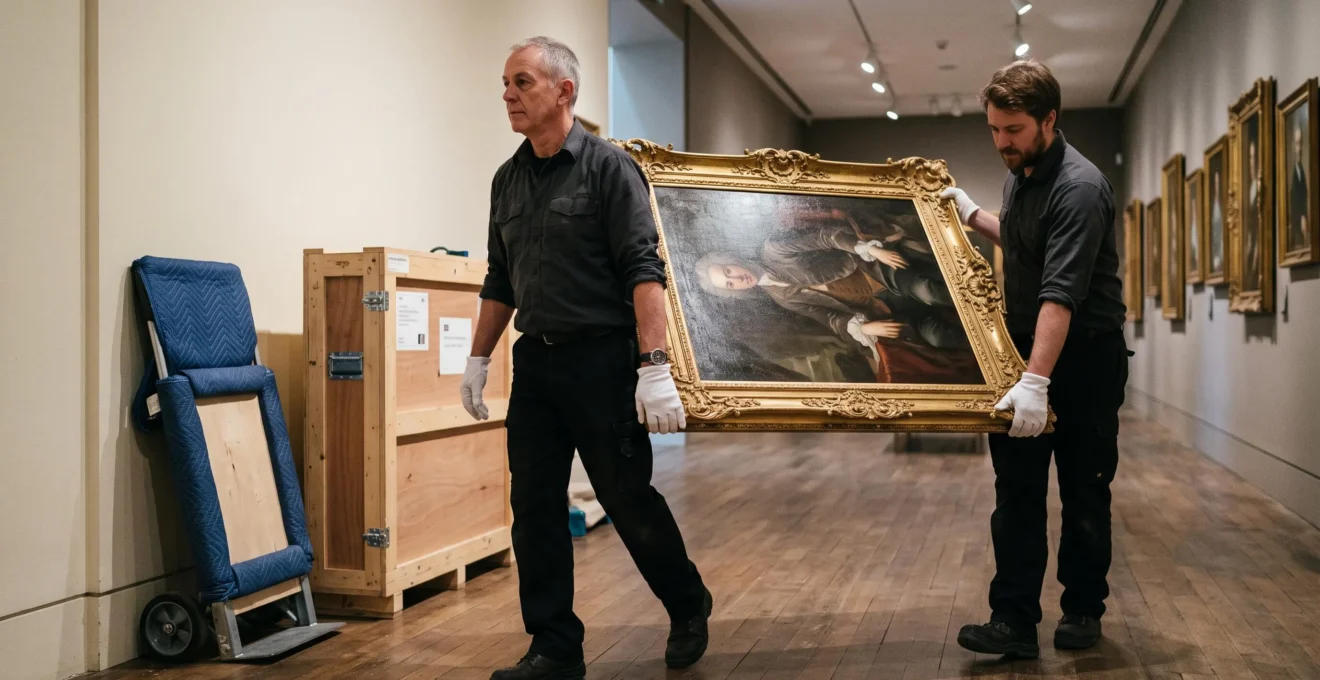
A painting does not have to fall to suffer serious damage. A hand placed on unstable gilding, a frame twisted during a doorway turn, or repeated vibration inside an inadequately cushioned crate can compromise an object without producing an obvious incident.
For museum art handlers, registrars and installation teams, preventing a potentially £200,000 loss begins before anyone touches the artwork. The essential controls are a documented condition assessment, approved support points, an appropriate number of handlers, a cleared route, suitable handling equipment and an explicit authority to stop unsafe work.
These precautions protect different parts of an object. Gloves help prevent contamination of vulnerable surfaces; structural support limits bending and torsion; protective transport systems reduce shock and environmental exposure. Condition reports establish a record against which subsequent changes can be examined.
The £200,000 figure describes the scale of a possible high-value loss, not a verified average museum accident or a standard conservation bill. The procedures below address the physical mechanisms that make such losses possible, including damage that may only become apparent after an artwork has reached its destination.
Essential museum artwork handling precautions
- Inspect before lifting: establish the object’s condition, vulnerable areas and authorised support points before movement.
- Match handling methods to the object: dimensions, visibility, structural stability, route complexity and equipment determine whether a solo move is acceptable.
- Document and stop when necessary: record the condition and movement, investigate unexpected changes, and postpone operations without adequate controls.
- Why Does Touching a Gilded Frame’s Edge Cause £40,000-Style Conservation Damage?
- How Do You Determine Where to Grip a Painting Without Causing Hidden Structural Stress?
- Solo Carry vs Team Lift: At What Size Does One-Person Handling Become Dangerous?
- The Invisible Harm: When Rough Handling Creates Cracks That Appear Months Later
- The Refusal Threshold: When to Tell Curators an Installation Is Too Risky to Attempt
- Why Do Museums Spend £30,000 to Ship a Painting That Weighs 15kg?
- The Handling Error That Destroyed Millions Worth of Renaissance Panels in Transit
- How Do Museums Ship £100 Million Paintings Across Continents Without Damage?
Why Does Touching a Gilded Frame’s Edge Cause £40,000-Style Conservation Damage?
Touching a vulnerable gilded frame can transfer moisture and contaminants, abrade delicate finishes or dislodge poorly attached decoration. The gold itself is relatively chemically inert, so fingerprints should not automatically be described as corrosion of gold leaf. The greater danger often lies in fragile gilding, underlying preparation layers, previous repairs and unstable ornamental surfaces.
A gilded frame is not a uniformly strong wooden structure. Traditional water gilding may involve thin gold leaf applied over carefully prepared gesso and bole layers. Even where the wooden substrate is sound, the decorative finish may have weak adhesion, existing losses or sensitivity to moisture and mechanical pressure.
Three areas deserve particular attention:
- Projecting edges: exposed corners and raised profiles are vulnerable to abrasion and concentrated pressure.
- Moulded ornaments: delicate leaves, scrolls and separately attached decorative elements may break or detach when used as lifting points.
- Previous conservation repairs: retouched or reattached areas may have different mechanical properties from surrounding original material.
The Canadian Conservation Institute’s basic painting-handling instructions recommend clean, well-fitting gloves when handling gilded frames and examination of frame components before movement. Gloves do not make an otherwise unstable surface safe to grasp.
Conservation bills can be substantial because treatment may involve stabilising fragile preparation layers, consolidating original decoration, matching historic finishes and carrying out specialist gilding work. However, £40,000 is not an established typical cost for damage caused by touching a frame. Actual treatment costs depend on extent, significance, materials and required intervention. Nor should frame treatment automatically be assumed more expensive than treatment of the painting.
Before the lift, photograph projecting details, mark existing losses in the condition record and agree which structurally sound areas may receive support. If no suitable contact area exists, a conservator should determine whether protective handling equipment or temporary stabilisation is required.
Protecting the surface is only the first control. The lifting method must also prevent forces from travelling through weak joints or into the painting itself.
How Do You Determine Where to Grip a Painting Without Causing Hidden Structural Stress?
Safe grip points are determined by the painting’s construction, framing and condition, not by a single rule requiring every painting to be held by its stretcher. Support must carry the object’s weight through sound structural components without compressing the canvas, twisting the frame or loading fragile decorative surfaces. Any doubtful support point requires assessment before lifting.
A stretched canvas behaves differently from its surrounding wooden structure. Pressure applied directly to the front or reverse can deform the textile and transmit localised stress into brittle paint and ground layers. Similarly, a frame corner with loose joints may fail when subjected to twisting, even if it appears stable while hanging.
For a structurally sound, framed easel painting, the established approach uses coordinated support around appropriate lower and side areas. The lower support carries weight while the side contact stabilises the object. Handlers should follow the approved object-specific method rather than assume that exposed stretcher bars are always accessible or suitable.
Three checks determine the final grip arrangement:
- Identify the load-bearing structure. Examine the frame, stretcher or strainer, attachments and any separate handling-travel frame.
- Identify prohibited contact zones. Exclude stretched canvas, loose ornament, weak joints, flaking surfaces and unprotected glazing where applicable.
- Test the movement plan without the object. Confirm that handlers can maintain stable support throughout lifting, turning and lowering.
A painting with raised cracking, weakened fabric, compromised frame joints or a recent structural intervention may need a specialist handling arrangement. The condition report and treatment history must inform the decision; a visually attractive surface is not evidence of mechanical stability.
During a two-person move, appoint one person to call commands. Agree on “ready”, “lift”, “stop”, “turn” and “lower” before beginning. A second handler or spotter monitors clearances and unexpected movement. If a grip needs changing, stop and place the object securely before repositioning.
Even well-chosen support points are insufficient when an artwork is too wide, awkward or visually obstructive for the available handling team.
Solo Carry vs Team Lift: At What Size Does One-Person Handling Become Dangerous?
One-person handling becomes dangerous when the artwork prevents the handler from maintaining clear visibility, stable two-handed support and reliable control over the entire route. Weight alone is insufficient. The Canadian Conservation Institute describes solo handling for small framed paintings of approximately 40 cm by 40 cm under suitable conditions, not as a universal maximum-size regulation.
A comparatively light painting may present considerable risk if its width conceals a doorway or forces a handler to rotate the body while supporting the load. A heavier but compact object may be easier to control with appropriate mechanical assistance.
Assess the entire movement, not just the initial lift. Important variables include sightlines, carrying distance, corners, door clearances, floor conditions, stairs, lift dimensions, available turning space and whether the work can be set down safely if movement is interrupted.
The practical distinction is between unaided solo carrying, assisted solo movement and a coordinated team lift.
| Assessment factor | Solo handling | Team or equipment-assisted handling |
|---|---|---|
| Object dimensions | Small enough to support without obscuring the route | Broad, tall or difficult to balance |
| Structural condition | Stable with approved contact points | Fragile or requiring controlled support |
| Route complexity | Clear, predictable and unobstructed | Doors, tight corners, stairs or restricted access |
| Equipment | Safe manual support is possible | Padded trolley, handling frame or suitable lifting equipment needed |
| Staff capacity | Handler can retain control throughout | Additional support, monitoring or rotation required |
A padded panel trolley can reduce carrying demands, but it does not automatically make a one-person operation acceptable. Stability, restraint, tipping risk, floor transitions and doorway clearance still require assessment. A second person may be necessary to guide the load through restricted spaces.
Fatigue also matters. Repeated lifting and manoeuvring can reduce grip reliability and movement control. The team should account for accumulated physical demands, schedule suitable breaks and reassess staffing if handling precision deteriorates.
Once movement is authorised, attention must shift from visible collisions to the smaller stresses that can remain undetected immediately after handling.
The Invisible Harm: When Rough Handling Creates Cracks That Appear Months Later
Rough handling may create or worsen structural weaknesses that become visible only after subsequent environmental changes or further movement. Shock, vibration and bending forces can affect paint, ground layers, canvas supports and wooden panels. However, a crack discovered months later cannot automatically be attributed to one earlier handling event without supporting condition evidence.
Paintings are composite structures. Their materials respond differently to mechanical force, temperature and relative humidity. Where paint or preparation layers have become brittle or poorly attached, vibration and repeated loading may increase the risk of cracking, lifting or separation.
The Canadian Conservation Institute’s recommendations for paintings before travel recognise that transport-related deterioration may develop gradually rather than appearing immediately. They also distinguish a painting’s suitability for display from its suitability for travel.
This has a direct consequence for responsibility. A clean-looking inspection immediately after delivery does not necessarily prove that the movement caused no deterioration. Equally, finding a defect later does not establish that the carrier or installation team caused it.
Condition evidence should be collected before departure, after arrival and at relevant intermediate handovers. Compare the same areas under repeatable lighting and photographic conditions, noting both newly observed features and uncertainty about their origin.
Raking light is especially useful for identifying surface deformations, raised paint and changes in texture. Normal illumination and, where appropriate, transmitted light reveal different features. No single lighting technique establishes when or why a crack formed.
The Canadian Conservation Institute’s condition-examination guidance distinguishes these techniques and recommends assessing paint layers, supports, frames and previous repairs. Examinations should be undertaken without introducing new handling risks.
For road transport, protective cushioning and suitable vehicle suspension address cumulative vibration as well as isolated shocks. The appropriate solution depends on the artwork’s characteristics and the journey, rather than distance alone.
When the likely mechanical or environmental exposure cannot be controlled adequately, the next professional decision is whether the movement should proceed at all.
The Refusal Threshold: When to Tell Curators an Installation Is Too Risky to Attempt
An installation should be postponed when a material risk of irreversible damage cannot be reduced to an acceptable level with the available access, equipment, staffing and preparation. A handler does not need to wait for an actual accident. The correct response is to identify the unresolved hazard, explain its consequences and specify what must change before work resumes.
A curator may have an agreed exhibition opening, lender commitments and a completed gallery programme. None of these removes the physical limitations of a fragile frame, unsuitable lift or structurally weak wall.
Refusal decisions should distinguish a fundamental incompatibility from a problem that can be resolved by further preparation.
| Hazard | Conditional postponement | Do not proceed under the proposed method |
|---|---|---|
| Restricted access | Replan the route or modify removable obstructions | Artwork cannot pass without unsafe contact or deformation |
| Unverified floor capacity | Obtain an appropriate structural assessment | Proposed load cannot be safely supported |
| Insufficient lifting equipment | Obtain rated equipment and qualified operators | Object cannot be controlled during lifting or positioning |
| Unstable artwork | Seek conservation assessment and stabilisation | Movement would place vulnerable material at unacceptable risk |
| Insufficient preparation time | Reschedule and rehearse the operation | Safe controls cannot be established before the proposed lift |
The Collections Trust’s location and movement control procedure calls for checking fitness to move, reviewing handling requirements, identifying access restrictions and recording movement risks. It supports a documented planning approach, although it does not prescribe a universal legal threshold for refusing a lift.
Communicate refusal as an actionable decision. For example: “The current access route does not provide sufficient clearance to maintain safe support of the frame. Installation should remain on hold until the route is modified or an alternative handling arrangement has been approved.”
Such wording identifies the obstacle, required control and decision point without implying that the artwork can never be exhibited.
Record the warning in the relevant risk assessment or movement documentation. Include the object reference, hazard, proposed control, responsible decision-maker and authorisation status. This record supports accountability but does not independently determine legal liability.
Where movement remains justified, the same risk assessment should inform the resources and expenditure needed for safe transport.
Why Do Museums Spend £30,000 to Ship a Painting That Weighs 15kg?
A 30,000 £ shipping quote for a 15 kg painting can reflect specialist protection, logistics, security and contractual requirements rather than the object’s weight. Bespoke packing, controlled transport, condition documentation, insurance arrangements and international procedures may contribute to the price. The example is illustrative: neither amount represents a verified standard rate for moving paintings of that weight.
Ordinary freight pricing primarily considers transportable mass, volume, destination and service requirements. Fine-art logistics must additionally account for an object’s vulnerability, value, conservation condition, required handling and consequences of an incident.
A shipment may involve:
- Custom protective packing: a fitted crate, appropriate cushioning, handling supports and protective materials.
- Specialist labour: trained packers and handlers, installation assistance and equipment at both destinations.
- Transport management: appropriate vehicles, route planning, security arrangements and handover procedures.
- Insurance and administration: agreed coverage, documentation, permits where applicable and coordination between parties.
- Courier arrangements: a lender-appointed representative or another agreed method of supervising critical stages where required.
A well-designed crate protects against predictable mechanical hazards and can help moderate environmental fluctuations. Its cushioning must suit the object and expected handling conditions. A crate should not be assumed to maintain stable relative humidity for weeks unless that performance has been appropriately designed and verified.
International shipping adds requirements that do not apply to a straightforward internal museum move. These may include export permissions, temporary admission arrangements, customs declarations and, where eligible and accepted, an ATA carnet. Applicability depends on the countries, artwork and movement involved.
There is no defensible universal monetary threshold at which professional art shipping suddenly becomes mandatory. For a stable, modestly valued painting, suitable packing and controlled transport may be proportionate. For a fragile historic work, specialist assessment may be justified even when its declared financial value is relatively low.
A useful purchasing decision compares the exposure created by each proposed transport method, not merely the difference between freight quotations. Ask providers to identify which protective measures are included, which are optional and what risks remain.
Cost controls must remain material-specific: what adequately protects a modern canvas may be entirely unsuitable for an early wooden panel.
The Handling Error That Destroyed Millions Worth of Renaissance Panels in Transit
Historic Renaissance panel paintings are especially vulnerable to unsafe edge loading, twisting, shock and changes in relative humidity. Their wooden supports can deform or split, potentially disturbing the paint and preparation layers. However, the available conservation sources do not verify a particular transport accident in which millions of pounds’ worth of Renaissance panels were destroyed, so no specific incident can responsibly be presented as established fact.
Many Italian Renaissance paintings were executed on prepared wooden panels, including poplar supports. Wood changes dimensions in response to moisture, and those changes can interact with grain direction, joins, earlier repairs and rigid structural components.
A painting that remains stable in a controlled gallery can become vulnerable when subjected to abrupt environmental fluctuations or mechanical loading during transportation.
Consider the following explicitly hypothetical handling scenario.
Hypothetical case: an early Italian wooden panel
A fifteenth-century panel painting has an old join, local paint lifting and evidence of previous structural treatment. During preparation for movement, a handler proposes grasping the panel directly along two exposed edges and lifting it into an ordinary transport crate.
The conservation assessment identifies unacceptable loading near the weakened join. The operation is postponed until the artwork can be supported using an approved protective handling arrangement, with appropriate packaging and environmental precautions. This scenario illustrates a preventable risk; it does not describe a documented historical accident.
Wooden-panel fractures can be difficult to stabilise and may leave permanent physical or visual evidence. Canvas damage can also be irreversible, so the distinction should not be simplified into an assumption that canvas is easily repaired while wood is not.
Before authorising transport, the conservator should assess panel movement, joins, surface stability, previous treatment and anticipated environmental exposure. Protective travel frames, suitable cushioning and controlled handling may be appropriate depending on the individual work.
Crate orientation cannot be determined from wood grain direction alone. The correct arrangement depends on the panel’s construction, support system, environmental needs and engineered packing design.
The central lesson applies equally to works on canvas, copper, paper and other supports: understand the material system before prescribing a lifting method. A visually similar pair of paintings may require very different treatment because of their structural histories.
The same principle becomes more consequential when the artwork must cross countries, airports and multiple organisational handover points.
Key decisions before high-value artwork transport
- Approve the movement based on conservation condition and transport suitability, not market value or exhibition readiness alone.
- Assign responsibility for handling, packing, environmental protection and handovers before the object leaves its starting location.
- Require a documented alternative whenever the planned movement cannot maintain safe structural support or acceptable environmental conditions.
How Do Museums Ship £100 Million Paintings Across Continents Without Damage?
Museums reduce the risks of intercontinental artwork shipping by combining conservation assessment, specialist packing, controlled handling, coordinated logistics and documented transfers of responsibility. No protocol can guarantee a damage-free journey. The objective is to identify foreseeable hazards, apply proportionate controls and retain reliable evidence of an artwork’s condition throughout the movement.
A major international loan commonly involves multiple parties whose responsibilities must be agreed before dispatch. The lender or originating museum establishes loan and conservation requirements. A specialist shipper coordinates packing and transport. Carriers manage relevant journey stages, while insurers and receiving institutions operate under the applicable agreements.
A courier may accompany or supervise certain stages where required by the lender and the agreed arrangements. Attendance, condition examinations, reporting and authority to intervene should be defined rather than assumed.
The shipment begins with a travel-suitability assessment. Conservators examine structural stability, identify vulnerable areas, review existing condition documentation and decide whether preventive treatment or additional support is necessary. Imaging or other specialist examination may be warranted for particular objects, but radiography is not a routine requirement for every valuable painting.
Once travel is approved, a suitable packaging system is designed around the object and journey. Shock protection, environmental buffering, lifting arrangements and safe access for inspection must work together. A sophisticated crate cannot compensate for a poor handling plan at departure or arrival.
Documented chain of custody connects these protections. Each transfer should establish which party received the object, when responsibility changed, what documentation accompanied it and whether any new condition concern was identified. Seals, photographs and shipment records may provide additional evidence where the agreed procedures require them.
Traceability improves incident investigation; it does not replace damage prevention. Likewise, a GPS location record alone does not establish whether a work experienced damaging vibration or environmental fluctuations.
The following checklist translates these principles into a practical movement authorisation process.
Five checks before authorising an artwork move
- Confirm fitness to move. Review the current condition report and conservation history; produce a dated movement approval or documented conservation hold.
- Approve structural support. Identify safe grip points, prohibited contact areas and required protective supports; produce an object-specific handling instruction.
- Validate the route and resources. Check clearances, access, equipment and team responsibilities; produce an approved movement plan with named personnel.
- Establish condition evidence. Record relevant existing defects using appropriate photographs and examination notes; produce an identifiable pre-movement condition record.
- Authorise or postpone. Confirm that unresolved hazards have appropriate controls and decision-maker approval; produce a signed or otherwise traceable go/no-go decision.
After arrival, the receiving team should reconcile the movement record, inspect the object’s condition under the agreed procedures and escalate unexpected findings for conservation assessment. Any subsequent storage or installation must follow the same object-specific restrictions.
For the next artwork movement, begin with the condition record, inspect the route with the actual handling team and secure agreement on the support method before lifting. If a critical control remains unresolved, document the reason and postpone the move rather than improvising around a valuable object.
Should museum handlers always wear white cotton gloves?
No. Glove selection depends on the material, surface condition and handling task. Clean, well-fitting gloves are recommended for vulnerable gilded frames, but other materials and tasks may require different gloves or carefully controlled clean-hand handling. The primary requirements are preventing contamination while retaining secure, appropriate control of the object.
Can a painting be moved immediately after a previous conservation treatment?
Not automatically. The conservator responsible for the treatment should confirm whether the support, paint layers and treated areas are sufficiently stable. Restrictions may depend on the treatment performed, the materials used and the anticipated handling or transport conditions.
What should handlers do if an object makes an unexpected cracking sound during lifting?
Stop the movement without abrupt repositioning, maintain safe support and lower the object onto a suitable prepared surface if this can be done safely. Notify the responsible registrar or conservator and document the occurrence. Do not continue handling until the source of the sound and the object’s condition have been assessed.
Does a clean delivery condition report prove that transport caused no damage?
No. Some structural deterioration may not be immediately apparent. A delivery condition report documents observations at a particular time under particular examination conditions. Subsequent findings should be compared with earlier records and interpreted by an appropriate conservation specialist rather than automatically attributed to the transport.
Who should approve a change to the handling method during installation?
Changes should be authorised by the responsible personnel under the institution’s agreed procedures, with conservation input when object safety may be affected. The handling team should not substitute an improvised support point, lifting arrangement or installation route simply because the original plan has become inconvenient. Significant changes should be recorded before work resumes.