
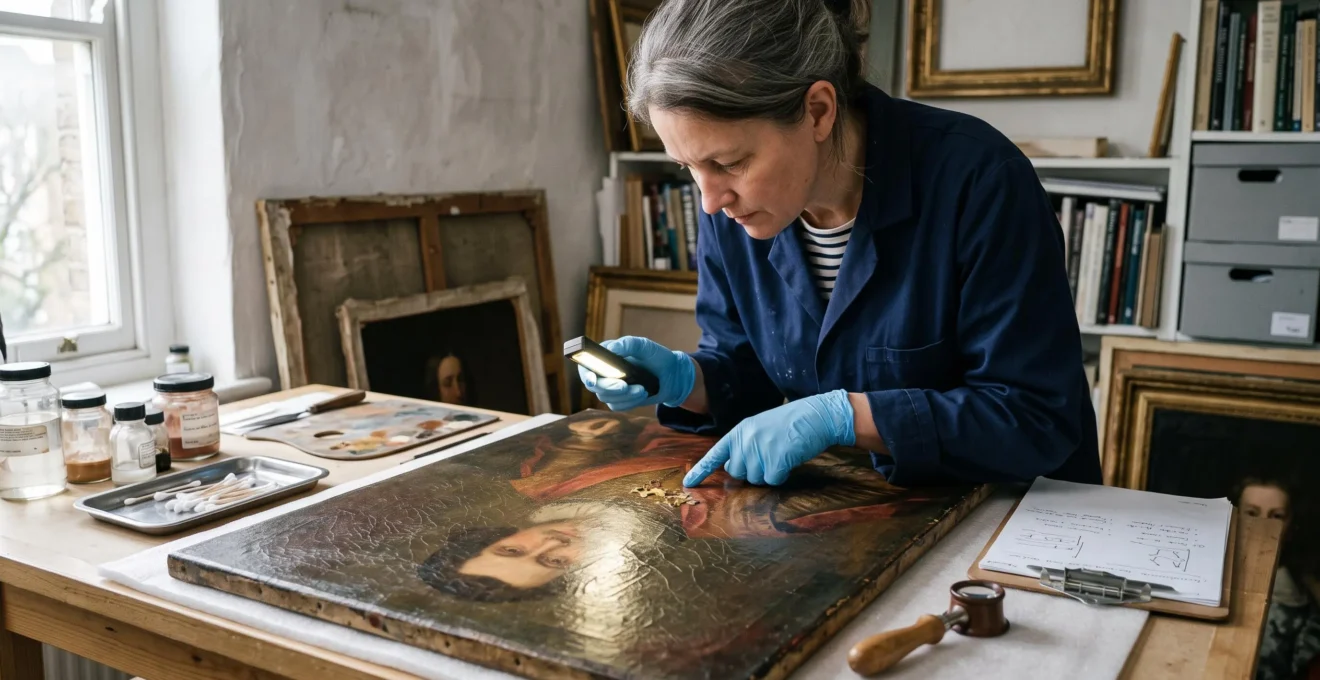
Some Renaissance paintings retain remarkably coherent surfaces after five centuries, while others have developed extensive cracking, discoloured passages, detached paint and missing areas. Their contrasting conditions are not simply consequences of age. They reflect differences in pigment chemistry, binding media, preparation layers, support movement, environmental exposure and subsequent conservation.
A painting is a mechanically connected structure. Its pigment particles are held in a binder, attached to a ground, and carried by wood, fabric or another support. Each component responds differently to moisture, temperature and ageing. A highly lightfast pigment cannot protect an unstable ground from separating beneath it.
For painters and conservation researchers, the practical question is therefore not which historical recipe lasted longest, but which combinations of materials minimise chemical deterioration and mechanical stress over time.
The most reliable approach is to select well-characterised pigments, match the ground to the support, establish compatible painting layers and control the conditions in which the finished work will live. None guarantees centuries of survival, but each addresses a documented mechanism of deterioration.
What determines a painting’s long-term durability?
- Material compatibility matters more than historical period. Pigment, binder, ground and support must function together rather than merely exhibit individual stability.
- Structural movement is a major threat. Humidity fluctuations, incompatible grounds and poorly sequenced paint layers can initiate cracking and detachment.
- Long-term preservation requires both construction and environmental control. Appropriate layering, support selection and preventive conservation reduce avoidable risks without providing fixed lifespan guarantees.
- Why Do Paintings From 1950 Show More Colour Loss Than Works From 1550?
- How Do You Verify That Your Gesso and Canvas Will Not Separate After 50 Years?
- Linen vs Cotton Canvas: Which Surface Remains Stable for 200 Years Under Oil Paint?
- The Oil-and-Acrylic Layering Mistake That Destroyed £80,000 of Contemporary Artworks
- When Do High-Humidity Climates Require Synthetic Grounds Instead of Traditional Rabbit-Skin Glue?
- Why Do Paintings That Violate Fat-Over-Lean Crack Within 5 Years?
- How Do You Create Glaze Medium That Remains Crystal-Clear After 50 Years?
- Which Oil Painting Layering Sequences Prevent the Cracking That Ruins 60% of Amateur Works?
Why Do Paintings From 1950 Show More Colour Loss Than Works From 1550?
Some paintings made around 1950 exhibit more visible colour change or structural deterioration than much older Renaissance works because their pigments, binders, grounds and supports sometimes behaved unpredictably together. However, this is not a universal historical pattern. Modern synthetic pigments are not inherently less stable than traditional mineral pigments, and surviving Renaissance paintings represent a selectively preserved population.
Renaissance workshops developed material knowledge through repeated use, observation and transmission between practitioners. Painters could draw upon established experience with mineral pigments such as natural ultramarine, derived from lapis lazuli, and vermilion.
These traditional colourants had identifiable characteristics, but they were not immune to deterioration. Vermilion can darken under certain conditions, while other historical pigments undergo chemical reactions or changes associated with their binding media.
Consequently, historical use is evidence of experience, not proof of permanence.
Industrial paint technology introduced an increasingly diverse range of pigments, resins, drying systems and prepared surfaces. These innovations greatly expanded artistic possibilities, but some entered studios before their long-term behaviour had been extensively documented.
The Getty Conservation Institute‘s Modern Paints research project investigates the chemical and physical characteristics of synthetic painting materials and the challenges their diversity creates for conservation.
Importantly, new does not necessarily mean unstable. Individual formulations must be assessed on their own properties.
The mid-twentieth century also produced changes in how artists prepared their supports. Some colour-field paintings from the 1950s and 1960s were executed directly on canvas without conventional sizing or ground layers.
The Canadian Conservation Institute documents cases in which oil migrated into exposed fabric, creating discoloured halos. It also identifies darkening, cracking and incompatibility problems involving certain industrial paints.
These mechanisms differ significantly from pigment fading.
A visibly altered colour may result from several processes:
- Pigment alteration: chemical transformation or light-induced change in the colourant.
- Binder deterioration: yellowing, darkening or other alteration of the medium surrounding pigment particles.
- Support interaction: migration of oil or other components into inadequately isolated fabric.
- Layer failure: cracking, separation or material loss exposing differently coloured underlying passages.
Diagnosing the cause matters because selecting a lightfast replacement pigment will not correct an unstable preparation system.
Conservators evaluating a painting’s future stability should therefore document the support, preparation, pigment composition, binding medium and layer interfaces before making conclusions from appearance alone.
A painting created in 1550 has no inherent chemical advantage over one created in 1950. What matters is whether its materials remained compatible under the environmental and conservation conditions it encountered. That principle makes the preparation beneath the paint an essential next consideration.
How Do You Verify That Your Gesso and Canvas Will Not Separate After 50 Years?
No practical studio test can certify that gesso and canvas will remain bonded for 50 years. However, adhesion observations, controlled flexibility comparisons and examination of prepared sample edges can identify potentially incompatible combinations before a major painting is begun. The objective is to detect weakness early, not to translate a short-term test into a guaranteed lifespan.
The ground establishes an interface between the support and the paint layers. A poor bond at that interface can compromise everything applied above it.
As explained in the Canadian Conservation Institute‘s guidance on painting structure and deterioration, the stability and attachment of the ground are critical to the coherence of the painting as a whole.
Ground-support separation may develop when their mechanical properties differ substantially.
Traditional glue-bound gesso can be relatively rigid and is generally better suited to appropriately prepared rigid supports than to freely flexing stretched canvas. Commercial acrylic dispersion grounds are formulated differently and may accommodate canvas movement more effectively, although their performance depends on the specific product and preparation.
The problem becomes particularly serious when humidity changes cause fabric movement while the ground resists deformation.
To investigate a proposed preparation, make representative test pieces using the intended fabric, sizing, ground thickness and application method.
Allow them to dry or cure according to the materials’ requirements. Examine their initial surfaces and edges before subjecting selected samples to gentle, controlled handling.
A practical comparative assessment can include:
- Document the preparation. Record canvas type, product identity, sizing, number of ground coats and drying conditions.
- Inspect adhesion-sensitive areas. Examine corners, fold regions and stretching edges for early lifting or discontinuities.
- Compare limited flexibility. Observe how appropriately prepared test samples respond to gentle movement without forcing a brittle film to fracture.
- Examine the surface under angled light. Look for cupping, raised edges, cracks or local detachment.
- Record changes. Photograph comparable areas and note which construction remains visually and mechanically coherent.
These are preliminary screening observations, not standardised accelerated-ageing tests. Absence of immediate damage cannot establish 50-year adhesion.
For valuable finished paintings, destructive flexion or adhesion testing is inappropriate without a professionally justified examination protocol.
The strongest design decision comes before testing: choose a ground whose rigidity and absorbency suit the movement expected from the support.
A rigid panel with a compatible preparation may reduce movement-related stress. A stretched fabric system requires particular attention to the flexibility and adhesion of its preparation layers.
Testing can reveal immediate weaknesses, but the complete system must still withstand changes in tension, humidity and temperature over time. Choosing the underlying fabric is therefore another important part of durability planning.
Linen vs Cotton Canvas: Which Surface Remains Stable for 200 Years Under Oil Paint?
Neither linen nor cotton canvas can be guaranteed stable under oil paint for 200 years. Linen is often preferred for its fibre strength and established history in traditional painting, but dimensional stability also depends on weave, preparation, tension, mounting and environmental conditions. A well-constructed cotton support may perform better than poorly prepared linen exposed to severe humidity fluctuations.
Linen consists of flax fibres, while cotton is formed from shorter seed fibres. Their physical structures differ, influencing tensile behaviour, fabric construction and responses to moisture.
Long flax fibres can provide advantages in strength and support manufacture. However, a fibre’s length does not independently establish how much a finished canvas will expand, contract or distort.
Both materials respond to changes in relative humidity, and the response of a stretched painting is influenced by the relationship between fabric, sizing, ground, stretcher and paint.
In other words, dimensional stability is a property of the assembled painting system, not simply its textile label.
The following comparison provides a useful selection framework without assuming a fixed lifespan.
| Selection criterion | Linen canvas | Cotton canvas |
|---|---|---|
| Fibre characteristics | Long flax fibres; commonly valued for strength and traditional painting applications. | Shorter cotton fibres; widely used in manufactured artists’ canvas. |
| Humidity response | Hygroscopic; behaviour depends on weave, preparation and mounting. | Also hygroscopic; movement depends on fabric construction and preparation. |
| Historical evidence | Extensive record of use in surviving historical canvas paintings. | Substantial use in modern painting, with performance varying by construction and environment. |
| Preparation requirements | Requires compatible sizing or ground and appropriate tension. | Requires comparable attention to preparation, isolation and tension. |
| Long-term choice | Consider when fibre quality, preparation and mounting are well controlled. | Consider when construction quality and environmental management meet the work’s requirements. |
The most consequential variable may be the environment rather than the fibre.
The Canadian Conservation Institute’s preventive-conservation guidance for paintings describes how canvas, wooden stretchers, sizing, grounds and paint layers can respond differently to humidity.
These differential movements may produce tension changes, distortion, cracking and eventual paint loss.
When choosing fabric for a painting intended for long-term preservation, inspect weave consistency, fabric weight, fibre condition and how the canvas will be attached to its support.
A high-quality fabric that is unevenly tensioned or covered with an incompatible ground can still create significant stress.
Support mounting also deserves attention. Excessive initial stretching tension is not equivalent to long-term structural stability, while poorly maintained stretchers may permit distortions.
For works where minimal movement is particularly important, an appropriately engineered rigid support can be worth considering instead of assuming that premium linen automatically offers the best result.
The historical survival of linen paintings demonstrates that some linen-based constructions can remain viable over centuries. It does not show how many comparable paintings failed, nor does it isolate linen from the effects of storage, restoration or selection.
The appropriate choice is the construction whose known characteristics best match the painting’s intended technique and environment. Even an excellent canvas cannot compensate for an incompatible sequence of materials applied above it.
The Oil-and-Acrylic Layering Mistake That Destroyed £80,000 of Contemporary Artworks
Applying acrylic paint over existing oil paint is a significant adhesion risk because acrylic coatings may not bond reliably to an oil-painted surface. The reverse arrangement—oil over suitable, sufficiently dried acrylic—can be acceptable under controlled conditions. The £80,000 loss in this heading is illustrative, not a documented conservation case, and cannot be attributed to a verified collection.
The distinction concerns the interface between different film-forming materials.
Acrylic dispersion paints generally form flexible polymer films as their water and volatile components leave the coating. Drying oils undergo oxidative curing, a process that develops over time and changes the film’s mechanical properties.
When acrylic is applied over oil, insufficient adhesion may lead to peeling or separation. Surface condition, contamination, film age and formulation further complicate the interface.
By contrast, oil painting over compatible acrylic preparation is an established practice, although it is not universally safe over every acrylic material.
The technical guidance from Golden Artist Colors distinguishes prepared acrylic grounds and suitable acrylic underpaintings from glossy acrylic gels or mediums, over which oil-paint adhesion and cracking can be more problematic.
Thin acrylic layers may require at least three days of drying under the manufacturer’s stated recommendations, while substantially thicker applications may require considerably longer. These intervals are preparation guidance, not assurances of permanent compatibility.
Illustrative scenario: £80,000 of artwork exposed to an adhesion problem
Consider a hypothetical body of contemporary paintings with a combined stated value of £80,000. Each work contains substantial acrylic passages applied over older oil-paint layers. Subsequent examination identifies local peeling and unstable interfaces in several paintings.
The financial exposure could involve examination, treatment planning, potential conservation costs and reduced confidence in the works’ condition. The figure represents the hypothetical value of the collection, not a verified amount destroyed or lost. Neither the extent of damage nor any financial outcome can be inferred without case-specific evidence.
The important lesson is that a construction error can be repeated across multiple artworks before its consequences become visible.
For new work, follow a straightforward compatibility decision:
- Use a properly prepared support and a compatible ground for the intended paint system.
- Apply oil paint over suitable acrylic layers only when the acrylic has dried adequately and its surface properties are appropriate.
- Avoid applying acrylic paint over existing oil paint or oil-based grounds.
- Treat glossy, unusually thick or poorly characterised acrylic layers as additional compatibility concerns.
For an existing painting of unknown construction, visual inspection alone may not establish the order of microscopic layers.
A professional conservator may use magnification, technical examination and, where justified, analytical investigation before deciding whether a proposed treatment could affect an unstable interface.
Unnecessary scraping or experimental adhesion tests on valuable artwork can themselves cause damage.
Although the hypothetical loss figure cannot be substantiated, the mechanical principle is relevant. Long-term stability depends on the interfaces that hold a painting together, especially when those interfaces respond differently to environmental conditions.
When Do High-Humidity Climates Require Synthetic Grounds Instead of Traditional Rabbit-Skin Glue?
Synthetic grounds are worth considering when a painting on a moisture-responsive support will experience persistent high humidity or substantial humidity fluctuations that cannot be adequately controlled. Rabbit-skin glue is hygroscopic and can transfer dimensional stresses to adjacent layers. However, climate, mounting and formulation determine the risk; no single humidity level automatically requires replacing every traditional glue-based preparation.
Rabbit-skin glue absorbs and releases moisture as surrounding conditions change.
Its mechanical properties can therefore vary with relative humidity. Moisture uptake may soften glue-containing layers, while drying and contraction can produce considerable tension.
Repeated changes are especially concerning in composite structures because the fabric, ground and paint do not necessarily move together.
A crack visible in the paint film may originate from stress transmitted through the preparation underneath rather than from an intrinsic defect in the pigment or oil binder.
This distinction matters when evaluating a historical work or specifying materials for a new one.
At very high humidity, canvases can undergo substantial dimensional changes while glue-containing layers soften. Conditions may also support mould growth.
At low humidity, glue-based materials can contract and contribute to brittleness and cracking elsewhere in the structure.
The Canadian Conservation Institute identifies an increased susceptibility to cracking in oil paintings below 35% relative humidity. It also warns about stresses associated with humidity fluctuations.
These observations should inform environmental risk management, not be interpreted as exact failure thresholds for every painting.
The decision between traditional and synthetic grounds should begin with three questions:
- Can the environment be controlled? Stable museum or collection conditions may reduce the risks associated with traditional glue-based preparation.
- How much will the support move? A rigid panel and a stretched canvas impose different mechanical demands on their preparation layers.
- What is known about the ground formulation? Hygroscopic response, flexibility, absorbency and adhesion should be considered together.
A synthetic acrylic dispersion ground may reduce reliance on strongly moisture-responsive animal glue in certain new painting systems.
However, synthetic grounds differ substantially between formulations. Their flexibility, absorbency and ageing behaviour cannot be reduced to a single description.
Nor does synthetic automatically mean permanently stable. Some modern materials have shorter historical records than traditional preparations, even where technical testing supports particular applications.
The objective is not to recreate Renaissance materials at any cost, but to match the preparation to the anticipated conditions of use.
For historic paintings already containing rabbit-skin glue, changing the original ground is not a routine preventive measure. Environmental management, suitable framing and support protection generally warrant consideration before invasive intervention.
A preparation system selected for the actual display and storage environment provides a more rational foundation than a universal preference for either traditional or synthetic materials. Once the support and ground are compatible, the order of the paint layers becomes the next structural concern.
Why Do Paintings That Violate Fat-Over-Lean Crack Within 5 Years?
Oil paintings may crack when a relatively lean, rapidly setting upper layer is applied over a slower-curing, oil-rich lower layer. The upper film can become mechanically resistant while the material underneath continues changing, creating stresses that contribute to cracking. Five years is not a reliable universal failure period: some problems appear earlier, while others develop much later or never become visible.
The traditional fat-over-lean rule addresses differences in the composition and behaviour of successive oil-paint films.
A lean layer generally contains comparatively little added oil or oily medium. A fatter layer contains a greater proportion, although the effective balance also depends on the paint’s original formulation.
As oil paint cures, chemical reactions involving its drying oil lead to the development and alteration of a polymeric film.
Film thickness, pigment chemistry, available oxygen and medium additions influence the process.
The familiar studio explanation is that a lean upper layer may harden while a richer underlayer remains more mobile.
That explanation captures an important practical risk, but fat-over-lean is not a complete model of oil-paint ageing. Oxidation, crosslinking, long-term embrittlement and pigment-binder interactions complicate the mechanical behaviour of each layer.
A superficially dry film may also continue undergoing chemical and mechanical changes.
Applying the rule therefore involves more than increasing the quantity of oil in every successive mixture.
Consider the following variables:
- Layer thickness: thick applications can develop very different curing conditions from thin paint films.
- Medium additions: adding oil, resin or solvent changes the formulation and may alter film formation.
- Pigment composition: different pigments influence drying behaviour and the properties of the finished paint.
- Drying conditions: temperature, airflow and environmental conditions affect surface drying and subsequent curing.
- Underlying adhesion: a correctly ordered oil-paint sequence can still fail if the ground or previous layer is weak.
A practical approach is to establish relatively thin, coherent underlayers and avoid applying highly solvent-rich mixtures over substantially oilier paint.
Allow suitable drying intervals before building additional paint layers, particularly when working over slow-drying pigments or thicker passages.
Avoid treating tack-free paint as proof that all internal curing processes have finished.
Also avoid excessive additions of oil solely to satisfy the rule. An overly rich medium can introduce other vulnerabilities, including undesirable changes in appearance and film properties.
The point is to maintain a compatible progression in composition, thickness and mechanical behaviour rather than follow a fixed numerical oil ratio.
Early cracking is a possible consequence of incompatible construction, not a predictable five-year deadline. Even when the underlying sequence is sound, the long-term clarity of transparent finishing passages depends on another set of material choices.
How Do You Create Glaze Medium That Remains Crystal-Clear After 50 Years?
No glaze-medium recipe can guarantee crystal-clear transparency after 50 years. Long-term appearance depends on the oil or resin chemistry, pigment choice, medium concentration, film thickness and environmental exposure. A conservative approach uses well-characterised materials, thin coherent applications and minimal unnecessary additives while recognising that some colour change may occur even in properly prepared oil glazes.
A glaze is a relatively transparent paint passage whose optical effect depends on transmitted and reflected light.
Its appearance is influenced by pigment concentration, refractive properties, binding medium and the colour of the layers underneath.
Changes in any of these components can alter apparent transparency.
Drying oils are particularly important because their chemical ageing can affect colour and optical behaviour.
Linseed oil has a long history of artistic use and considerable accumulated evidence about its properties, but oil films may yellow or darken under certain conditions.
Alternative oils, including some paler-drying formulations, offer different compromises in drying behaviour, film development and yellowing tendency.
Resin-containing and proprietary glazing media introduce further variation. Their precise formulation and compatibility must be evaluated rather than assumed from marketing descriptions.
The presence of a traditional ingredient is not sufficient evidence of permanent optical stability.
A working method for improving glaze durability is to:
- Select a pigment with documented lightfastness appropriate to its intended concentration and exposure.
- Choose a glazing medium whose composition and compatibility with the underlying paint are sufficiently characterised.
- Use only the amount of additional medium necessary to achieve the desired application and transparency.
- Apply coherent, relatively thin glaze passages instead of unnecessarily thick accumulations of medium-rich paint.
- Allow appropriate drying before additional layers or final finishing treatments.
Thin applications can reduce some risks associated with excessive medium accumulation. However, thinness alone does not guarantee stability, and excessive solvent dilution can produce binder-poor paint films.
It is also inaccurate to assume that a thick glaze necessarily contains oil that will never polymerise. Thick drying-oil films may cure unevenly and undergo extended chemical changes, but their behaviour depends on composition and conditions.
The appropriate aim is controlled film formation, not absolute avoidance of oil.
Transparent pigments should be selected for optical suitability as well as stability. A strongly coloured, lightfast opaque pigment may not perform the intended function of a glaze without substantial modification of the paint mixture.
Likewise, a visually attractive medium that produces immediate brilliance does not necessarily have the best long-term record.
Unverified recipes promising exceptionally clear or permanently non-yellowing finishes deserve particular caution. Claims should be assessed against documented material behaviour, not studio anecdotes alone.
Glaze longevity is one component of the wider construction problem. To make a painting that remains coherent as well as visually legible, every layer must be considered in relation to the sequence supporting it.
Key takeaways before planning your next painting
- Choose the support and ground as a compatible structural pair before deciding how many paint layers to apply.
- Evaluate oil, acrylic and glazing media by their actual formulations, surface properties and intended application sequence.
- Document layer composition and drying conditions so that future conservation decisions are informed by the materials originally used.
Which Oil Painting Layering Sequences Prevent the Cracking That Ruins 60% of Amateur Works?
A durable oil-painting sequence begins with a stable support, a compatible ground, coherent underlayers and progressively appropriate applications of paint that respect drying and mechanical behaviour. Avoiding excessive thickness, weak interfaces and poorly timed overpainting reduces preventable cracking risks. However, there is no substantiated universal finding that cracking ruins 60% of amateur paintings.
The value of a systematic layering method is that it addresses several potential failure mechanisms together.
Support movement can stress a ground; weak ground adhesion can destabilise paint; incompatible paint layers can develop cracks or separate; and unstable finishes may compromise an otherwise sound construction.
No later layer can reliably compensate for all defects beneath it.
For conventional oil painting, the following sequence provides a practical reference framework.
| Stage | Recommended approach | Risk addressed |
|---|---|---|
| 1. Support | Choose a stable, appropriately constructed canvas or rigid support suitable for the intended technique. | Excessive movement, distortion and mechanical stress. |
| 2. Preparation | Apply or select compatible sizing and ground layers appropriate to the support and oil-paint system. | Ground separation, excessive absorption and unstable adhesion. |
| 3. Initial painting | Establish thin, coherent underlayers without excessive solvent or unnecessary medium additions. | Weak, binder-deficient lower paint films. |
| 4. Development | Build subsequent paint layers with attention to composition, thickness and suitable drying intervals. | Stress arising from incompatible film formation and insufficiently dried lower passages. |
| 5. Glazing and finishing | Apply compatible transparent or final paint layers conservatively, with suitable drying between applications. | Excessive medium accumulation, interlayer problems and optical instability. |
| 6. Protection and storage | Plan appropriate finishing treatment, handling, framing and environmental management. | Damage arising after the painting leaves the studio. |
The relationship between layer composition and thickness deserves particular attention.
A solvent-rich upper layer over a more oil-rich passage can produce an unfavourable mechanical arrangement. Adding heavy impasto over lower layers that remain insufficiently developed can introduce further risks as the painting ages.
Likewise, the apparent dryness of a surface is not equivalent to complete chemical curing throughout the structure.
There is no single universal waiting period suitable for every paint and medium combination.
Before continuing a complex painting, compare its planned next layer with the materials already present. Confirm that the existing surface is suitable, that the new application does not create an obvious mechanical incompatibility and that the intended film thickness is justified.
Record uncertain product combinations for further technical evaluation rather than relying on appearance immediately after application.
Five-point pre-painting durability audit
- Specify the support. Record the material, construction, dimensions and mounting method. Deliverable: a support specification sheet.
- Identify the ground system. Record its manufacturer or composition, intended support compatibility, application method and drying requirements. Deliverable: a preparation record.
- Map the paint sequence. List the planned pigments, binders and media from underpainting to final passages. Deliverable: a layer-order diagram.
- Review interface and drying risks. Identify acrylic-over-oil arrangements, excessive solvent dilution, problematic ground absorbency and unusually thick layers. Deliverable: a marked compatibility checklist.
- Define preservation conditions. Document intended display conditions, handling precautions and any relevant framing or backing requirements. Deliverable: a basic preservation plan attached to the artwork record.
These records cannot predict every future deterioration mechanism. They do, however, make material choices explicit and provide useful information if the work later requires examination or treatment.
The same approach helps explain the apparent durability of some Renaissance paintings. Successful preservation does not depend on a single historical pigment, traditional ground or secret layering formula.
It depends on the relationship between material properties, structural design, environmental conditions and conservation history.
For the next painting intended to last, begin by writing down its support, preparation, pigments, binders and planned layering sequence. Check the most uncertain combinations using relevant technical guidance and representative test materials before committing to the final work. Long-term durability starts with decisions that can be examined, justified and documented—not with an untestable promise of permanence.
Can a painting look undamaged while its materials are already deteriorating?
Yes. Changes in binding media, developing interlayer weakness and chemical alterations may precede visible cracking or paint loss. A coherent-looking surface does not establish that every layer remains structurally stable. Examination techniques, condition records and knowledge of the materials can reveal risks that ordinary viewing may miss.
Does varnishing prevent cracks in an oil painting?
No. An appropriately selected varnish can serve optical and protective functions, but it cannot eliminate incompatible ground adhesion, support movement or internal stresses within oil-paint layers. Varnish selection and timing also require consideration of the painting’s condition and drying state. Structural durability must be addressed during construction and preservation.
Is a rigid painting panel always more archival than stretched canvas?
No. An appropriately engineered rigid support can reduce some movement-related risks, but panels also have material-specific vulnerabilities. Wood, for example, is moisture-responsive and can distort or develop structural problems under unsuitable conditions. The preparation, construction and environment remain essential regardless of support type.
Can accelerated ageing tests prove that artist materials will survive for centuries?
Accelerated ageing can help researchers compare specific deterioration mechanisms under controlled conditions, but it cannot establish an exact lifespan for a complete painting without validated relationships between test conditions and real-world behaviour. Different chemical and mechanical processes may respond differently to accelerated exposure. Results are best interpreted alongside material analysis, historical evidence and environmental risk assessment.
What information should an artist preserve for future conservators?
Useful records include support material, ground and sizing products, pigment and paint identities, medium additions, major layer sequences, unusual application methods and finishing treatments. Documentation of the painting’s creation and intended display environment can also assist future condition assessment. Accurate material records make later treatment decisions better informed without guaranteeing that deterioration can be prevented entirely.